GB turns two parts of a record into one distance
Major League Baseball standings list wins, losses, winning percentage and a column marked GB. The letters mean games behind: a compact estimate of how far a team trails the division leader. The leader receives a dash because every other club's gap is measured from that reference point.
Winning percentage is the team's wins divided by its decided games. GB asks a different question. It compares the two clubs in both columns: how many fewer wins the trailing team has and how many more losses it has. Add those two differences and divide by two.
One unmatched loss becomes half a game
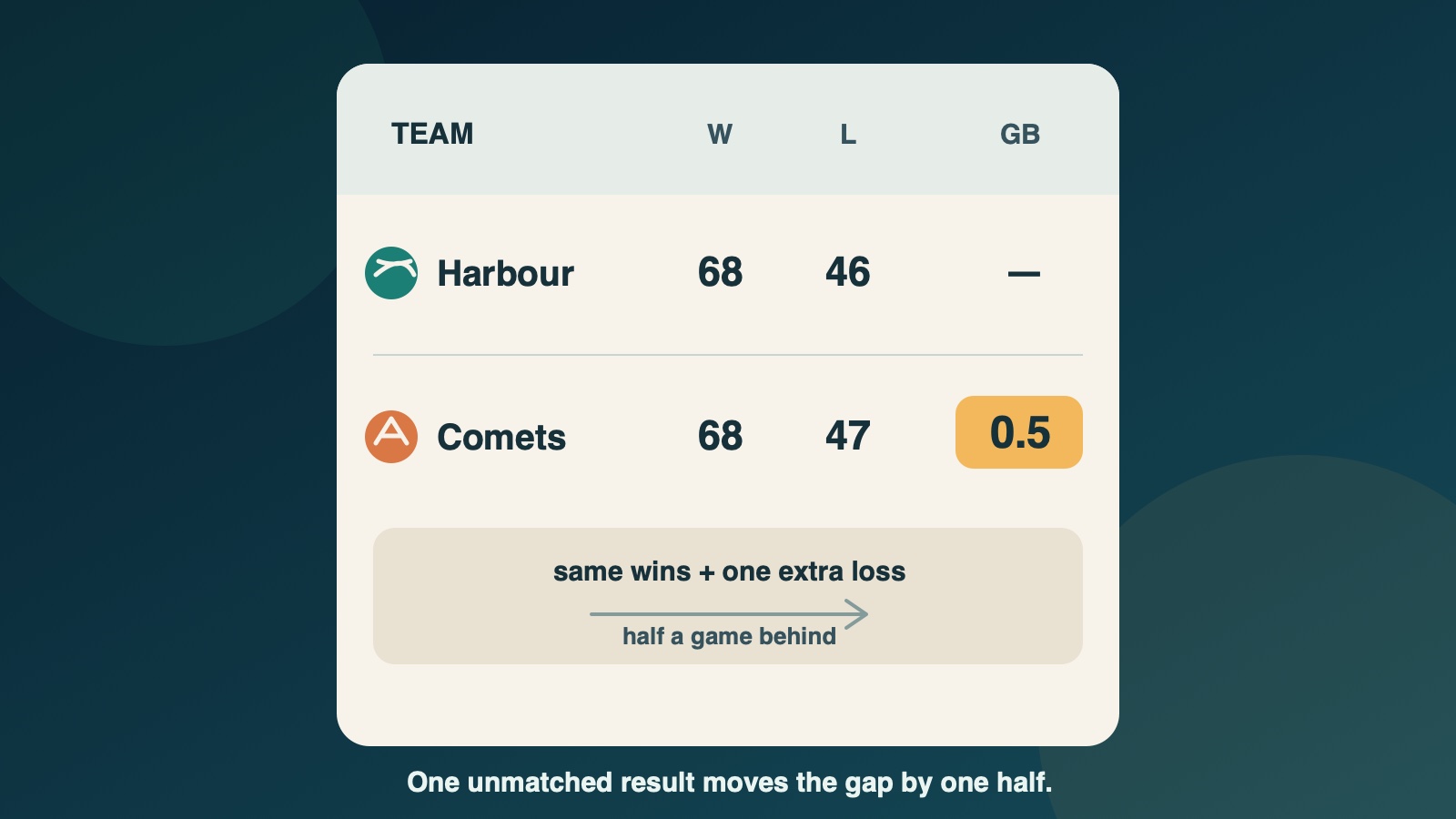
Imagine the fictional Harbour club is 68–46 and the Comets are 68–47. The Comets have the same number of wins and one extra loss. The win difference is zero, the loss difference is one, and their average is 0.5. That is why the table can show the Comets half a game behind even though nobody played half a match.
The fraction belongs to the comparison, not to a shortened game. If the trailing club wins while the leader is idle, the win difference narrows by one; after division by two, GB falls by half. If the leader loses while the trailer is idle, the loss difference also narrows by one, producing the same half-game movement.
A head-to-head result moves the gap by a full game
When the two clubs play each other, one result changes both sides of the calculation. If the trailing team wins, it gains one win while the leader gains one loss. The two one-unit changes add to two, and dividing by two reduces the gap by a full game.
The reverse is equally important. A loss by the trailer against the leader gives the leader another win and the trailer another loss, widening GB by one. This is why late-season series between close rivals can move a race faster than separate games against other opponents.
Teams can have unequal totals without anything being wrong
During the season, rainouts, postponements, off-days and rescheduled games can leave clubs with different numbers played. Winning percentage lets the table compare records with unequal denominators. A 68–46 club has a .596 winning percentage, while 68–47 is .591, so the first club leads even though their win totals match.
GB makes that small difference readable as a race. It is not a prediction of how many future wins will guarantee first place, and it is not identical to the number of games a team must win while the leader loses. It is the traditional average of the current win and loss gaps.
WCGB changes the reference line, not the arithmetic
The main division table measures GB from first place. A wild-card table may show WCGB, meaning wild-card games behind. There the reference is usually the club occupying the final qualifying wild-card position, not the best team in the division or league.
A positive figure therefore tells a reader how far a non-qualifying club trails the current cut line. A plus sign can appear for teams safely above that line. The same arithmetic is useful only after the correct reference team is identified, which is why GB and WCGB can differ on the same day.
A tied record is settled by rules beyond the GB column
GB describes a moving regular-season gap; it does not by itself decide every final tie. MLB's current postseason procedure uses mathematical tiebreakers instead of an extra Game 163. For two tied clubs, the first comparison is their head-to-head record, followed if necessary by records within the division and league and then specified late-season intraleague results.
The half-game is therefore a clean piece of bookkeeping, not half an event. One unmatched result changes one side of the comparison and becomes 0.5. A direct meeting changes both sides and becomes 1.0. Once that mechanism is visible, the standings stop looking like a mysterious decimal table and start reading like a map of who must gain on whom.
Sources and further reading
This article was written for Curiosity Desk. We do not copy other publishers or invent quotes. If a material error is found, we correct it openly.
Read the full standards →One answer should lead to a better question
Bring your curiosity to the group
Curious Minds is our public Facebook community for surprising science, strange history, Australian wildlife and everyday questions. No copied posts, no personal-friend invitations and no link dumping.
- Three self-contained discussion prompts each week
- Sourced answers and honest uncertainty
- Respectful conversation without spam