The short answer: authorities received a threat about the flight
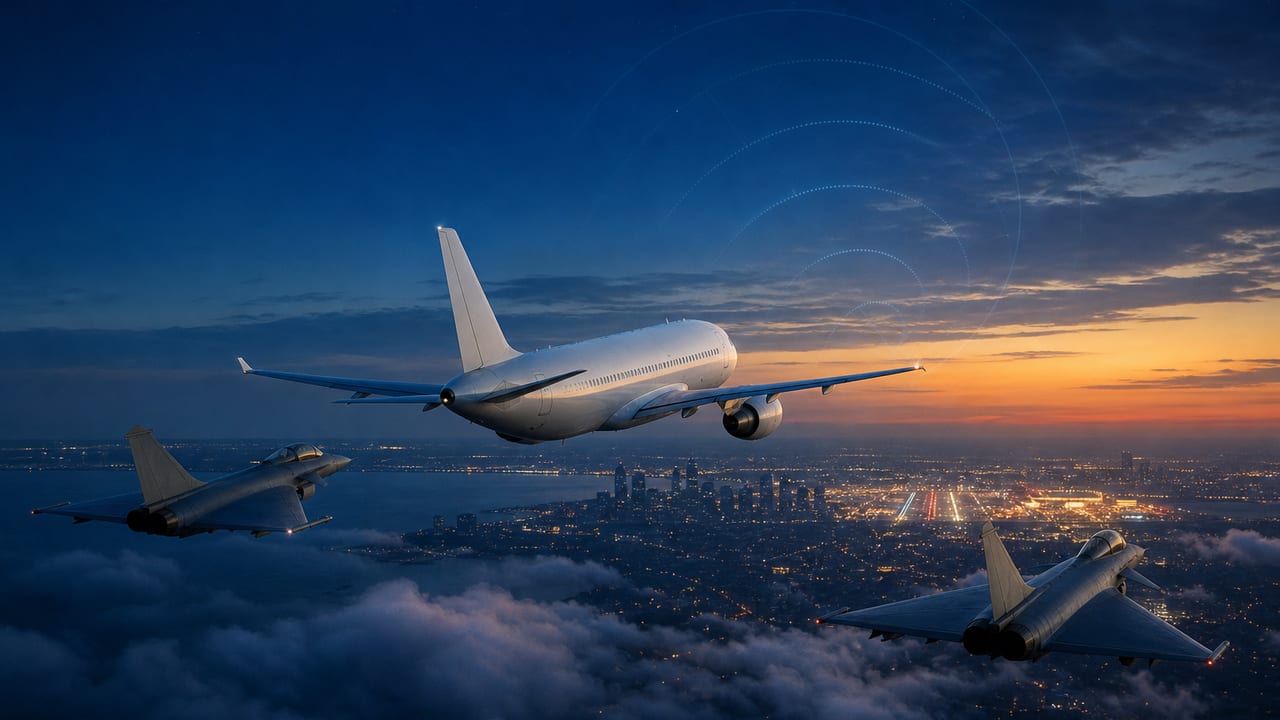
RAF Typhoon fighter jets were sent to intercept a Qatar Airways passenger flight approaching Manchester on Friday 24 July 2026 after the National Air Traffic Services received a threat concerning the aircraft. Greater Manchester Police says it was alerted at about 6 pm and worked with the Royal Air Force and airport authorities while the flight continued toward Manchester.
The aircraft landed safely, and police later said there had been no threat to passengers or crew. Their enquiries found that the report was a hoax. A 14 year old boy from the Bolton area who was not on the aircraft was identified and was assisting officers with their enquiries when the police statement was published. That sequence is the verified explanation for the unusual escort.
Why fighter jets were sent before the report was proved false
An alert involving an aircraft cannot be treated as harmless while its truth is still unknown. The people making the decision have to work with the information available at that moment, not the safer explanation discovered later. A fast airborne response gives authorities another way to locate, observe and accompany the aircraft while civilian controllers, police, the airport and defence teams coordinate.
Greater Manchester Police says all necessary resources were deployed to ensure the safety of the aircraft and those on board. The later finding that the call was a hoax does not mean the response was pointless. It means the precaution ended with the best possible outcome: the flight landed safely, the reported danger was ruled out and investigators could turn to the origin of the false report.
The RAF keeps a standing system called Quick Reaction Alert
The Royal Air Force calls its permanent air defence readiness system Quick Reaction Alert, usually shortened to QRA. UK airspace is monitored continuously through military and civilian radar information. The RAF says its control centres build a recognised picture of aircraft in and around the country, while the National Air and Space Operations Centre can order Typhoons to launch when the situation justifies it.
RAF air traffic controllers at Swanwick work alongside their civilian counterparts so the fighters can travel quickly and safely through busy airspace. Controllers and operations staff continue coordinating with the pilots during the response. This is not an improvised chase by individual fighter crews. It is a rehearsed chain involving surveillance, national command, civil air traffic control and aircraft already kept at readiness.
An interception does not automatically mean hijacking or attack
The sight of fighter aircraft beside an airliner looks dramatic, but the word intercept describes the act of reaching and identifying an aircraft. The RAF says QRA can be used for unidentified, uncooperative or unnotified aircraft, and its training includes scenarios involving lost communication and deviation from a flight plan. A reported security threat is another reason authorities may need rapid confirmation and control.
The fighters' presence alone therefore cannot tell an observer exactly what has happened inside the passenger jet. It does not prove a hijacking, a mechanical failure or hostile intent. In this case, police later established that the report itself was a hoax and that there was no threat to the people on board. The safe landing is part of the result, not evidence that the original alert should have been ignored.
What the fighter pilots can add to the response
Radar and radio provide information from a distance, but an interceptor can reach the aircraft and give the command system a direct airborne presence. The fighters can visually identify the airliner, observe whether its flight appears consistent with instructions and remain with it while the wider situation is assessed. The exact tactics used in this event have not been publicly detailed, so claims about cockpit gestures or specific manoeuvres would go beyond the confirmed record.
The RAF's own description of QRA shows that an interception can continue into an escort. That does not mean the fighters take over the passenger aircraft's controls. The airliner remains flown by its own crew, with civilian and military agencies coordinating around it. The escort provides observation, communication options and a rapid response if the facts change before the aircraft is safely on the ground.
Why the response involves more than the two jets people can see
Photographs and flight tracking make the Typhoons the visible part of the story, but they are only one element. Police identify the Royal Air Force, airport authorities and National Air Traffic Services as partners in the response. The RAF describes separate teams handling radar surveillance, national decisions, fighter control and coordination with civil air traffic services.
That hidden network matters because the passenger flight was approaching a major airport and sharing controlled airspace with other traffic. Sending fast military aircraft through that environment has to be coordinated as carefully as the airliner itself. The purpose is not only to reach the aircraft quickly. It is to do so without creating a second problem for passengers, crews or other flights.
The hoax finding changes the story, but not the seriousness
Early discussion around an interception can fill gaps with guesses because the public sees the aircraft before investigators can explain the alert. The police update supplies the crucial later fact: the report was found to be a hoax, and there was no threat to passengers or crew. That should replace unsupported theories about what caused the response.
Police also stressed that false reports are not harmless pranks. They can divert emergency resources, disrupt aviation and cause concern for passengers, crew and the public. The identities and legal outcome of any person involved are matters for the continuing investigation. The responsible conclusion is limited to what police have published rather than predicting charges or punishment.
What is confirmed and what remains unknown
Confirmed facts are straightforward. A threat concerning an inbound aircraft was reported to National Air Traffic Services on 24 July. Authorities responded with the RAF and airport partners. The Ministry of Defence confirmed to news media that Typhoons intercepted the Qatar Airways flight. The aircraft landed safely, and police later determined that the report was a hoax with no threat to those aboard.
Public sources checked for this article do not describe the wording of the hoax, the intelligence assessment made during the flight, the instructions given to either set of pilots or the full cost of the response. Those gaps should remain gaps until an authority provides more information. What the event does reveal is how quickly an ordinary passenger journey can activate a much larger protective system when an uncertain warning reaches air traffic services.
Sources and further reading
This article was written for Curiosity Desk. We do not copy other publishers or invent quotes. If a material error is found, we correct it openly.
Read the full standards →One answer should lead to a better question
Bring your curiosity to the group
Curious Minds is our public Facebook community for surprising science, strange history, Australian wildlife and everyday questions. No copied posts, no personal-friend invitations and no link dumping.
- Three self-contained discussion prompts each week
- Sourced answers and honest uncertainty
- Respectful conversation without spam