See the mechanism
From an impressive demo to a meaningful claim
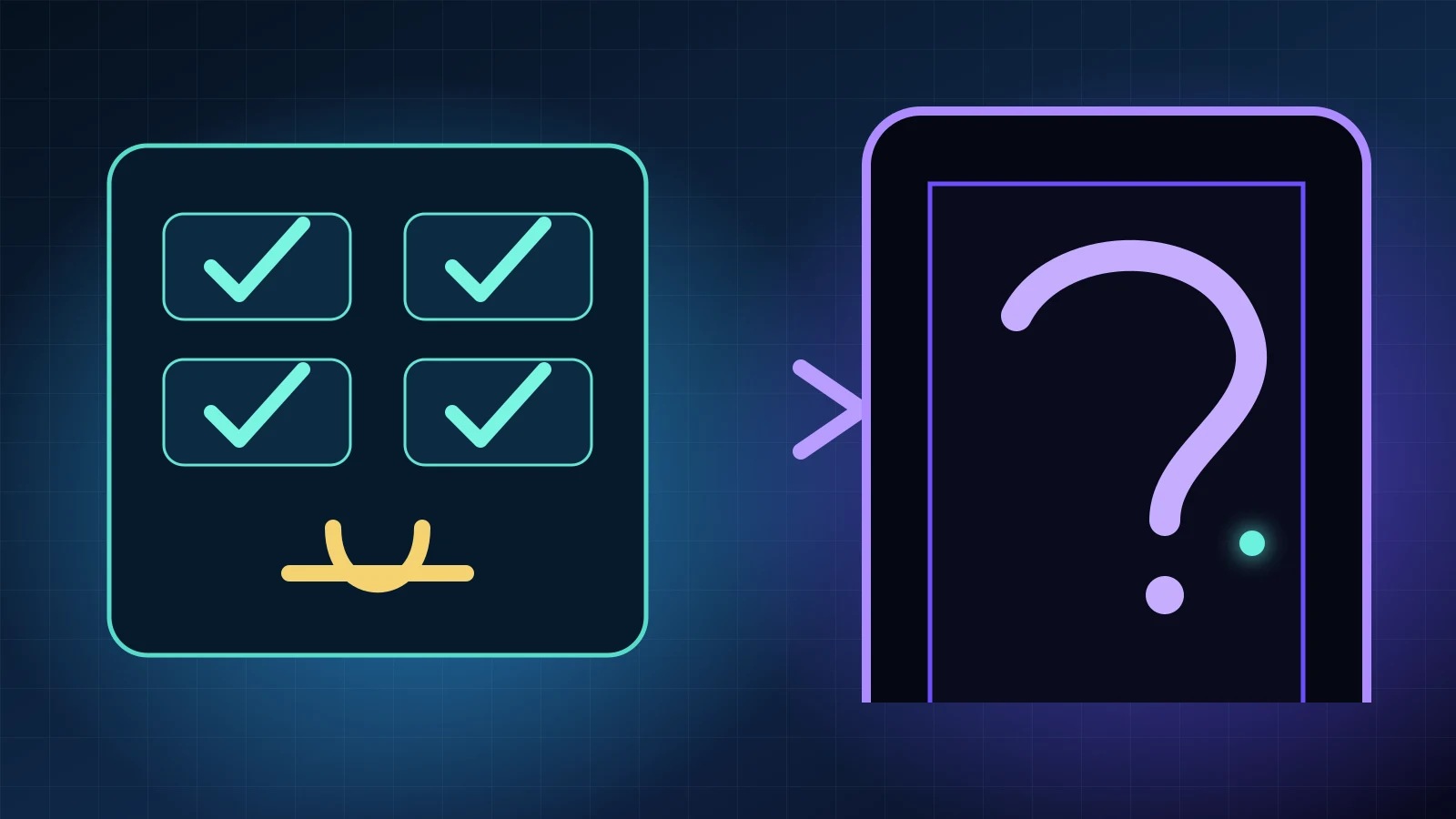
Map the demonstrated capability
State exactly what the system completed, under which inputs, tools, training conditions and evaluation rules.
Change the situation
Test whether knowledge transfers when the task, environment or success criteria are materially unfamiliar.
Measure reliability
Look beyond a best example to repeat performance, error recovery, calibration and behaviour across domains.
Expose the boundary
Record where human scaffolding, hidden benchmarks, unsafe autonomy or brittle failure prevents the broad claim.
A machine can look brilliant and still leave the biggest question open
An AI can write software, explain a photograph and solve an expert-level exam without proving that it has artificial general intelligence. Those achievements show powerful capabilities. AGI asks a harder question: can one system use what it knows broadly and reliably when the task, rules or environment are genuinely unfamiliar? That difference is why a spectacular demonstration is evidence of progress, not a universally accepted AGI certificate.
The gap is visible in what Stanford's 2026 AI Index calls jagged intelligence. Frontier systems have reached exceptional results in areas such as competition mathematics, yet the same report describes much weaker performance on apparently simpler tasks and in uncontrolled physical settings. Intelligence is not arriving as one smooth rising line. It looks more like an uneven skyline, with astonishing peaks beside stubborn valleys.
AI is the broad field; AGI is a disputed threshold inside the conversation
Artificial intelligence is the umbrella term for systems that infer from inputs and produce predictions, content, recommendations or decisions. It includes specialised tools and increasingly flexible general-purpose models. Artificial general intelligence is a proposed milestone, not a separate ingredient engineers can install. Definitions differ, but they usually demand capability across a wide range of tasks rather than excellence inside one narrow lane.
Google DeepMind's Levels of AGI framework separates two ideas that headlines often mix together: performance and generality. A system might perform at an expert or superhuman level in some areas while remaining less general than an ordinary person. The framework also treats autonomy as another axis. A capable assistant that waits for instructions and an independent agent that plans and acts for hours may have similar skills but very different levels of autonomy and risk.
The most revealing test may begin with no instructions
Imagine placing a person and an AI inside a completely new digital room. Neither receives the rules, the goal or a tutorial. They must experiment, notice what changes, infer what success means and reuse that discovery in later rooms. This is the idea behind ARC-AGI-3, an interactive benchmark designed to test exploration and adaptation rather than stored facts or familiar language patterns.
In its April 2026 technical report, the ARC Prize Foundation said human testers could solve all of its environments while the tested frontier AI systems, measured as of March 2026, scored below one percent. That dated result is not proof that ARC-AGI-3 is the one true AGI test, and later systems may improve. Its value is the contrast it exposes: following instructions brilliantly is not the same as discovering the rules of a new world efficiently.
One score cannot capture a general mind
Benchmarks can become familiar, contain faulty questions or reward strategies that do not transfer beyond the test. Stanford's 2026 review reports that several widely used evaluations contain invalid items and that difficult benchmarks can lose their usefulness quickly as systems improve. A model may also encounter similar material during training. That is why a leaderboard result needs context: what was tested, what was held back, how reliable the questions were and whether the skill survives outside the benchmark.
A newer DeepMind cognitive framework proposes looking across ten faculties, including learning, memory, reasoning, attention, problem solving, executive functions, metacognition and social cognition. Its important idea is the profile, not a magic total. Researchers would compare a system with representative human baselines across held-out tasks and examine the shape of its strengths and weaknesses. A tall spike in one faculty cannot quietly stand in for breadth everywhere else.
What evidence would make an AGI claim harder to dismiss?
A convincing case would need several kinds of evidence at once. The system would perform across many meaningful domains, learn genuinely new tasks without enormous retraining, transfer knowledge when the surface details change, remain reliable under pressure and use resources efficiently enough for a fair comparison. Evaluators would need protected tests, human baselines, repeated independent results and clear records of tools, prompts and assistance. Its autonomy would be measured separately rather than smuggled into the word intelligence.
Even that evidence would not answer every philosophical question. Capability does not prove consciousness, feelings, a human-like inner life or moral status. Nor is there a global authority that can stamp one model as AGI for everyone. The honest answer to AI versus AGI is therefore not a countdown. It is a changing evidence problem: when a machine leaves the familiar test room, can it understand the next one without engineers secretly rebuilding the map?
Evidence boundary
What the evidence supports—and where it stops
Benchmarks, demonstrations and deployed systems can establish particular capabilities. A convincing AGI case would need converging, reproducible evidence across unfamiliar domains rather than one lab's preferred showcase.
There is no universally accepted AGI definition or single decisive benchmark. These criteria make claims testable; they do not prove that one final threshold is philosophically or scientifically complete.
Sources and further reading
This article was written for Curiosity Desk. We do not copy other publishers or invent quotes. If a material error is found, we correct it openly.
Read the full standards →One answer should lead to a better question
Bring your curiosity to the group
Curious Minds is our public Facebook community for surprising science, strange history, Australian wildlife and everyday questions. No copied posts, no personal-friend invitations and no link dumping.
- Three self-contained discussion prompts each week
- Sourced answers and honest uncertainty
- Respectful conversation without spam