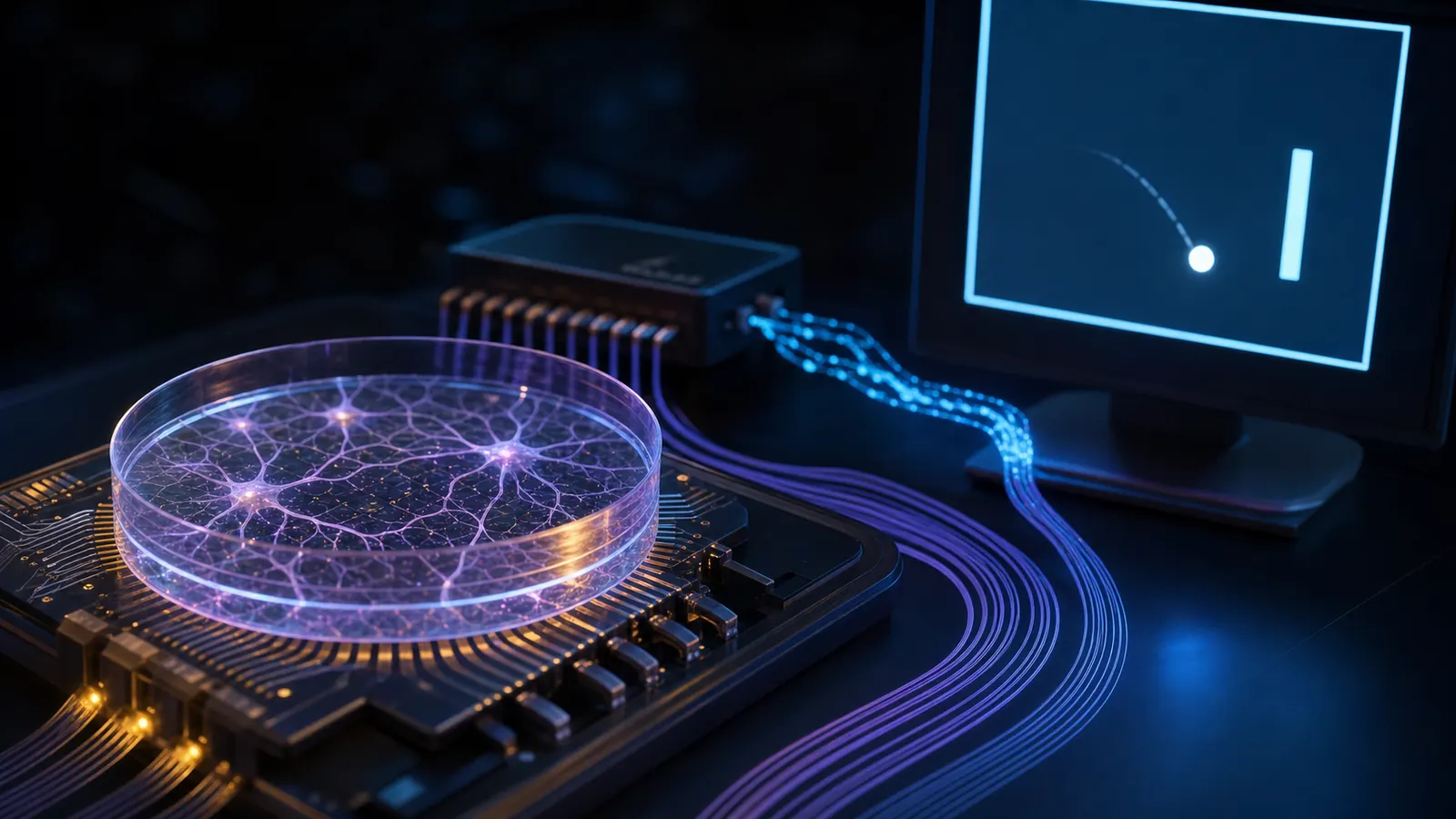
A dish of cells was placed inside a world with only a paddle and a ball
The phrase 'brain cells learned to play Pong' sounds as if a miniature mind looked at a screen, understood a game and chose to win. The real experiment was stranger and more precise. Researchers grew human and rodent neurons over a high-density multielectrode array. The array could deliver electrical stimulation to the culture and record the electrical activity that returned. A computer simulation turned information about a moving Pong ball into patterns of stimulation and converted neural activity into movement of a virtual paddle.
Nothing in the dish saw a ball. There were no eyes, muscles, memories of arcades or instructions in English. The culture existed inside a deliberately simple loop: receive structured electrical information, produce activity, then receive new information shaped by what that activity caused. Because the consequences arrived immediately, the network could change within the environment rather than merely firing while a prerecorded game happened elsewhere.
The important ingredient was feedback, not a secret game-playing gene
In the 2022 Neuron paper, the researchers compared closed-loop cultures with controls and reported apparent learning within minutes. When the paddle intercepted the ball, the system received a predictable pattern. A miss produced a different, less predictable stimulation. Over time, the activity associated with the paddle became better aligned with longer rallies than in several control conditions. The result suggested that a living neural network could adapt its activity when its outputs had immediate sensory consequences.
That does not mean every cell knew the score. Neural tissue is plastic: connections and firing patterns change in response to activity. The experiment arranged those changes inside a task with a measurable outcome. Calling that 'playing' is a useful shorthand only if the mechanism comes with it. Without the stimulation map, decoding rules and closed loop, the same cells would not independently invent Pong or understand why a paddle should meet a ball.
Adaptive is not the same word as conscious
The paper used provocative language about synthetic biological intelligence and discussed sentience. That title is not a scientific certificate that the culture had an inner experience. Consciousness has no single accepted laboratory meter, and behaviour that improves in a narrow feedback task can arise without evidence of feelings, self-awareness or a point of view. A culture containing neurons is also not a scaled-down human brain: it lacks the brain's organised regions, sensory organs, body, development and continuous biological history.
The safest conclusion is narrower. The researchers built a system in which living neural networks received structured input, generated an output and changed their behaviour in response to consequences. That is enough to interest neuroscientists and computer engineers. It is not enough to claim that the dish was bored, enjoyed winning or suffered when it missed. Those descriptions turn an unresolved ethical question into an invented fact.
Why engineers are curious about cells when silicon already works
Brains perform flexible recognition and control while consuming remarkably little power compared with large digital systems, but a culture dish is not automatically an efficient product. Living cells need stable temperature, nutrients, sterile handling and interfaces that can survive. Their behaviour varies. A silicon chip can be manufactured to a specification; a biological network grows, changes and sometimes dies. The opportunity is therefore not 'replace every processor with a brain in a jar'. It is to learn whether living networks can solve certain adaptive tasks with unusual efficiency.
The next convincing milestones are practical and ethical. Independent teams need to reproduce learning across multiple tasks and laboratories. Cultures must remain stable for useful periods, outperform fair silicon baselines on a defined measure, and reveal which changes actually produce improvement. Researchers also need standards for cell origin, welfare questions and experiment limits. If those gates are met, biological computing may become a specialised tool. Until then, DishBrain is best understood as a doorway: not a conscious computer, but proof that the boundary between a biological experiment and an interactive machine can be engineered.
Sources and further reading
This article was written for Curiosity Desk. We do not copy other publishers or invent quotes. If a material error is found, we correct it openly.
Read the full standards →One answer should lead to a better question
Bring your curiosity to the group
Curious Minds is our public Facebook community for surprising science, strange history, Australian wildlife and everyday questions. No copied posts, no personal-friend invitations and no link dumping.
- Three self-contained discussion prompts each week
- Sourced answers and honest uncertainty
- Respectful conversation without spam