The photograph is impressive enough without a lost civilisation
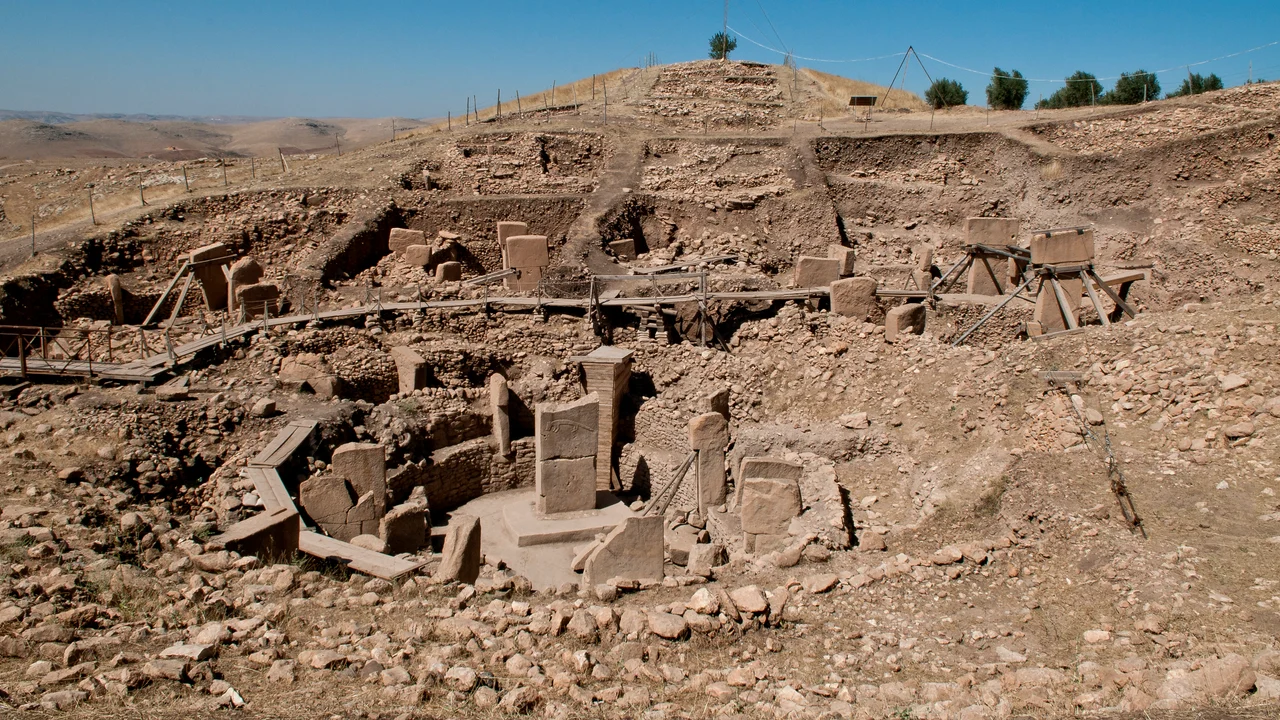
The enclosure above stands on a limestone ridge near Şanlıurfa in southeastern Türkiye. T-shaped pillars rise from low stone walls and face a taller pair at the centre. The builders had no metal tools, wheels or writing, yet they quarried, shaped, moved and arranged multi-tonne blocks into planned architecture.
That achievement often attracts a false choice. Either early hunter-gatherers were too simple to build it, or a forgotten advanced civilisation must have intervened. Archaeology rejects the premise. Foraging communities could possess skilled craftspeople, social networks, seasonal knowledge and the ability to organise large cooperative projects without resembling a later city or state.
Twelve thousand years old is useful shorthand, not one birthday
UNESCO dates Göbekli Tepe's monumental megalithic structures broadly between about 9600 and 8200 BCE. That range covers many generations, repairs and building phases. The oldest excavated enclosures belong near the beginning of the Pre-Pottery Neolithic, while smaller rectangular buildings overlap with and continue after parts of the monumental phase.
The limestone cannot be radiocarbon-dated like charcoal. Archaeologists combine dated organic material from secure contexts with stratigraphy, tool types and changing architecture. New samples can refine the sequence, but the tenth- and ninth-millennium BCE framework rests on multiple connected lines of evidence rather than a guess made from the appearance of the stones.
The T-shapes are bodies without faces
Some central pillars carry shallow reliefs of arms that run down their narrow sides, hands meeting across the front, plus belts and garments. Those details make a strong case that the T-form represents a stylised human or human-like body. The horizontal top functions as a head even though a face is normally absent.
Foxes, snakes, birds, boars, insects and other animals occupy many pillar surfaces. Researchers can catalogue which creatures appear and how images were altered, but there is no surviving caption. Claims that one panel records a comet, a zodiac, a flood or a named god go beyond what the stones securely say unless an interpretation can survive archaeological context and competing explanations.
The stone came from the same hill
Unfinished pillars and extraction scars remain in limestone quarries around the plateau. Workers could outline a block with stone tools, detach it along natural bedding, shape it and drag it toward a building area. Local raw material removes the need for an unknown transport technology, but not the difficulty of coordinating labour.
Experimental archaeology and comparisons with recent communities that moved heavy stone show that ropes, timber, levers, prepared paths and many people can move large blocks. No single reconstruction proves the exact Göbekli Tepe procedure. It does show that human muscle, planning and ordinary materials are sufficient possibilities before invoking machines absent from the excavation.
Some buildings reveal geometry before construction
A 2020 architectural analysis examined Enclosures B, C and D and found their centres form an approximately equilateral triangle. The geometry and the placement of central pillars led the researchers to argue that the three structures were conceived as a related project rather than growing through random additions alone.
Pre-planning does not require written blueprints or modern measurement. Builders can use ropes, stakes, repeated lengths, sight lines and remembered proportions. The finding matters because it identifies abstract spatial planning at an early date. It does not identify an architect, a government or the meaning of the finished spaces.
Seven thousand grinding tools put food beside ceremony
Researchers analysed 7,268 grinding tools from the site. Microscopic wear and plant phytoliths showed that cereal processing was a major use. Almost 3,400 handstones were recorded, and large quantities of equipment also came from spaces between buildings and from deposits associated with later rectangular structures.
The research team proposed work feasts as one plausible way to feed and motivate a concentrated labour force. That is a model, not a photograph of one event. The evidence securely establishes intensive cereal processing; it cannot tell us that every bowl fed a builder, that the grain was domesticated, or that beer caused the Neolithic revolution.
First temple is a headline built on an uncertain word
The site's first long-term excavator, Klaus Schmidt, interpreted the large enclosures as sanctuaries used by mobile hunter-gatherer groups rather than a settlement. That idea helped make Göbekli Tepe famous and supplied a dramatic reversal: religion gathered people first, then settlement and farming followed.
Archaeologists cannot interview the builders, and temple is not a neutral label. Monumental buildings, feasting, imagery, curated skull fragments and unusual deposits support ritual or communal roles. They do not prove that the hill served only worship, that priests controlled it or that every building belongs on the sacred side of a modern sacred-versus-domestic divide.
The empty sanctuary has become a lived-in hill
Later excavation and reanalysis identified dwellings, domestic activities and intensive food processing. The current German Archaeological Institute project says there is no longer a reason to treat Göbekli Tepe as a highly specialised site without domestic life. Its researchers describe it as a settlement with a strong ritual component.
This change does not make the monumental enclosures ordinary houses. It places special buildings among other work, food and habitation instead of marooning them on an empty ceremonial summit. It also connects the site more naturally with a regional landscape of early Neolithic settlements that shared T-pillars, imagery, materials and social practices.
Farming did not switch on after one religious building
Wild cereals had been collected and processed in Southwest Asia long before Göbekli Tepe, and experiments with cultivation, storage, settlement and animal management unfolded at different speeds. The people at the site lived inside that long transition. Hunter-gatherer, farmer, nomad and villager are not four switches that changed in one order on one morning.
Monument building could strengthen cooperation, create obligations and make large gatherings worthwhile. Reliable food processing could help support those gatherings. More settled life could make heavy architecture easier to maintain. Archaeology supports interaction among these changes, not a simple proof that religion invented agriculture or that farming had nothing to do with the monuments.
The enclosures were not all neatly buried in one farewell
Older accounts often say the builders deliberately filled the monuments and walked away. Humanly deposited material is present, and objects were sometimes deliberately placed. Recent work on the underlying rock terraces and damage patterns, however, shows a more complicated history involving rebuilding, collapse, movement downslope, erosion and later activity.
That matters because fill is not automatically a ritual burial. Rubble containing tools and bones can accumulate through several processes, and a deposit may enter a damaged building after its main use. Current site-formation research replaces the satisfying single event with a layered biography in which people and the hill repeatedly changed the structures.
What changed was the size of the possible
Göbekli Tepe did not push civilisation back to 9600 BCE. There is no evidence there for writing, a city, a metal industry or a lost global state. It changed a narrower and more important assumption: monumental planning and powerful shared imagery did not have to wait for those later institutions.
Small-scale societies could coordinate difficult work, feed gatherings, maintain regional networks and create places that outlived individual builders. The discovery did not destroy archaeology's timeline. It made the beginning of the Neolithic less like a ladder and more like a web of experiments in dwelling, food, memory, ritual and cooperation.
Sources and further reading
- UNESCO World Heritage Centre: Göbekli Tepe chronology, architecture and regional network ↗
- German Archaeological Institute Göbekli Tepe project: Current settlement interpretation ↗
- PLOS ONE: More than 7,000 grinding tools and cereal processing at Göbekli Tepe ↗
- Cambridge Archaeological Journal: Geometry and architectural planning in Enclosures B, C and D ↗
- Current Anthropology: Why identifying Göbekli Tepe as temples requires caution ↗
- Science Advances: Modified human crania and the anthropomorphic T-pillars ↗
- Istanbuler Mitteilungen: Reconstructing Göbekli Tepe's rock terraces and site formation ↗
- Archaeological Research in Asia: Seismic damage and rebuilding at Neolithic Göbekli Tepe ↗
- German Archaeological Institute: Evidence and experiments for making and moving monoliths ↗
This article was written for Curiosity Desk. We do not copy other publishers or invent quotes. If a material error is found, we correct it openly.
Read the full standards →One answer should lead to a better question
Bring your curiosity to the group
Curious Minds is our public Facebook community for surprising science, strange history, Australian wildlife and everyday questions. No copied posts, no personal-friend invitations and no link dumping.
- Three self-contained discussion prompts each week
- Sourced answers and honest uncertainty
- Respectful conversation without spam