The surprising answer is written on a wartime patent
Hedy Lamarr is usually introduced as a Hollywood star, then suddenly described as the inventor of Wi-Fi. The documented story is both narrower and more impressive. In 1941, Lamarr and composer George Antheil filed a United States patent for a secret communication system. The patent proposed making a radio-control signal difficult to jam by changing its carrier frequency while the transmitter and receiver stayed synchronised.
The problem was urgent. A radio-guided torpedo could be steered by signals from a ship, but an enemy that discovered the control frequency could broadcast interference on the same channel. Lamarr and Antheil's answer was not to hide one permanent frequency. It was to keep moving between frequencies according to a pattern known at both ends of the link.
Frequency hopping is a moving target
Imagine two people who agree to change radio channels at the same moments: channel 4, then 17, then 2, then 41. A listener who does not know the sequence hears only fragments. A jammer that blocks one channel interrupts only part of the conversation unless it can predict and follow the pattern. That is the core intuition behind frequency hopping.
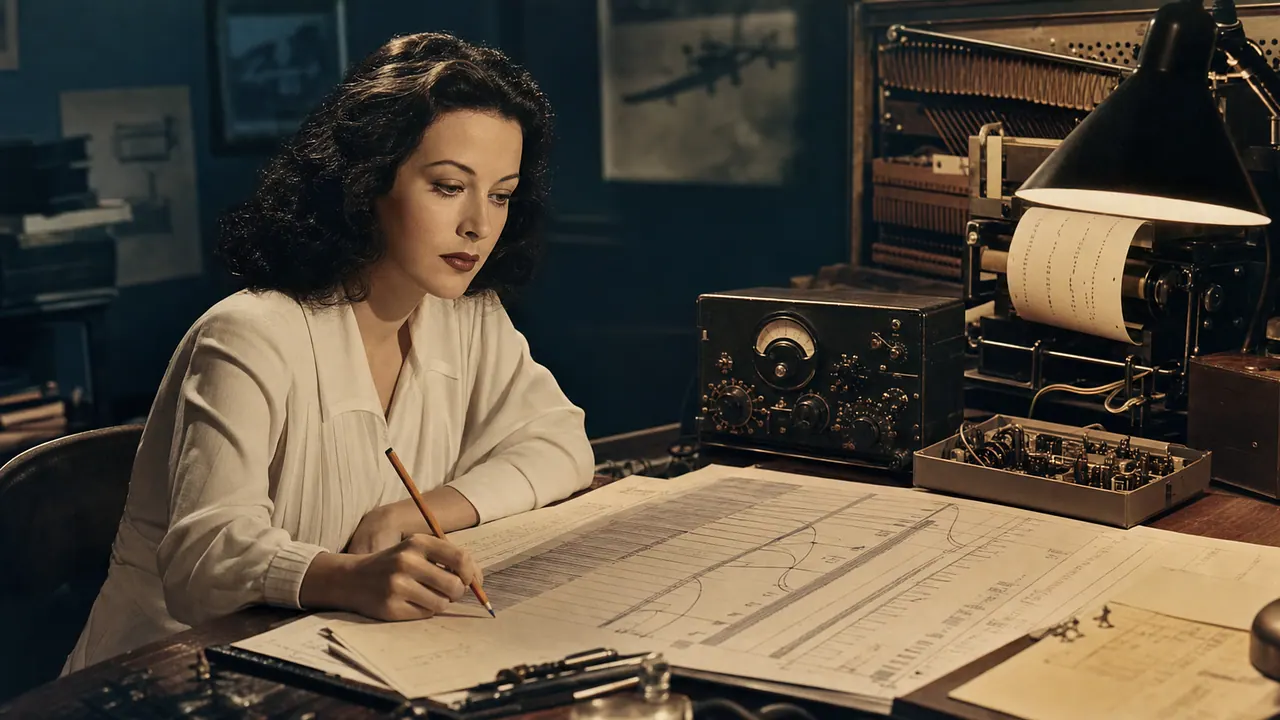
The 1942 patent described variable-frequency equipment at the transmitting and receiving stations. Matching record strips would tune both sides to new frequencies in step. The patent also proposed sending misleading signals on frequencies the receiver would ignore. It was a mechanical and electronic design for a specific wartime problem, not a modern wireless router hidden inside a film star's notebook.
A player piano supplied the synchronisation idea
George Antheil was an experimental composer familiar with automated player pianos. Their perforated paper rolls could trigger notes in a precise sequence. The patent proposed using paired records of that type to coordinate frequency changes. A conventional piano has 88 keys, and the document explicitly noted that an 88-row record could control 88 carrier frequencies.
The important leap was synchronisation. Randomly changing the transmitter would be useless if the receiver did not change with it. Two matching records, started together and driven at calibrated speed, could keep both machines following the same sequence. Lamarr and Antheil combined insights from radio control, weaponry and musical machinery into one system.
Lamarr was not a decorative name on the filing
The patent lists the inventors as Hedy Kiesler Markey, Lamarr's legal name at the time, and George Antheil. Smithsonian archival material preserves papers related to their work. Accounts that treat Lamarr as a glamorous mascot miss the point: she brought technical curiosity and knowledge of the weapons problem, while Antheil contributed experience with synchronised mechanisms and player-piano systems.
Good invention stories rarely fit the lone-genius template. This one involved collaboration, prior technologies and a particular historical need. Giving Antheil proper credit does not diminish Lamarr. It makes her contribution more credible because it places the invention in the real process that produced it.
The Navy did not immediately turn it into a weapon
The patent was granted on 11 August 1942, but the proposed system was not adopted for wartime torpedo guidance. A patent proves that the inventors described and claimed a design; it does not prove that the design entered service, worked at operational scale or directly produced every later technology that used a related principle.
Mechanical player-piano rolls were an ingenious way to explain and implement synchronisation, but they were not an obvious fit for the cramped, wet and violent environment of a torpedo. Later electronic systems could change frequencies without rolls of paper. The idea became more practical as radio and digital components advanced.
So did Hedy Lamarr invent Wi-Fi?
No, not in the direct sense. Wi-Fi emerged decades later through many standards, inventions and engineering teams. Lamarr and Antheil did not specify the networking protocols, hardware or radio techniques that make a modern Wi-Fi connection work. Calling Lamarr the sole inventor of Wi-Fi turns a fascinating contribution into an inaccurate slogan.
The fairer connection is that their patent belongs to the history of spread-spectrum communication. Frequency-hopping and related techniques became useful for making radio links more resistant to interference, harder to intercept and better able to share spectrum. Those principles appear in later military and civilian wireless systems, even though the path from one 1941 filing to today's networks is not a single straight line.
Why the real story matters more than the myth
Lamarr's invention challenges two comfortable assumptions at once: that creativity stays inside professional labels, and that technologies arrive fully formed from one celebrated person. A film performer could make a serious contribution to communications engineering. A composer could help solve a radio-synchronisation problem. Their idea could be overlooked in its original form yet still belong in the longer technical story.
The most accurate one-sentence version is powerful enough: Hedy Lamarr and George Antheil co-invented and patented a synchronised frequency-changing communication system intended to resist enemy jamming. It was not Wi-Fi, it was not a solo invention and it was not immediately deployed. It was a clever solution whose central idea was ahead of the machinery available to realise it.
Sources and further reading
This article was written for Curiosity Desk. We do not copy other publishers or invent quotes. If a material error is found, we correct it openly.
Read the full standards →One answer should lead to a better question
Bring your curiosity to the group
Curious Minds is our public Facebook community for surprising science, strange history, Australian wildlife and everyday questions. No copied posts, no personal-friend invitations and no link dumping.
- Three self-contained discussion prompts each week
- Sourced answers and honest uncertainty
- Respectful conversation without spam