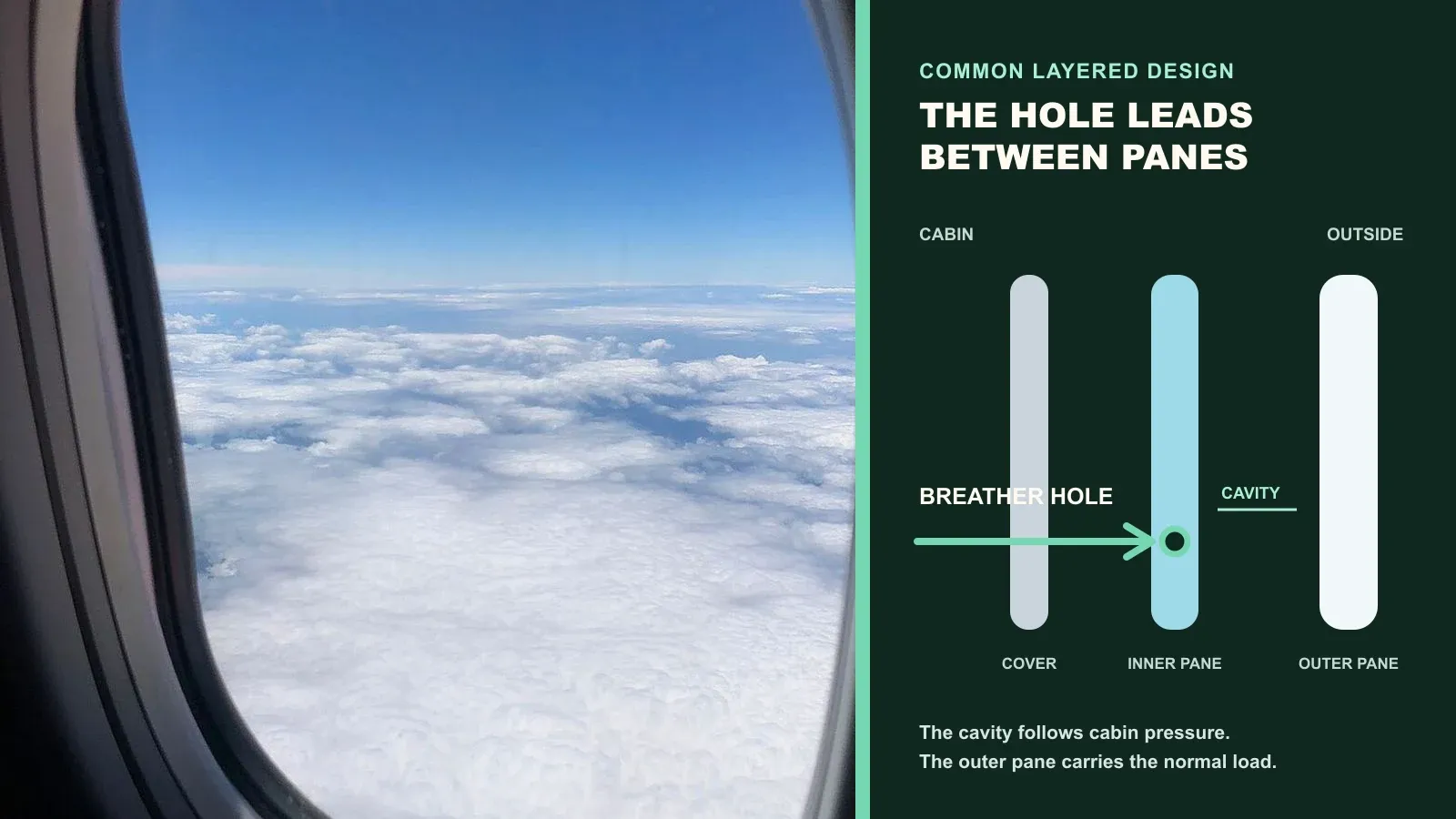
What the small opening actually does
The airplane window hole in six facts
- Common name
- Breather hole or vent hole
- Where it leads
- Into the space between panes
- Where it does not lead
- Directly outside
- Main job
- Equalise cavity and cabin pressure
- Normal load
- Directed to the intended structural pane
- Second benefit
- Provides a path for moisture and air
Window assemblies vary between aircraft. The diagram and explanation show a common layered design rather than a maintenance guide for every model.
The hole is real, but it is not open to the sky
Look near the bottom of many passenger windows and you may find a tiny circular opening. It can appear alarming because the aircraft is flying through air far thinner than the pressurised cabin. The reassuring answer is simple: the opening does not pass through every layer of the window and the fuselage.
It is usually called a breather hole, vent hole or pressure compensation hole. Its destination is the enclosed space between window panes. The hole is part of the pressure management system, not damage that the airline forgot to repair.
A passenger window is an assembly, not one sheet
The clear surface within reach of a passenger is not the whole window. A typical airliner installation includes a cabin side scratch cover and two panes designed as part of the pressure window. Exact names, materials and load paths vary by aircraft and manufacturer, so a universal three identical panes description is too simple.
What matters is the layered arrangement. There is an outer environment, a pressurised cabin and at least one cavity between panes. Engineers must control the pressure in that cavity as the aircraft climbs, cruises and descends.
Cabin pressure creates a load that wants to push outward
At cruising altitude, air pressure outside the aircraft is much lower than it is in the cabin. The aircraft does not keep the cabin exactly at sea level, but it maintains a pressure that people can tolerate. The difference between the two sides pushes outward on the fuselage and every pressure retaining opening.
A window therefore has to do more than keep wind and rain away. Its panes, seals, frame and surrounding structure must repeatedly carry pressure loads through thousands of climbs and descents. FAA guidance for transport aircraft treats pressurised windows as structural components that must be assessed for strength, fatigue, damage tolerance and fail safe behaviour.
The breather hole lets the cavity follow the cabin
Suppose the space between two structural panes were sealed at ground level. During a climb, its trapped pressure could differ from both the cabin and the outside atmosphere. That would place an additional and changing load across the inner pane, even when the window was intended to make the outer pane carry the normal cabin pressure difference.
The small hole provides a controlled path between the cabin and the inter pane cavity. Air can move slowly as cabin pressure changes. With the cavity kept close to cabin pressure, there is little pressure difference across the vented inner structural pane. The main difference remains across the outer structural pane in a common design.
Small hole does not mean small engineering
The opening is tiny because pressure equalisation during a normal climb or descent does not require an open window. It requires enough airflow for a small enclosed cavity to follow the slower changes in cabin pressure. The aircraft's main pressurisation system controls the cabin as a whole.
Some window assemblies add a damper or a shaped air path near the vent. A Boeing assigned patent describes a device that allows slow moving air to equalise pressure while reducing short pulses caused by vibration. The detail shows how even a simple looking opening can be tuned for a specific job.
The second structural pane is there for redundancy
Transport aircraft design does not depend on one flawless transparent sheet. FAA guidance requires windows in pressurised cabins to be designed with fail safe considerations. In common passenger window arrangements, one structural pane carries the normal pressure load and another can provide a backup load path if damage occurs.
The breather hole helps establish that normal load path. It does not make every cracked window harmless, and passengers should never diagnose a window from an internet diagram. Any crack, loose trim, unusual sound or visible damage should be reported to cabin crew so the aircraft operator can apply the correct maintenance procedure.
Moisture is part of the story, but the slogan is too neat
Many short explanations say the hole simply prevents fogging. It is more accurate to say that the opening provides ventilation and a route for pressure and moisture to move. Aircraft window patents describe pressure compensation and venting as connected design problems.
The same airflow can also carry humid cabin air into a cold window cavity. That is why some designs use dampers and why a passenger may still see frost or condensation between layers. A vent helps manage the cavity, but it does not guarantee a perfectly clear view in every temperature and humidity condition.
Putting a finger over it does not open or close the aircraft
A passenger can sometimes touch the opening in the cabin side of the assembly. Covering it briefly does not expose the cabin to outside air because the outer structural pane remains between the passenger and the atmosphere. It also does not instantly change the pressure of the entire cabin.
There is still no useful reason to block it. The feature was designed to breathe as pressure changes, and window trim is not a toy. Leave the opening clear, avoid pressing on damaged looking areas and tell the crew if anything appears unusual.
Rounded corners solve a different pressure problem
Passenger windows are also rounded rather than square. Curved corners allow stress in the fuselage skin to flow around an opening more smoothly. Sharp corners concentrate stress and can become starting points for fatigue cracking under repeated pressurisation cycles.
The rounded outline and the breather hole are therefore related to pressure but perform different jobs. The outline manages how structural stress travels around the fuselage opening. The breather hole manages the pressure inside the layered window assembly.
The most important word is controlled
The hole works because its position, size and surrounding assembly are engineered together. It is not evidence that any hole in an aircraft is safe. A puncture through the pressure vessel, a missing seal or a damaged structural pane is a completely different condition.
This distinction matters when a cropped photograph circulates online. A genuine breather hole is small, deliberately placed in a window pane and repeated across similar windows. If a passenger is uncertain, cabin crew can inspect the concern and communicate with the flight deck and maintenance team.
The tiny feature reveals the whole design philosophy
A passenger sees one window. An engineer sees several panes, a frame, seals, a pressure cavity, a load path, fatigue cycles, moisture and a backup plan. The visible hole is the one clue that the layers are not merely stacked together.
Its purpose is almost the opposite of what first impression suggests. The opening is present because the window must manage pressure safely. It leads into the window, not out of the aircraft, and it helps ensure the correct structural pane does the work it was designed to do.
Sources and further reading
This article was written for Curiosity Desk. We do not copy other publishers or invent quotes. If a material error is found, we correct it openly.
Read the full standards →One answer should lead to a better question
Bring your curiosity to the group
Curious Minds is our public Facebook community for surprising science, strange history, Australian wildlife and everyday questions. No copied posts, no personal-friend invitations and no link dumping.
- Three self-contained discussion prompts each week
- Sourced answers and honest uncertainty
- Respectful conversation without spam