The famous key is visibly incomplete
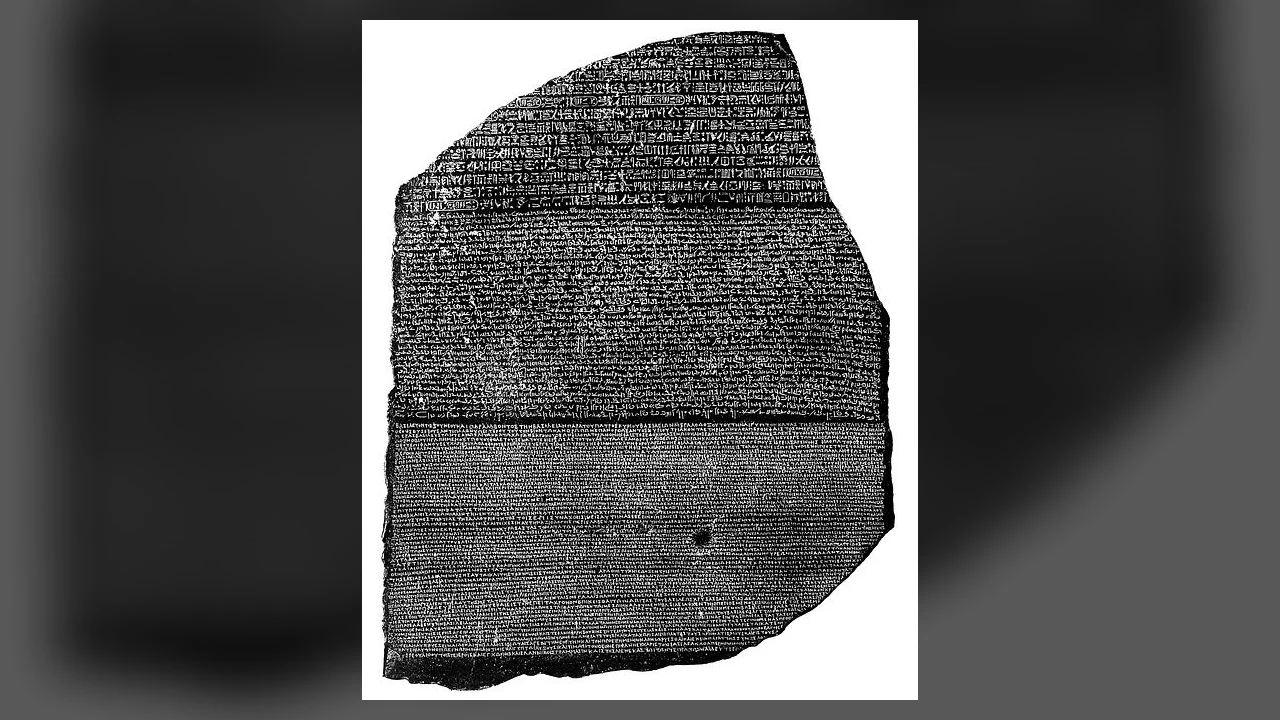
The object that became a symbol for translation begins with a problem: much of it is missing. The Rosetta Stone is the surviving part of a granodiorite stela, not a complete black tablet and not, as it is often called, a slab of basalt. Its broken upper edge removed most of the hieroglyphic portion before modern scholars ever saw it.
The British Museum records 14 surviving lines of hieroglyphs, 32 lines of Demotic and 54 lines of Greek. The fragment measures about 112 centimetres high, 76 centimetres wide and 28 centimetres thick. Those details matter because the decipherment did not begin with three pristine columns lined up like a modern language exercise. It began with an awkward, damaged comparison whose shortest section was the one scholars most wanted to understand.
It records a political bargain, not a language lesson
The words were carved in 196 BCE after a council of priests met at Memphis. Their decree praised Ptolemy V, a young king from the Greek-speaking dynasty that ruled Egypt, listed benefits associated with his reign and established honours for his royal cult. It was public political and religious communication, not a dictionary prepared for people two thousand years later.
The setting was unsettled. Ptolemaic control had been challenged in parts of the country, and support from influential temples mattered. The decree presents the king's generosity toward temples and the honours returned by the priesthood. Its final instruction called for copies to be placed in important temples. Other copies and fragments of the same decree have since been identified, proving that the Rosetta Stone was not a unique message created in isolation.
Three scripts did not mean three unrelated languages
The familiar phrase three languages is misleading. The Stone carries three scripts. Hieroglyphic and Demotic both write forms of the Egyptian language, while the third text is in Ancient Greek. Hieroglyphs suited the formal priestly setting. Demotic was a cursive Egyptian script used in daily and administrative life. Greek was the language of the Ptolemaic administration.
That distinction explains why the layout was so valuable. European scholars could read Greek, so they could establish the decree's broad subject and look for corresponding passages in the Egyptian sections. They were not translating an unknown language by matching each symbol to a Greek letter. They were comparing related versions written for different audiences and trying to discover how two Egyptian scripts represented speech and meaning.
The versions overlap, but they are not carbon copies
A popular diagram makes the Stone look like the same sentence repeated exactly three times. The real relationship is less tidy. The Digital Rosetta Stone project aligns passages across the inscriptions and notes that the versions are not completely congruent. Some material appears in one version without a direct partner in another, and wording or emphasis can differ.
That did not destroy the comparison. Shared names, titles, dates and repeated ideas still constrained what an unknown group of signs could mean. In fact, the differences reveal something important about decipherment: the Stone did not provide a mechanical substitution table. It supplied a dense field of hypotheses that could be checked against one another and then tested on other monuments.
A reused building stone became an international prize
French soldiers found the fragment in 1799 while digging or rebuilding fortifications near Rashid, the Nile Delta town Europeans called Rosetta. It had been reused as building material at Fort Saint Julien. Its significance was recognised quickly, and copies of the inscriptions began circulating among scholars even while European armies fought over Egypt.
After the French defeat, the British took possession of the Stone with other antiquities under the 1801 settlement known as the Capitulation or Treaty of Alexandria. It reached the British Museum in 1802. The route from an Egyptian temple decree to a French military work and then a British collection is part of the object's history, not background scenery. The intellectual race unfolded inside the same imperial competition that moved the Stone out of Egypt.
A cartouche turned a king's name into a test
The Greek text repeatedly named Ptolemy. In the hieroglyphic section, groups of signs appeared inside oval frames now called cartouches, which marked royal names and titles. If one cartouche represented Ptolemy, scholars had a rare advantage: a likely pronunciation and a bounded group of unknown signs in roughly the right place.
A name is not enough to decode a language, but it can expose a writing principle. If signs within the cartouche tracked sounds in Ptolemy, then hieroglyphs could not be only mystical pictures standing for complete ideas. Comparisons involving Cleopatra and names on the Philae obelisk expanded the possible sound values. Each new match created predictions that could succeed or fail elsewhere.
Thomas Young opened part of the lock
Decipherment was a chain of contributions, not a scene with one solitary genius. Scholars including Silvestre de Sacy and Johan David Åkerblad made early progress with the Demotic text. The English polymath Thomas Young then showed that several signs in the royal cartouche carried phonetic values connected with the name Ptolemy. He also investigated relationships among hieroglyphic, Demotic and later Egyptian writing.
Young's results were substantial, but he did not yet explain the full structure of the script. He tended to restrict some phonetic uses to foreign royal names. That limitation is a useful reminder that a correct clue and a complete model are different achievements. Young opened an important part of the lock; the remaining task was to show how sounds, words and qualifying signs worked throughout Egyptian writing.
Champollion needed Coptic and more than one monument
Jean-François Champollion brought a crucial linguistic resource to the problem: deep knowledge of Coptic, the latest historical stage of the Egyptian language. Greek letters and additional Demotic signs were used to write Coptic, so it preserved Egyptian vocabulary that could be compared with proposed hieroglyphic readings. A string of signs was useful only if it produced something that behaved like an Egyptian word.
Champollion also moved beyond the Rosetta Stone. He compared the Philae obelisk, inscriptions at Abu Simbel and royal names from periods long before Greek rule. In his 1822 Letter to M. Dacier he set out phonetic values for royal names. Continued work showed that sound signs were not a late trick invented for foreigners. They belonged to the writing system across Egyptian history.
The answer was a mixed system, not a picture code
Hieroglyphs look like birds, people, tools and animals, which encouraged the old assumption that every sign expressed an idea directly. The decipherment revealed a more flexible system. Some signs represented sounds, some represented whole words or ideas, and determinatives helped identify what kind of word a group of signs expressed. A picture could participate in spelling without referring to the object it depicted.
That mixture explains why a simple one-symbol, one-letter alphabet could never solve the text. A sign might represent one consonant, several consonants, a word or a semantic category depending on context. Champollion's major achievement was not guessing a longer list of labels for pictures. It was recognising the structural logic that let phonetic and non-phonetic signs work together.
The Stone was one key on a growing ring
The Rosetta Stone transformed the problem because its known and unknown passages constrained one another. Yet it did not instantly translate every inscription, and Champollion did not finish Egyptology in 1822. Scholars still had to refine grammar, vocabulary, chronology and the changing uses of Egyptian scripts across thousands of years.
Its real power was repeatability. A proposed reading drawn from Ptolemy could be checked against Cleopatra, Ramesses, Thutmose and ordinary words on unrelated objects. Coptic supplied possible Egyptian meanings. Demotic exposed connections between scripts. Other bilingual and multilingual inscriptions provided fresh controls. One broken stone made the first bridge unusually strong, but an entire landscape of texts proved that the bridge could carry weight.
Sources and further reading
- British Museum collection record: The Rosetta Stone, material, dimensions, inscription and history ↗
- British Museum: The Rosetta Stone, its decree, copies and decipherment ↗
- British Museum: How Egyptian hieroglyphs were decoded ↗
- British Museum: Reconstructing the mixed phonetic and non-phonetic system ↗
- Bibliothèque nationale de France: Champollion's 1822 Letter to M. Dacier ↗
- Bibliothèque nationale de France: How Champollion compared Rosetta, Philae and Abu Simbel ↗
- Digital Rosetta Stone project: Alignment and differences among the three versions ↗
- Smarthistory and the British Museum: How Egyptian hieroglyphs represent sounds and words ↗
- Wikimedia Commons: 1922 Rosetta Stone photograph and public-domain status ↗
This article was written for Curiosity Desk. We do not copy other publishers or invent quotes. If a material error is found, we correct it openly.
Read the full standards →One answer should lead to a better question
Bring your curiosity to the group
Curious Minds is our public Facebook community for surprising science, strange history, Australian wildlife and everyday questions. No copied posts, no personal-friend invitations and no link dumping.
- Three self-contained discussion prompts each week
- Sourced answers and honest uncertainty
- Respectful conversation without spam