There is a real patch of the world that each eye cannot detect
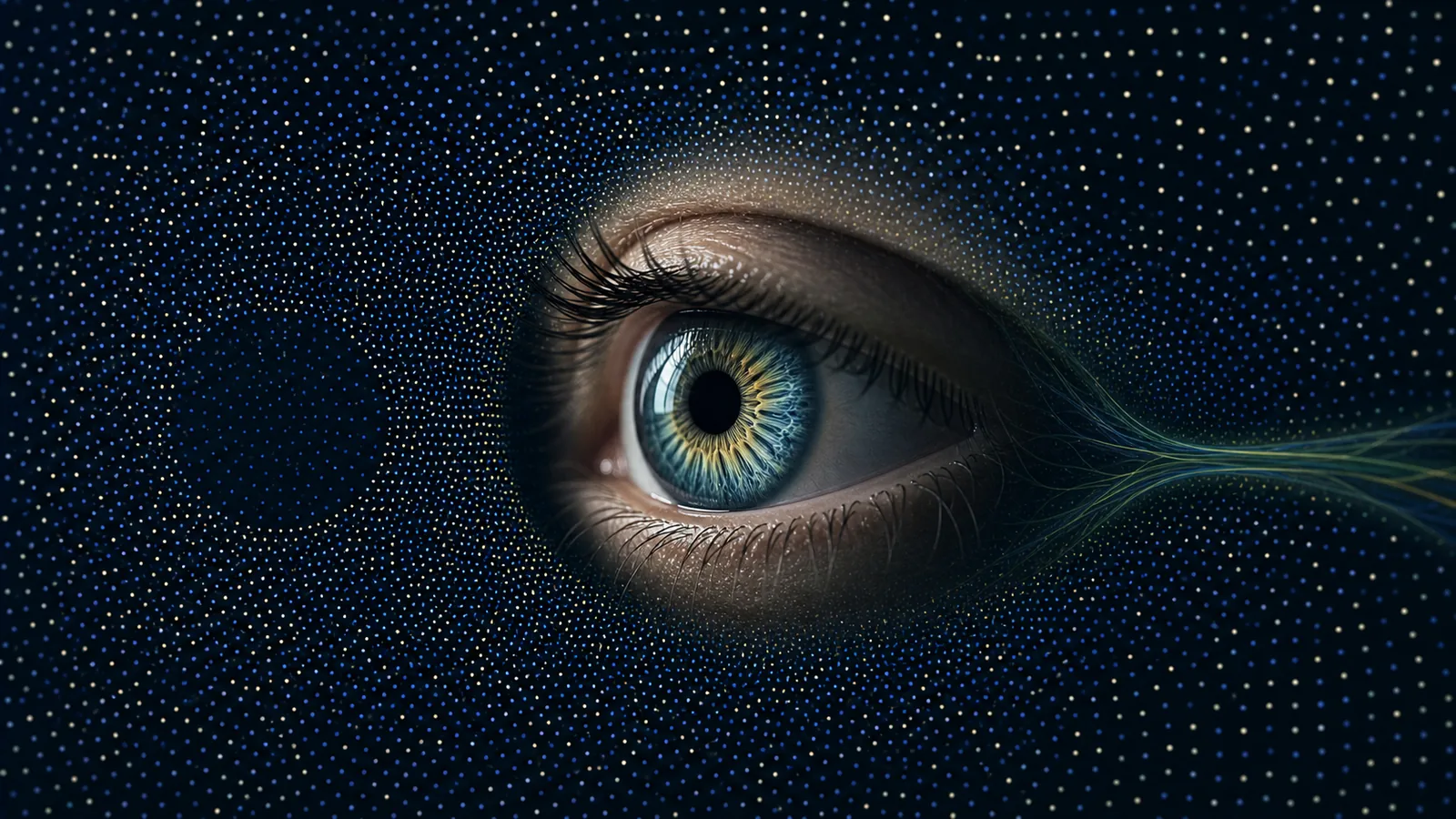
Look around a room with both eyes open and the view appears continuous. Yet each eye contains a place that receives no ordinary image at all. About 1.2 million retinal ganglion-cell axons gather at the optic disc and leave the eye as the optic nerve. That exit contains no rods or cones, the photoreceptors that normally respond to light. Whatever part of the scene falls there produces no ordinary visual signal from that eye.
The missing patch is called the physiological, or natural, blind spot. It is not a black dot printed on vision because black would still be a visual experience. It is closer to an absence of measurement. The National Library of Medicine places its centre roughly 15 degrees to the side of where an eye is looking. That is close enough to test deliberately, yet far enough from the sharp centre of vision to remain unnoticed during ordinary life.
Your second eye hides much of the gap before filling-in is needed
The blind spots of the two eyes point to different parts of the visual field. With both eyes open, a location that falls on the optic disc of one eye is usually visible to the other eye. The visual system combines those overlapping views, so the information missing from one channel can still arrive through the other. This binocular coverage is the first reason a hole in each retina does not become an obvious pair of holes in everyday vision.
Close one eye, however, and the view still does not acquire a neat empty oval. Research on perceptual filling-in shows that the visual system can continue simple colour, brightness, texture and contours across the blind region. A bar passing behind the blind spot may look unbroken. A uniform wall may remain uniform. The result feels seamless, but it does not mean the hidden object has somehow been photographed by the brain.
The visual system completes a pattern, not the missing evidence
Filling-in is often described as the brain inventing the missing picture. That phrase is memorable but too powerful. If a tiny unknown letter sits entirely inside the blind spot, the eye has not collected the information needed to identify it. The visual system can extend the paper colour or a line surrounding the letter, but it cannot recover the letter’s true shape from light that never reached rods or cones there.
Experiments reveal that completion depends on context. Coherent colours, textures, contours and motion can continue across the natural blind spot more strongly than they continue across an ordinary visible gap. Researchers disagree about how much should be described as active neural completion and how much reflects the way perception represents surfaces and boundaries. The careful conclusion is still remarkable: conscious vision is a constructed interpretation, not a pixel-for-pixel screen fed directly by the retina.
A dot and a cross can reveal your blind spot in seconds
Draw a cross and a solid dot several centimetres apart on the same horizontal line. To test the right eye, cover the left eye and stare only at the cross while keeping the dot to its right. Slowly move the paper or screen closer and farther without chasing the dot with your gaze. At one distance the dot should vanish, then return as you move past that position. Reverse the layout and covered eye to test the other side.
The disappearance happens when light from the dot lands on the optic disc. Try drawing a continuous line through both marks and repeat the test. When the dot disappears, the line may look continuous rather than punctured, demonstrating how surrounding structure is carried across the missing region. Screen size, viewing distance, glasses and fixation change the exact point, so failing to find it immediately says little about eye health. This is a perception demonstration, not a diagnostic examination.
The trick exposes why seeing is more than receiving light
The eyes continually move, the two views overlap and the brain must organise incomplete signals into stable objects. Most of the time that efficiency is useful. A wall should not appear to develop a hole whenever one eye’s optic disc points at it. Continuing the dominant colour and texture produces a practical model of the scene while attention remains available for edges, movement and changes that carry more useful information.
The blind-spot test turns that invisible work into an event you can watch. First the dot is present. Then, without dimming or moving behind anything, it disappears from experience. Nothing happened to the dot; the alignment changed inside the eye. The deeper surprise is not that vision occasionally fails. It is that a sensory gap exists every waking moment and a combination of two-eye coverage and context-sensitive completion makes the world feel whole.
A normal blind spot is different from a new patch of missing vision
Everyone’s physiological blind spot follows from normal optic-disc anatomy. A new dark, blurred or distorted patch is different and should not be explained away with this experiment. Changes can arise from several parts of the eye or visual pathway and cannot be diagnosed from an online demonstration. An optometrist or ophthalmologist can examine the retina and formally map a visual field when a person notices a change.
Official health guidance recommends prompt assessment for vision changes such as new blurring, double vision, flashing lights, shapes or a dark shadow, while sudden inability to see requires emergency care. The exact service and emergency number depend on the country. The safe boundary is simple: enjoy the disappearing-dot demonstration as evidence of the blind spot every normal eye already has, but seek local eye-care advice for a new, persistent or worsening area of missing vision.
Sources and further reading
- National Eye Institute: how the eyes turn light into visual signals ↗
- NCBI Bookshelf: optic-disc anatomy and the physiological blind spot ↗
- Frontiers in Psychology: a research taxonomy of perceptual filling-in ↗
- Scientific Reports: filling-in across natural blind spots and visible gaps ↗
- Exploratorium: the dot-and-cross blind-spot demonstration ↗
- NHS: when changes or loss of vision need medical attention ↗
This article was written for Curiosity Desk. We do not copy other publishers or invent quotes. If a material error is found, we correct it openly.
Read the full standards →One answer should lead to a better question
Bring your curiosity to the group
Curious Minds is our public Facebook community for surprising science, strange history, Australian wildlife and everyday questions. No copied posts, no personal-friend invitations and no link dumping.
- Three self-contained discussion prompts each week
- Sourced answers and honest uncertainty
- Respectful conversation without spam