A giant Moon can shrink without moving farther away
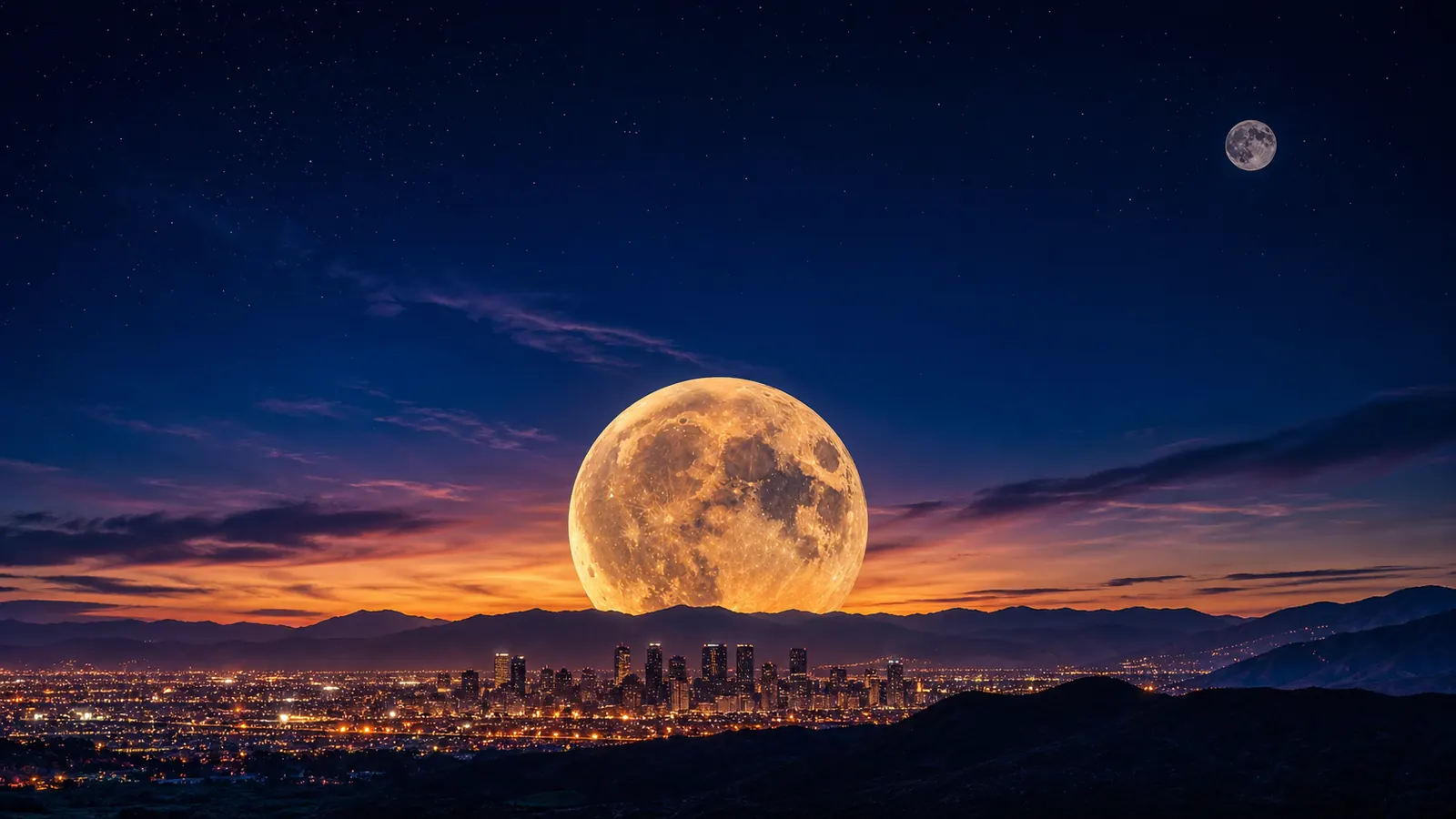
Watch a full Moon clear a line of houses and it can look large enough to touch the rooftops. Return a few hours later and the same Moon appears smaller in an empty sky. The obvious explanation seems physical: perhaps the horizon magnifies it or the Moon has moved closer. Both guesses fail. NASA notes that the Moon is about 1.5 percent farther from an observer when it sits near the horizon than when it is overhead.
Keep a camera at the same zoom and photograph the Moon in both positions. Its horizontal diameter covers essentially the same number of pixels. Hold a fingernail at arm's length and compare it again. The dramatic change survives in experience while disappearing from the measurement. That disagreement is the Moon illusion, a perception puzzle discussed for more than two thousand years and still not closed by one universally accepted explanation.
The atmosphere changes the Moon, just not in the expected direction
Light from a low Moon passes through more atmosphere. Shorter blue wavelengths are scattered more strongly, so the rising Moon can genuinely appear yellow, orange or red. Dust, haze and pollution can deepen the colour. Refraction near the horizon can also compress the Moon vertically, making it look slightly squashed. These are physical changes to the light reaching the eye.
They do not create the apparent giant. NASA's side-by-side photographs show the same horizontal width and a small vertical flattening at the horizon. The atmosphere is therefore not acting like the enlarging glass imagined in the popular explanation. Colour and shape change a little; the breathtaking increase in perceived scale comes mainly from the way the eye-brain system interprets the scene.
Your brain is trying to place a distant object inside a familiar world
Near the horizon, the Moon sits among cues that normally help the brain judge distance: buildings, mountains, trees and a landscape receding toward a vanishing point. One family of explanations links the effect to size-distance perception and the Ponzo illusion. If the brain treats the horizon as very far away but the Moon's angular size does not shrink like ordinary distant objects, it may interpret that unchanging angle as a much larger object.
Foreground comparison probably contributes, but it is not the entire answer. Astronauts in orbit have reported a Moon illusion without trees or city skylines. Experiments also show that viewing posture, the shape of the visible sky and assumptions about distance can alter the experience. NASA's careful conclusion is unusually satisfying: several mechanisms may participate, and researchers still lack the decisive experiment that makes everyone agree.
A twenty-second test can make the illusion collapse
When the Moon looks huge, view it through a rolled sheet of paper so the surrounding landscape disappears. Some observers find that it immediately seems smaller. You can also bend forward and look between your legs, or compare photographs made with unchanged settings. Each test removes or rearranges the contextual cues while leaving the Moon's image almost untouched.
The trick is not proof that your eyes are defective. Vision is an active estimate of a three-dimensional world built from a flat pattern of light. Most of the time those estimates let us move safely through complex spaces. Once in a while, the sky presents an object so distant and contextually strange that a normally useful system produces a beautiful disagreement with a ruler. The Moon has not swollen. Your brain has revealed how much invisible work goes into seeing size.
The illusion survives because your brain is solving a harder problem
Vision is not a camera feed with a ruler printed across it. The brain must infer size and distance from incomplete signals, and the horizon supplies a rich field of familiar objects, perspective lines and apparent depth. A Moon seen among rooftops can therefore be judged against an enormous-looking landscape, while the same disc high in an otherwise empty sky loses those anchors. The explanation is plausible, but researchers still debate how the different depth and size cues combine.
That uncertainty makes the illusion more interesting, not less. It shows a dependable physical measurement and a vivid human experience can disagree without either being fake. The next time the Moon looks impossibly large, take two photographs at the same zoom or compare it with a fingertip held at arm's length. The sky will change position over the night; the Moon's measured width will barely change; the feeling of bigness may change dramatically.
Sources and further reading
This article was written for Curiosity Desk. We do not copy other publishers or invent quotes. If a material error is found, we correct it openly.
Read the full standards →One answer should lead to a better question
Bring your curiosity to the group
Curious Minds is our public Facebook community for surprising science, strange history, Australian wildlife and everyday questions. No copied posts, no personal-friend invitations and no link dumping.
- Three self-contained discussion prompts each week
- Sourced answers and honest uncertainty
- Respectful conversation without spam