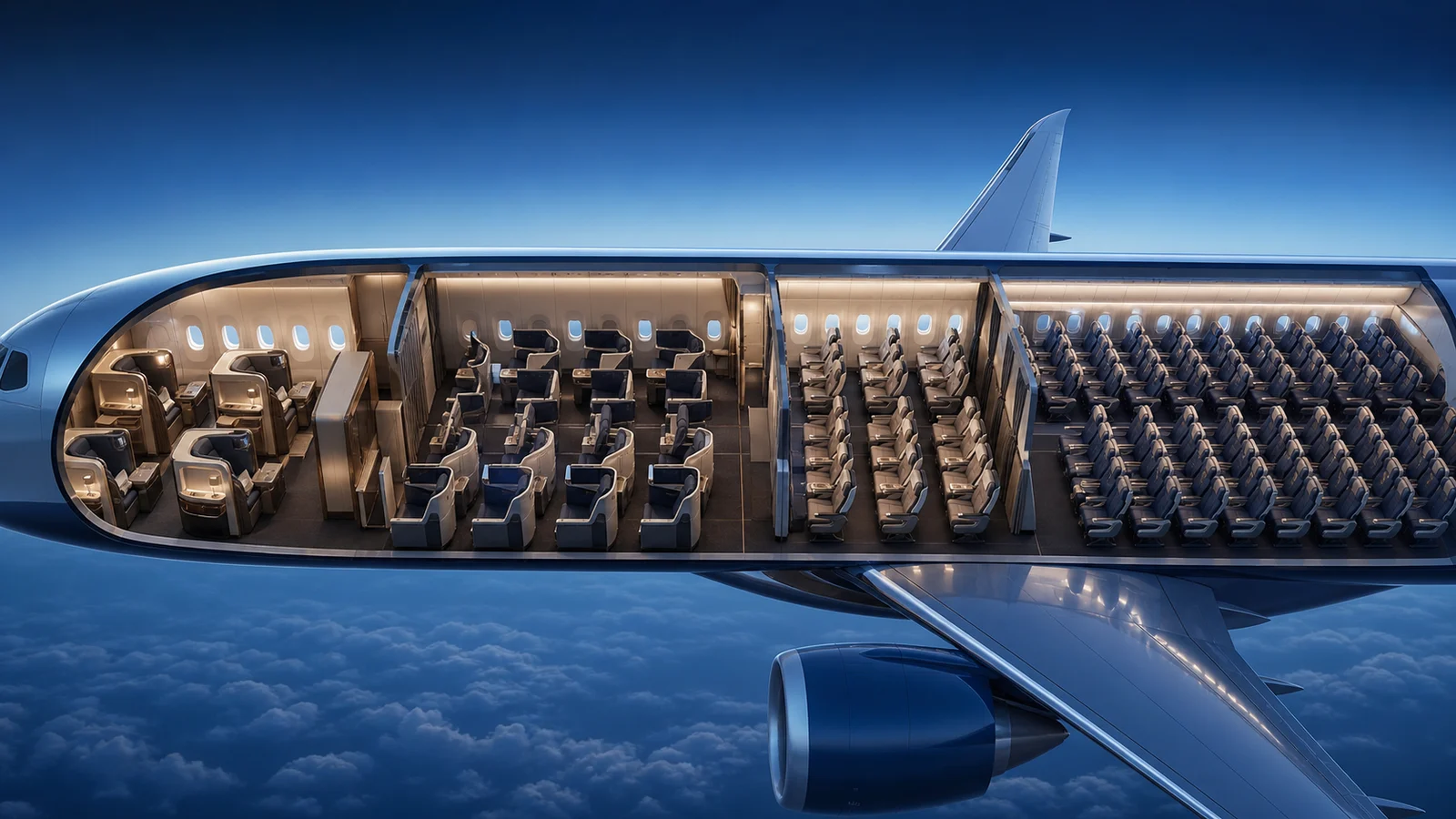
The published cabin plan
Project Sunrise seating plan at a glance
- All passenger seats
- 238 across four cabins
- First
- 6 suites in a 1-1-1 layout
- Business
- 52 suites in a 1-2-1 layout
- Premium Economy
- 40 seats in a 2-4-2 layout
- Economy cabin
- 140 seats in a 3-3-3 layout
- Economy Plus
- 42 of the 140 Economy seats
- Standard Economy
- 98 seats by subtraction
- Wellbeing Zone
- Between Premium Economy and Economy
Qantas has published cabin totals and seating configurations. Its current A350 pages do not yet show a numbered, row-by-row seat map, and the airline says the designs remain indicative and subject to change.
How are the 238 Project Sunrise seats divided?
Qantas divides the cabin into six enclosed First suites, 52 Business suites, 40 Premium Economy seats and 140 seats in the combined Economy and Economy Plus cabin. The four published totals add to 238.
First uses a 1-1-1 configuration, Business uses 1-2-1, Premium Economy uses 2-4-2 and Economy uses 3-3-3. These numbers describe seats across each row, not the number of rows or a specific seat number.
How many Project Sunrise Economy seats are there?
There are 140 seats in the Economy cabin. Qantas says that figure includes 42 Economy Plus seats at the front of the cabin, leaving 98 standard Economy seats by subtraction.
Both products use the published 3-3-3 Economy layout. Economy Plus has a 34-inch pitch, while Qantas says more than 70 percent of all seats on the aircraft offer a pitch of at least 33 inches.
Is a numbered Qantas A350 seat map available?
The current official A350 pages publish cabin totals, row configurations and indicative cabin images, but they do not show a numbered, row-by-row Project Sunrise seat map. Calling the published cabin plan a final seat map would therefore promise detail that Qantas has not yet provided.
Qantas plans to open Project Sunrise bookings in February 2027. Once seat selection becomes available, the live booking map for a specific flight should provide stronger row and seat-number evidence than today's indicative cabin designs.
Why does the Project Sunrise A350 have only 238 seats?
Airbus can support different layouts, so 238 is not a universal capacity of every A350-1000. It is the configuration Qantas selected for the A350-1000ULR used on Project Sunrise.
The published total includes six enclosed First suites, 52 Business suites, 40 Premium Economy seats and 140 Economy seats. More than 40 percent of all seats sit in premium cabins.
Long missions need space for more than seats
A flight of up to 22 hours needs galleys, lavatories, crew facilities, storage and service areas. Qantas also includes a purpose-built wellbeing zone rather than using every possible section of floor for passenger rows.
Premium suites occupy more floor area than conventional seats. A four-class layout therefore reaches a lower total well before every passenger receives the same amount of space.
Weight and range still interact
Passengers, baggage, seats, partitions, catering and cargo all add mass. A lower-density cabin can support the mission design, but the official sources do not present 238 as a simple weight-derived maximum.
Range is managed across fuel, structure, take-off weight, weather and payload. It would be inaccurate to claim that adding one more passenger automatically makes Sydney to London impossible.
Economy still represents most passengers
The published split places 140 of 238 seats in Economy and Economy Plus. The 42 Economy Plus seats have a 34-inch pitch, and most of the remaining Economy cabin uses the published 33-inch pitch.
A low total seat count therefore does not make the aircraft all-premium. It describes a mixed cabin with substantial premium allocation and more room per passenger than a dense long-haul arrangement.
The commercial logic is not fully public
Qantas says demand for point-to-point ultra-long-haul travel is strong and frames the cabin around comfort and wellbeing. Ticket prices, cargo decisions and final route economics remain airline matters beyond the fact sheet.
The evidence supports a careful conclusion: 238 seats reflect Qantas's chosen balance of four classes, cabin space and ultra-long-range service, not a technical claim that the airframe could never hold more.
The numbers reveal where the cabin space went
First, Business and Premium Economy together account for 98 seats, or about 41.2 percent of the total. Economy and Economy Plus account for 140 seats, or about 58.8 percent. The percentages confirm Qantas's statement that more than 40 percent of the cabin is premium.
Seat count alone still understates the floor-area difference. Six enclosed First suites and 52 Business suites use far more room per traveller than standard rows, while aisles, monuments and the wellbeing zone also occupy fixed space.
Comfort features are designed as a system
Qantas lists a 33-inch pitch in Economy and 12 lighting scenes intended to support adjustment to the destination time zone. The dedicated wellbeing zone provides space for movement, stretching and hydration away from the seat.
Those features do not guarantee sleep or eliminate jet lag. They show how the airline is using the available cabin area: fewer seats, varied lighting, large premium products and a shared movement space for a journey that may last up to 22 hours.
Three different limits are often confused
The airframe's possible seating capacity, Qantas's chosen 238-seat configuration and the payload permitted on a particular day's flight are not the same number. Only the second is fixed by the published Project Sunrise cabin plan.
A route-day payload can vary with weather, fuel, cargo and operational restrictions. The public evidence does not show that 238 is a hard aerodynamic maximum. It shows that Qantas deliberately chose a low-density layout for this mission and product.
Sources and further reading
- Airbus - A350-1000ULR certification flight testing ↗
- Airbus - Project Sunrise aircraft, range and delivery overview ↗
- Qantas - Project Sunrise aircraft and service fact sheet ↗
- Qantas - Current A350 cabin totals and Economy Plus details ↗
- Qantas - 2026 cabin configurations for every travel class ↗
- Qantas - Economy and Economy Plus seat details ↗
This article was written for Curiosity Desk. We do not copy other publishers or invent quotes. If a material error is found, we correct it openly.
Read the full standards →One answer should lead to a better question
Bring your curiosity to the group
Curious Minds is our public Facebook community for surprising science, strange history, Australian wildlife and everyday questions. No copied posts, no personal-friend invitations and no link dumping.
- Three self-contained discussion prompts each week
- Sourced answers and honest uncertainty
- Respectful conversation without spam