See the mechanism
A room route that does not double back
Check before moving dirt
Identify fragile surfaces, product instructions, ventilation needs and unusually contaminated areas first.
Work from high to low
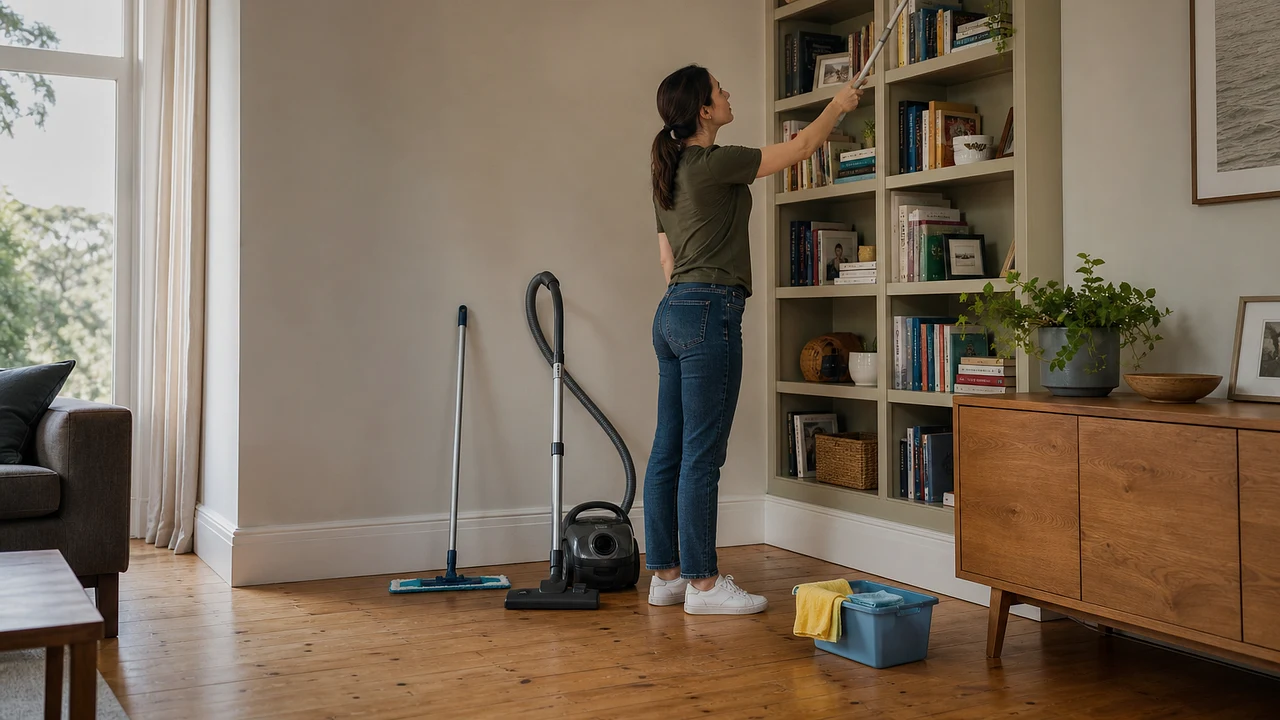
Start above eye level so falling dust and droplets land on areas that have not yet been finished.
Move clean to dirty
Change cloth faces or tools as needed instead of carrying contamination back across lower-risk surfaces.
Finish at the exit
Use a systematic room path and clean the floor last, ending where you can leave without crossing the wet work.
A good cleaning order prevents the second clean
Imagine mopping a floor, then wiping the top of a bookcase. Dust, crumbs and an occasional dirty droplet now land on the floor you just finished. The work was not poor because the products were weak. It was poor because the sequence forced one task to undo another.
High-to-low cleaning solves that simple movement problem. Public-health cleaning guidance uses the same principle to stop dirt and microorganisms from falling or dripping onto finished surfaces. A home is not a hospital, so its infection-control rules are different, but gravity and cross-contamination still behave the same way.
Three directions create one repeatable route
The first direction is high to low: overhead and upper surfaces before lower furniture, skirting and floors. The second is clean to dirty: lower-risk areas before toilets, greasy zones, pet accidents or other obvious contamination. The third is systematic: move clockwise, left to right or in another fixed pattern so attention does not jump randomly around the room.
CDC environmental-cleaning guidance combines all three. It recommends high-to-low to prevent recontamination, cleaner-to-dirtier to limit spread and a methodical pattern to reduce missed surfaces. In a home, the value is practical rather than clinical: fewer repeated steps, clearer cloth changes and an obvious finish point.
The room check comes before the first cloth
Stand at the doorway and look for hazards. Is there broken glass, a leaking cleaner, exposed wiring, mould, pest waste, sewage, blood, a large unknown spill or a ceiling surface that cannot be reached safely? Is a child, pet or food-preparation task about to cross the work area? Ordinary routine cleaning should pause when the risk needs a specialist method.
Then identify the materials. Timber, natural stone, painted walls, electronics, coated screens and upholstery do not share one cleaner. Read the product label and the surface maker's care instructions before wetting anything. Gather the products, cloths, waste bag, vacuum attachments and protective equipment needed for this room so the route is not interrupted by repeated trips.
Remove obstacles without turning tidying into a detour
Take out rubbish, spoiled food, dishes and laundry first. Put objects that already have a nearby home away. Place everything else in one relocation basket instead of leaving the room for every book, cable or toy. Clutter is not merely visual; it hides surfaces and creates trip points while both hands are occupied.
Do not create a giant pile on the bed or sofa if those surfaces also need cleaning. Keep a clear path to the doorway and leave the floor tools outside that path until their turn. The goal is enough access to clean safely, not a complete organising project disguised as one room's routine clean.
Capture dust instead of launching it
Household dust can contain pollen, skin cells, pet allergens, dust-mite material and other particles. The US Environmental Protection Agency notes that walking, sweeping, dusting and vacuuming can stir settled dust into the air. It recommends damp dusting because a slightly damp cloth helps keep particles from becoming airborne again.
Damp does not mean dripping. Use a clean cloth and the moisture level approved for the surface. For delicate electronics and porous materials, follow the manufacturer rather than applying a general wet method. People with asthma or allergies may need to leave the room while vacuuming, and a properly designed HEPA vacuum can reduce some dust escaping through the exhaust.
Begin at the highest surface you can reach safely
Start with ceiling-fan blades, accessible vents, light fittings, curtain tops, door frames and the tops of tall furniture only when the power, surface and reach make the task safe. Switch a fan off at the control and wait until it stops. Use a long-handled tool where it gives stable reach, and support removable fittings as their manual directs.
Do not stand on a dining chair, sofa arm, benchtop or stacked objects. WorkSafe Tasmania describes portable ladders as among the least stable ways to work at height, while Safe Work Australia advises considering safer access before a ladder. If the job cannot be done with stable footing, the correct next step may be suitable equipment or a qualified service, not extra stretching.
Move through the middle of the room once
After upper dust is captured, clean wall art frames, shelves, window ledges, mirrors, tables, switches, handles and other mid-level surfaces in a fixed direction. Work around the room rather than following whichever mark catches your eye next. A clockwise path makes it easy to see where the clean section ends.
Use the least aggressive product suitable for each material and give mechanical wiping time to work. Spray onto a cloth instead of into the room when the label and surface directions prefer that method. Never spray toward electrical controls, open seams or ventilation grilles. Clean removable objects before returning them to a finished shelf so they do not put dust back immediately.
Clean to dirty is about the cloth's journey
Begin with lower-soil surfaces and finish with areas more likely to carry grease, food residue, body fluids or toilet contamination. A general room cloth should not travel into a toilet zone and then return to a bedside table or kitchen bench. Separate bathroom and kitchen tools, and use dedicated cloths or a clear colour system if that prevents mix-ups in your home.
This principle operates within one surface too. Wipe from the cleaner edge toward the soiled patch, lifting material rather than smearing it outward. For a heavy spill, remove bulk contamination with separate material before routine cleaning. Blood, sewage, floodwater, animal waste and unknown chemicals can require protective equipment and disposal steps beyond an ordinary cloth routine.
A folded cloth has more than one working face
CDC guidance recommends folding a cloth to create multiple usable sides, then rotating to a fresh face as each becomes soiled. That simple habit makes the point of contact visible. A grey, gritty face should not continue across a mirror, tap and light switch merely because the cloth still feels wet.
Change the cloth when every clean face is used, when it becomes heavily soiled or when you move into a distinctly dirtier zone. Place used cloths in a dedicated bag or container rather than back among clean supplies. Launder reusable materials using their care directions and dry them fully before storage; a permanently damp cloth is not a clean starting tool.
The wet-time exception changes the route deliberately
Some products need time on a surface. A bathroom descaler may need a stated dwell period, and a disinfectant must remain visibly wet for the contact time on its label. Apply such a product only when the surface and directions permit it, start the timer and clean another safe area while it works. Return before it dries contrary to the directions or remains longer than the material allows.
That is not random backtracking. It is a planned parallel task. Keep the timed zone separate so nobody touches it, never combine chemicals to speed the result and use ventilation and protective equipment from the label. In most home situations, CDC guidance says ordinary soap-and-water cleaning removes most germs; disinfection is more relevant during illness, for higher-risk occupants or after specific contamination.
Kitchens and bathrooms need smaller zones
In a kitchen, move from food-storage and preparation surfaces toward the sink, cooktop and greasy splash zone. Use separate materials for the floor and rubbish area. Raw-meat contamination needs the food-safety process appropriate to the surface, while a chemical used on a food-contact bench may require a potable-water rinse after its labelled contact time.
In a bathroom, clean mirrors and upper fittings before the basin, shower and toilet. Treat the toilet as the final surface zone and use dedicated tools. High-to-low does not mean dragging toilet contamination down the outside of the bowl; it means completing upper and cleaner bathroom surfaces before entering that dirtier zone, then changing tools before leaving it.
Walls and low-touch surfaces follow evidence, not habit
Ceilings, full walls, blinds and cupboard tops do not usually need the same frequency as handles, benches and switches. Australian community-cleaning guidance separates frequently touched surfaces from minimally touched ones and recommends cleaning walls and blinds when visibly dusty or dirty. Cleaning every wall on every visit can consume time while the genuinely touched surfaces remain unfinished.
Spot-clean marks using the paint or wall-covering maker's method and test an inconspicuous area when permitted. Avoid soaking plasterboard, wallpaper seams or electrical fittings. A stain that returns with dampness, bubbling paint or a musty odour points to a moisture source that cleaning alone will not solve.
The floor is the collection step
Once upper and middle surfaces are finished, let remaining particles settle briefly if substantial dust was disturbed. Vacuum or sweep using the method suitable for the floor, including edges, under accessible furniture and the route where debris fell. Then damp-mop only if the material permits it. Timber, laminate, stone, tile and resilient flooring have different moisture and chemistry limits.
Start at the point farthest from the doorway and work toward the exit so you do not walk across the finished area. CDC floor guidance uses the same route and recommends cleaning floors last. Change a dirty pad or solution rather than spreading recovered soil. Use a caution sign or block access until a wet floor is fully dry.
Finish by cleaning the tools, not abandoning them
Empty the vacuum and clean its filter according to the manufacturer, preferably where captured dust cannot immediately return to the room. Rinse buckets and reusable equipment as directed, launder cloths and mop pads, and allow everything to dry. Return closed, labelled chemicals to secure storage away from children, pets, food and heat.
Remove gloves safely and wash your hands. Check the doorway view once more for a missed waste bag, wet patch, unstable object or product left on a surface. The room is not complete if the tools create the next contamination problem or a wet floor creates a fall risk.
The ten-step route to remember
Assess hazards. Open safe ventilation. Remove rubbish and obstacles. Gather the correct tools. Capture dust from the highest safe surfaces. Move systematically through mid-level surfaces. Work from cleaner zones toward dirtier ones. Rotate or replace cloths. Vacuum and mop the floor last. Finish at the doorway and reprocess the tools.
The order does not make every room fast, and it does not replace material-specific care or specialist contamination procedures. It does make the next action obvious. Instead of repeatedly asking what to clean next, the room itself becomes a route from high to low, clean to dirty and far corner to exit.
Evidence boundary
What the evidence supports—and where it stops
Environmental-cleaning guidance independently converges on high-to-low, cleaner-to-dirtier and systematic movement because each rule reduces recontamination or missed areas.
A home is not a healthcare facility. Surface care instructions, product labels and specific spill or infection guidance override a general route, and chemical products must never be mixed casually.
Sources and further reading
- US CDC: High-to-low, clean-to-dirty and systematic environmental cleaning ↗
- Victorian Department of Health: Methods for high-to-low and clean-to-dirty surface cleaning ↗
- Australian Department of Health and Aged Care: Community cleaning and disinfection guidance ↗
- US CDC: When and how to clean and disinfect a home ↗
- US CDC: Cloth handling, colour separation and cleaning-equipment care ↗
- US EPA: Household dust, damp dusting and HEPA vacuum guidance ↗
- US EPA: Biological contaminants and routine household cleaning ↗
- WorkSafe Tasmania: Using portable ladders safely ↗
- Safe Work Australia: Ladder safety guidance ↗
This article was written for Curiosity Desk. We do not copy other publishers or invent quotes. If a material error is found, we correct it openly.
Read the full standards →One answer should lead to a better question
Bring your curiosity to the group
Curious Minds is our public Facebook community for surprising science, strange history, Australian wildlife and everyday questions. No copied posts, no personal-friend invitations and no link dumping.
- Three self-contained discussion prompts each week
- Sourced answers and honest uncertainty
- Respectful conversation without spam