The famous instruction leaves out an invisible step
The Southern Cross is often described as though its foot were a luminous arrowhead aimed at a spot on the ground. Look closely and the problem appears immediately. Acrux, the star at the foot of the cross, is still high in the sky, and there is no bright star directly beneath it marking due south.
Crux works because its long axis leads towards the south celestial pole. That pole is an imaginary point in the sky directly above geographic south. You first estimate the pole, then trace straight down from it to the horizon. Skipping that second step turns a useful geometric method into a misleading slogan.
First make sure the cross is the right one
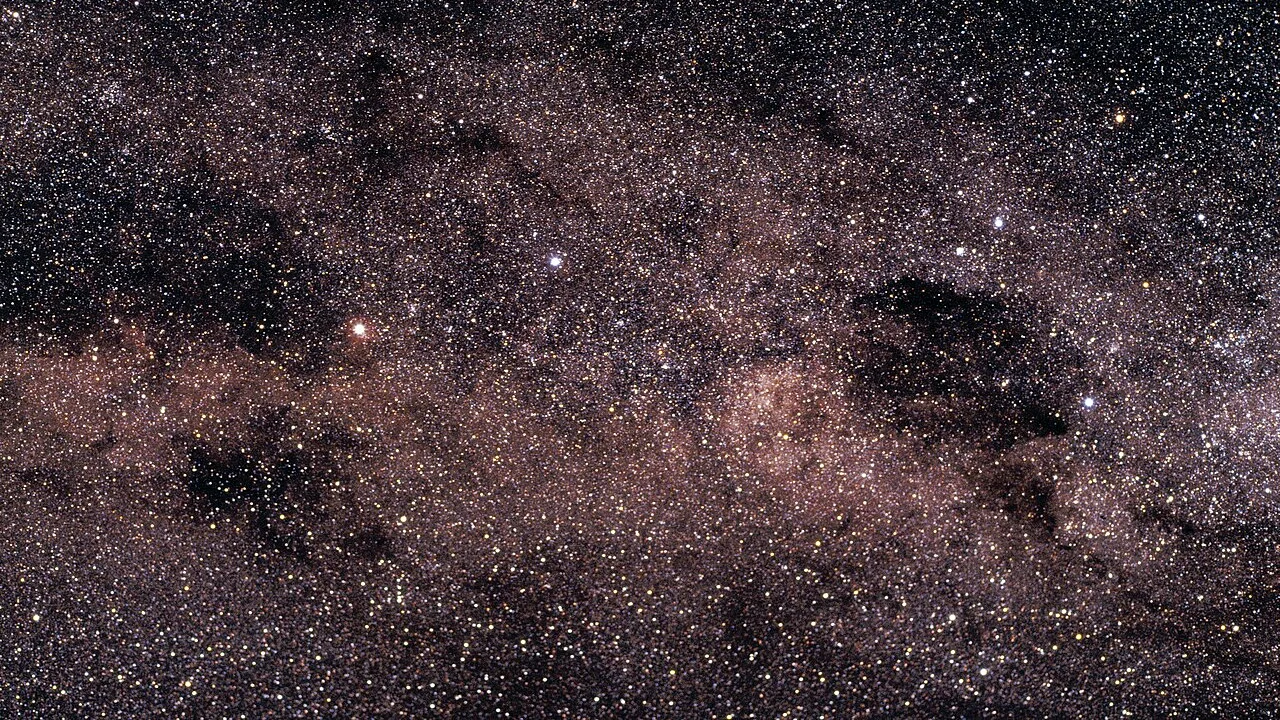
The four brightest stars of Crux form a compact, uneven kite rather than a perfect cross. Acrux is the bright foot, Gacrux is the reddish star at the head, and Mimosa and Imai form the shorter bar. A fifth star, Epsilon Crucis, can appear inside one side of the pattern under a reasonably dark sky.
The best confirmation is nearby. Alpha and Beta Centauri form two bright Pointer stars that lead the eye towards Crux. They belong to Centaurus, not to Crux, but their position distinguishes the real Southern Cross from the larger False Cross made from stars in Carina and Vela. The False Cross has no comparable pair of pointers.
Measure four and a half cross lengths beyond Acrux
Imagine a line from Gacrux at the head of the cross through Acrux at its foot. Continue in that same direction for roughly four and a half times the distance between those two stars. The end of that imagined extension lands near the south celestial pole.
This is a visual estimate, not a demand for perfect angular measurement. Te Ara, the New Zealand government encyclopedia, describes the same four and a half length method. ABC Science gives a simplified version using about four additional lengths beyond the foot. Either instruction is trying to locate the same empty patch of sky.
The Pointers provide a second line
For a useful cross-check, imagine a line joining Alpha and Beta Centauri. Find its midpoint, then draw another imaginary line through that midpoint at a right angle, heading towards the long axis extended from Crux. Where the two lines meet is an estimate of the south celestial pole.
The method sounds complicated on a screen but becomes clearer outdoors because the two bright Pointers are easy to hold in view. It also exposes the real logic. Crux does not magically point to a compass bearing. Two separate pieces of sky geometry identify a rotation point that contains no obvious marker.
Now drop the pole to the horizon
Once the pole has been estimated, imagine a vertical line from it down to the horizon. The place where that line meets a clear, level horizon is approximately true south. A slope, building, tree line or nearby ridge can make this last projection less intuitive, so learning from a known location is valuable.
The pole's height above the horizon is related to latitude. From Hobart it appears much higher than it does from Darwin, yet the point directly beneath it is still south. This is why memorising where Crux sat on one holiday evening is less useful than understanding the construction.
The cross turns while its target stays put
Earth's rotation makes the southern stars appear to circle the south celestial pole. Across a night Crux can stand upright, lean sideways and appear upside down. Its changing pose is not a failure of the method because the long axis keeps aiming towards the same central region.
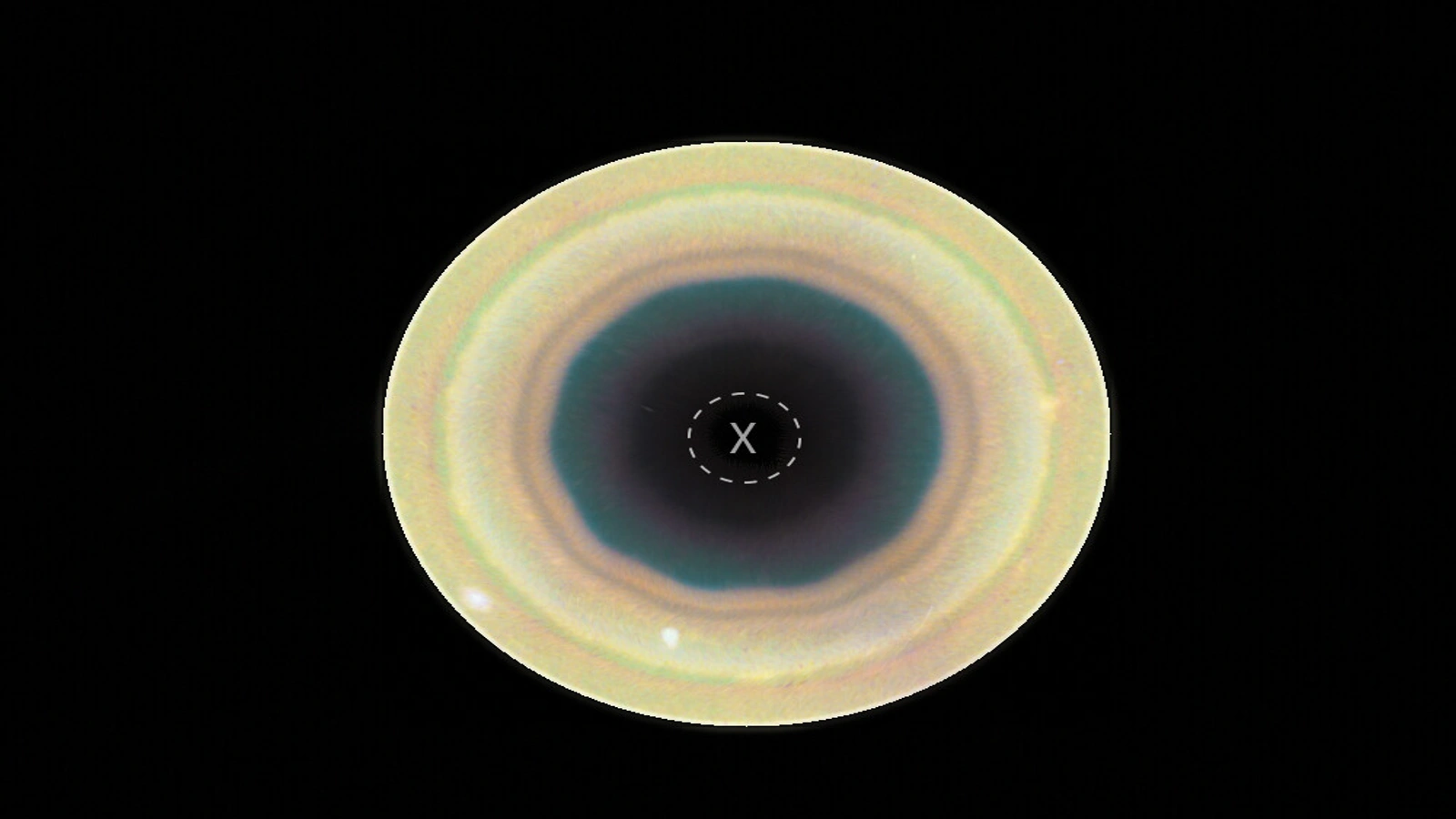
Long exposure photographs make the arrangement obvious. Stars draw circular trails around an apparently empty centre in the constellation Octans. Crux travels around that centre with the rest of the sky, so the phrase that it points south is true only after the pole and horizon steps are understood.
The south has no useful equivalent of Polaris
Northern observers can use Polaris because it lies close to the north celestial pole and is bright enough to identify easily. The International Astronomical Union's astronomy education material notes that the Southern Hemisphere has no star comparably close and obvious. The south celestial pole is therefore found using patterns around it.
Sigma Octantis is sometimes called the south pole star, but it is faint and not exactly on the pole. For most casual observers, locating Crux and the Pointers is faster than trying to isolate that dim star among many others. The empty target is the reason a cross became the practical landmark.
Crux is not fixed to south forever
Earth's rotational axis slowly changes direction in a motion called precession. ABC Science describes a cycle of roughly 26,000 years. That gradual movement changes which stars lie near the celestial poles and even which constellations are visible from a given latitude over very long periods.
Crux is an excellent directional aid in the present era, but it is not permanently attached to celestial south. That longer view turns a camping trick into something more interesting. The stars seem fixed during a human life, while the axis used to map the entire sky is slowly tracing its own vast circle.
Treat it as orientation, not a rescue guarantee
Cloud, smoke, moonlight, city glow and a confused identification can all weaken a naked-eye estimate. The technique is valuable for understanding direction and checking a known landscape, but it is not a substitute for a compass, map, GPS, local knowledge and a journey plan when getting lost would be dangerous.
The most accurate version of the familiar saying is also the most memorable: the Southern Cross does not point straight to a place on the horizon. It points towards an invisible pivot in the sky. Find that pivot, drop it to the horizon, and the geometry finally reveals south.
Sources and further reading
- ABC Science: Find south using the stars ↗
- Te Ara: Navigating by the Southern Cross ↗
- ABC Science: Southern Cross star guide, false crosses and precession ↗
- European Southern Observatory: Navigating the stars with Crux and the Pointers ↗
- IAU Office for Astronomy Outreach: Why the south celestial pole needs a pattern rather than a bright pole star ↗
This article was written for Curiosity Desk. We do not copy other publishers or invent quotes. If a material error is found, we correct it openly.
Read the full standards →One answer should lead to a better question
Bring your curiosity to the group
Curious Minds is our public Facebook community for surprising science, strange history, Australian wildlife and everyday questions. No copied posts, no personal-friend invitations and no link dumping.
- Three self-contained discussion prompts each week
- Sourced answers and honest uncertainty
- Respectful conversation without spam