The clock starts after the surface is wet
A quick spray followed by an immediate wipe can lift crumbs, fingerprints and some microorganisms. It does not necessarily complete disinfection. Disinfectants are evaluated using defined directions that include the product concentration, application method, surface and exposure period. Using only part of that process no longer matches the condition behind the claim.
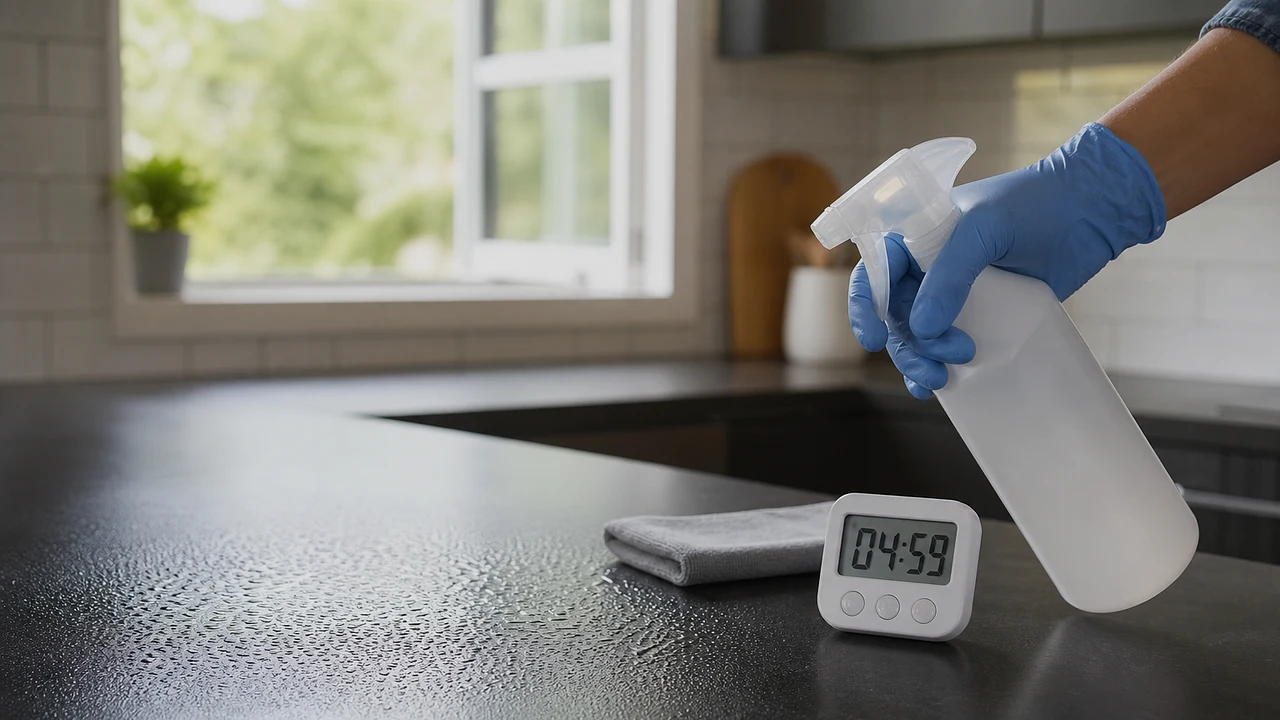
That exposure period is the contact time, sometimes called wet time or dwell time. Australia's Therapeutic Goods Administration defines it as the time a product needs to remain on the surface to inactivate or kill the stated microorganisms. The United States Environmental Protection Agency makes the practical requirement explicit: the surface should remain visibly wet for the entire contact time.
Cleaning, sanitising and disinfecting are not synonyms
Cleaning uses water, detergent and physical action to remove dirt, impurities and many germs. Sanitising reduces microorganisms to a level specified by a public-health standard or product claim. Disinfecting uses a product with a stronger claim to kill or inactivate microorganisms that remain on a surface. A surface can look clean without having been disinfected, and a surface can be exposed to disinfectant while still carrying soil that should have been removed first.
More disinfection is not automatically better. The US Centers for Disease Control and Prevention says ordinary soap-and-water cleaning is enough in most home situations. Targeted disinfection becomes more relevant when somebody is sick, recently visited while sick, has a weakened immune system or when a specific contamination event calls for it. That distinction reduces unnecessary chemical exposure and keeps attention on the places where it matters.
The label is the procedure, not decoration
Before using a product, find the directions for the exact task. Check the microorganisms covered by the claim, the allowed surfaces, whether pre-cleaning is required, how to dilute or apply it, the contact time, protective equipment, ventilation, rinsing and disposal. A front label that says disinfectant is not a universal instruction for every material or germ.
The same brand name can appear on sprays, concentrates and wipes with different active ingredients and directions. Even products with similar ingredients can have different tested claims. Do not borrow a contact time from a social post, another bottle or a workplace chart unless it refers to the exact product and use. If the directions are missing or unreadable, the TGA advises that the product may not be safe and effective; replace it or obtain the official label rather than guessing.
Contact time means continuously wet
A five-minute instruction does not mean spray a thin mist, let it dry in forty seconds and wait another four minutes. It means the treated area remains visibly wet for the stated five minutes. If the product directions allow reapplication, more may be needed before the surface dries. The label still decides how much, how often and whether the surface should then air-dry or be wiped.
Temperature, airflow, absorbency, product volume and the size of the treated area all affect drying. A warm benchtop beside an open window may dry faster than a cool bathroom surface. Plan the area so you can keep it wet without flooding edges, seams, electrical controls or the floor. Visible wetness is the useful observation; a phone timer only measures it.
There is no honest universal number
Contact time varies by product, organism, concentration, surface and claim. One label may list different times for bacteria, viruses or fungi. That is why a poster saying every disinfectant works in thirty seconds or every surface needs ten minutes is unreliable. The correct number is the one attached to the relevant use on the product label.
EPA labelling guidance says hard-surface disinfectant times are reviewed product by product and are generally not accepted above ten minutes unless immersion is part of the process. That regulatory ceiling is not an instruction to use ten minutes for everything. Some reviewed products require much less. Reading the actual directions prevents both an ineffective short exposure and needless extra chemical use.
Soil can stand between the product and the target
Grease, food residue, dust and body fluids can physically shield microorganisms or interfere with disinfectant chemistry. If the surface is visibly dirty, remove that soil using the method and detergent suitable for the material. Rinse or dry as the directions require, then begin the disinfection step. Applying more disinfectant on top of a dirty film is not a dependable shortcut.
Some products combine cleaning and disinfection and are tested for a one-step use under specified soil conditions. That permission has to be on the label. If it calls for a separate pre-clean, perform one. Moving from a visibly dirty section to a clean section with the same cloth can also redistribute soil, so change or refold cleaning materials before the disinfection pass.
One wipe does not cover an unlimited area
A disinfectant wipe becomes less useful as it dries or collects soil. EPA guidance for floor towelettes tells label reviewers to consider coverage, changing soiled wipes and using enough wipes to keep the stated area visibly wet for the full time. The same physical limitation is easy to see on a benchtop: a nearly dry wipe dragged across a whole kitchen cannot leave an even wet film.
Use the coverage and disposal directions on the pack. Do not return a used wipe to the container, and do not flush it unless the manufacturer and local wastewater authority explicitly permit that disposal. If the final section is already dry when you finish the first, reduce the working area or use another wipe as directed rather than pressing harder on an exhausted one.
Wet enough does not mean flooded
The goal is complete visible wetness on an approved surface, not a pool of liquid. Excess can run onto skin, drip to the floor, damage finishes or enter gaps where the product was never intended to go. Spray application may also have a stated distance or instruction to apply to a cloth rather than directly to the object.
Electronics, switches, touchscreens and appliances need their own manufacturer instructions. Never spray into a vent, socket, control panel or open seam. Ordinary hard-surface directions also do not authorise spraying disinfectant into heating, ventilation or air-conditioning systems. EPA guidance says HVAC use must be specifically included on the product label.
The surface decides whether the product belongs there
A hard, sealed, non-porous benchtop is different from unfinished timber, natural stone, upholstery, carpet or a mattress. Some products can discolour fabric, corrode metal, cloud acrylic, etch stone or soften a coating. A porous material may absorb liquid before the wet contact time is complete, and a product tested on hard non-porous surfaces does not automatically gain a fabric claim.
Check both the disinfectant label and the surface maker's care guide. Test a hidden area when the directions permit it. For valuable stone, antiques, electronics or specialist textiles, a suitable cleaning method or professional assessment may be safer than attempting disinfection with a household spray. No germ claim repairs chemical damage to the material underneath.
Stronger dilution is not a stronger plan
A concentrate must be measured to the label dilution. Too little active ingredient may fail the claim; too much can increase fumes, residues, corrosion and exposure without improving the tested result. Use room-temperature water unless the label specifies otherwise, because CDC home guidance warns against substituting hotter water by assumption.
Label every diluted solution and record its preparation time when the directions give a limited usable life. Never top up an unidentified bottle or pour product into a food or drink container. In a workplace, Safe Work Australia identifies the safety data sheet as a key source for hazards, handling, storage, first aid and disposal. Household users can also request current safety information from the supplier when directions are unclear.
Food-contact surfaces may need a final rinse
A kitchen counter can be both a hard surface and a place where food touches. Those facts do not make every disinfectant suitable for it. Check whether the label allows food-contact use and whether a potable-water rinse is required after the contact time. EPA product lists distinguish food-contact uses that require a post-rinse from other surface claims.
Do not spray disinfectant onto food, produce, cutlery or dishes unless the exact directions explicitly cover the item and method. Keep food and food-preparation tools away while applying the product. Complete the contact time, perform the labelled rinse if required and allow the area to dry as directed before preparing food again.
Protect the person doing the cleaning
Open windows or doors and use other ventilation that the label recommends. Wear the stated gloves, eye protection or other equipment, and wash your hands after the task. Do not eat, drink or touch your face while handling the product. A strong smell is not proof that disinfection is working, and deliberately breathing vapour is never part of the process.
Disinfectants are surface products. The TGA says they should never be used internally or on skin. CDC guidance also says not to ingest, inject or apply them to people or pets. Store the original closed container away from children and animals, separate from food and medicine, and at the temperature stated on the label.
Never create your own chemical combination
Do not mix bleach with ammonia, vinegar, acids, alcohol, toilet cleaner or another disinfectant. Do not assume that two useful products become more powerful together. CDC guidance warns that mixing bleach or disinfectants with other cleaners can release vapours that are dangerous to breathe. Use one labelled process, rinse between incompatible stages only when the directions require it and never experiment in a closed room.
If exposure occurs in Australia, move to fresh air only if it is safe, follow the label's first-aid directions and call the Poisons Information Centre on 13 11 26 for advice. Call Triple Zero on 000 for severe breathing difficulty, collapse or another immediate life threat. Do not wait for an online article or induce vomiting unless a health professional specifically tells you to.
High-risk settings need a specific protocol
Medical devices, food businesses, childcare, aged care, healthcare and contamination involving blood, sewage or certain infectious diseases can have requirements beyond ordinary household cleaning. The disinfectant may need a particular approval, organism claim, concentration, training record or disposal process. A household label and a general article cannot replace those procedures.
Follow the responsible authority, equipment manufacturer and workplace protocol. If a surface cannot safely remain wet for the required time, choose an approved alternative or seek infection-control advice rather than shortening the time. The correct product is one that can achieve the required claim on that exact material without creating a larger safety problem.
The thirty-second check before you start
Ask six questions. Is disinfection actually needed? Is this product approved for the surface and the target claim? Does the area need to be cleaned first? What is the exact contact time? Can you keep it visibly wet without damaging the object? What ventilation, protection, rinse and disposal steps does the label require?
Then work in an area small enough to control. Remove soil, apply the product exactly as directed, start the timer when the surface is wet and watch the surface rather than the clock alone. A disinfectant does not work because the bottle was present. It works when the full labelled process is completed safely.
Sources and further reading
- Therapeutic Goods Administration: Disinfectant information for Australian consumers ↗
- US EPA: Registered disinfectant directions, contact time and visible wetness ↗
- US CDC: When and how to clean and disinfect a home ↗
- US EPA: Differences between cleaning, sanitising and disinfecting ↗
- US EPA: Review guidance for disinfectant wipe coverage and wetness ↗
- US EPA: Product-specific hard-surface contact-time labelling guidance ↗
- US EPA: Food-contact post-rinse and surface-type definitions ↗
- US EPA: Limits on disinfectant and sanitiser use in HVAC systems ↗
- US CDC: Bleach ventilation, contact time and chemical-mixing safety ↗
- Safe Work Australia: Hazardous cleaning chemicals and safety data sheets ↗
- Queensland Poisons Information Centre: 24-hour Australian poisons advice ↗
This article was written for Curiosity Desk. We do not copy other publishers or invent quotes. If a material error is found, we correct it openly.
Read the full standards →One answer should lead to a better question
Bring your curiosity to the group
Curious Minds is our public Facebook community for surprising science, strange history, Australian wildlife and everyday questions. No copied posts, no personal-friend invitations and no link dumping.
- Three self-contained discussion prompts each week
- Sourced answers and honest uncertainty
- Respectful conversation without spam