The caddy is not clean just because it carries cleaner
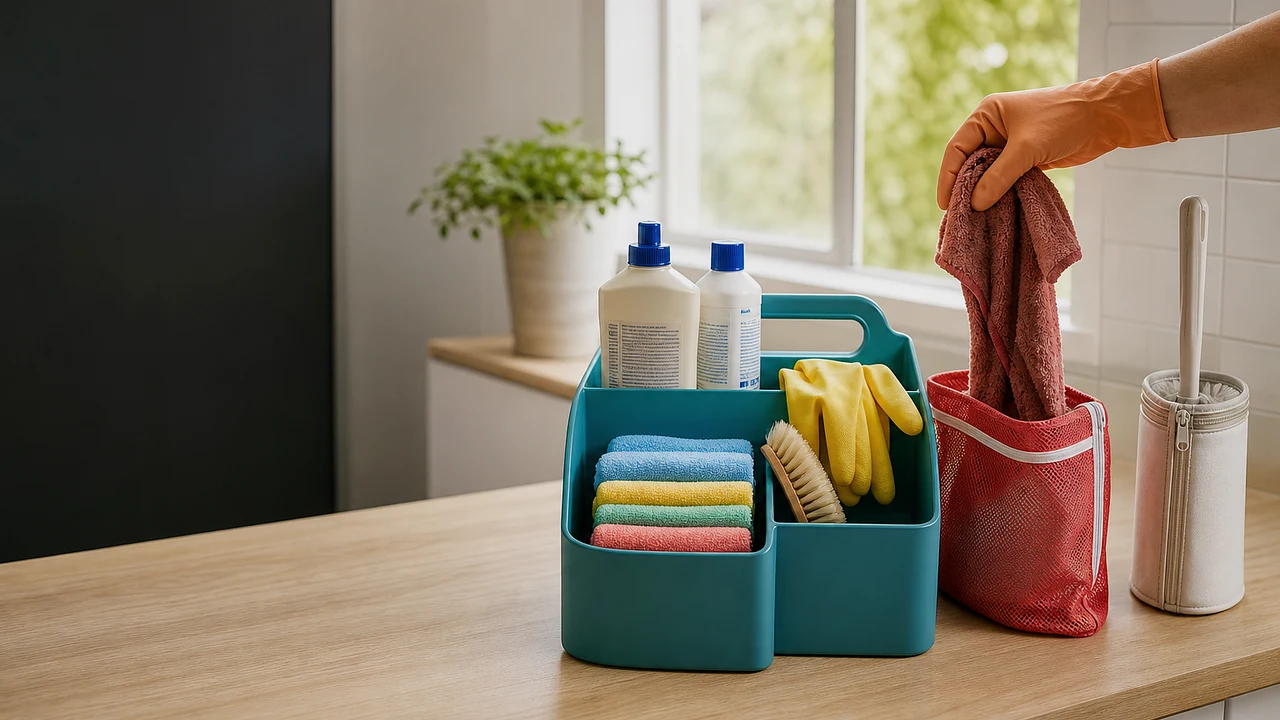
A caddy starts the job holding clean cloths, brushes and closed products. During the job, gloved hands touch taps, handles, bins, toilets and the caddy itself. Damp cloths collect soil. Brushes retain debris. If those used tools go back beside fresh supplies, the organiser becomes a return route for the material just removed.
The solution is not a bigger basket or more spray bottles. It is a one-way system. Clean tools leave one side. Used tools enter a separate washable bag or container. Nothing wet or soiled returns to the clean compartment. At the end, chemicals go back to secure storage and the caddy itself is cleaned and dried.
Build the kit around one task, not the whole supermarket
Decide the room and finish line before loading the caddy. A normal living-area pass may need a suitable detergent cleaner, several clean cloths, a small brush and waste bags. A bathroom may need a product approved for its surfaces, a dedicated toilet tool and protective equipment required by the label. A carpet spill needs absorbent white cloths and the carpet maker's treatment, not the bathroom kit.
Carrying every product in the house increases weight, label confusion and the chance that incompatible chemistry sits together. A small task-specific load also makes missing items obvious before work starts. The caddy should answer the next job, not become permanent storage for half-used products.
Start with the least complicated method that can work
For routine home surfaces, ordinary cleaning with soap or detergent is often enough. CDC household guidance says sanitising or disinfecting is usually unnecessary unless someone is sick or at higher risk. That means a general caddy does not automatically need bleach, multiple disinfectants and a different speciality spray for every room.
Use a product that is suitable for the surface and the actual soil. Add disinfection only when the situation calls for it and follow the exact label. A smaller chemical set reduces decisions without reducing the quality of the process. The useful measure is whether the surface was cleaned safely, not how many bottles travelled there.
Keep every product in its original labelled container
A small caddy does not justify decanting cleaner into an unmarked miniature bottle. The original package carries the ingredients, hazards, surface limits, dilution, first aid, storage and contact information. Australian Product Safety guidance says household chemicals should remain in their original containers and be put away immediately after use.
If a product label explicitly directs preparation of a working solution in another container, follow every instruction, including concentration, date, label and disposal. Do not improvise a soft-drink bottle, food jar or mystery spray. In a workplace, hazardous-chemical labelling and safety-data-sheet duties may apply even when the product began as a familiar household cleaner.
The label decides whether a bottle belongs in this caddy
Check the target surface, dilution, application method, ventilation, protective equipment, storage limits and prohibited mixtures before packing a product. TGA guidance says a disinfectant label should explain suitable surfaces, pre-cleaning, dilution, application and contact time. A product useful on one benchtop may damage stone, coated glass, timber or fabric.
Do not rely on bottle colour, fragrance or the word natural. US EPA's Safer Choice program can identify products whose ingredients and performance meet its standard, but any certified product still has a specific purpose and directions. Safer does not mean drinkable, universally compatible or safe to combine with another product.
Pack protective equipment for the product, not for the photograph
Gloves, eye protection or other equipment should come from the label, the safety data sheet where relevant and the task's real splash or exposure risk. TGA consumer guidance recommends care with hazard warnings, good ventilation and appropriate gloves for disinfecting. Safe Work Australia points workers to labels and safety data sheets for handling, storage, first aid and required controls.
One pair of reusable gloves is not automatically suitable for every chemical, and damaged gloves do not protect the user. Inspect them, keep the inside clean and dry, and follow the maker's cleaning and replacement instructions. Wash hands after removing gloves. Do not store contaminated gloves against fresh cloths simply because both items fit the same compartment.
Carry enough clean cloths to finish without turning back
The strongest lesson from healthcare caddy guidance is the separation principle, not the hospital-level product list. CDC guidance recommends enough clean cloths to complete a cleaning session and a distinct place for soiled cloths. A household can use the same logic without pretending an ordinary home is an intensive-care unit.
Estimate the number of zones before starting. A kitchen, general surfaces, bathroom fittings and toilet area should not depend on one increasingly dirty cloth. Pack extras rather than rinsing a heavily used cloth in a handwashing sink and returning it to the clean pile. Once a cloth is visibly soiled, dry, damaged or assigned to a higher-risk area, retire it to the used bag.
A folded cloth has several clean working faces, not infinite life
Folding a cloth into quarters creates multiple controlled faces. Wipe a small area, turn to a clean face and continue from cleaner surfaces toward dirtier ones. CDC environmental-cleaning procedures describe rotating and unfolding a cloth, then removing it for reprocessing when all sides are used or it no longer carries the required solution.
That principle helps avoid repeatedly dragging the same soiled patch across new surfaces. It does not turn one cloth into a whole-house tool. Change sooner after a spill, obvious residue, a toilet area or contamination that requires a specific process. The used cloth goes into the separate bag, never under the fresh stack.
Colour coding is memory support, not decontamination
Different cloth colours can help reserve one set for toilets, another for general surfaces and another for a separate process. CDC guidance uses colour coding to reduce cross-contamination between zones. There is no universal household colour law, so the system works only when everyone using it knows the same simple map.
Write the map near permanent storage or use a small washable card. Do not create six colours nobody remembers. A red cloth is not automatically dirty, and a blue cloth is not automatically safe. Colour identifies intended use. Cleaning, laundering, complete drying and timely replacement determine whether the cloth is ready to use again.
Keep toilet tools outside the general caddy
A toilet brush, toilet cloth and any tool used around bodily-fluid contamination should not share the open compartment that holds fresh kitchen or living-area supplies. Give toilet tools a dedicated washable holder and cloth category. Carry them separately when needed and return them to their own storage zone.
Clean from less contaminated surfaces toward more contaminated ones and leave the toilet for the final part of that bathroom sequence. Do not carry a used toilet tool through the home uncovered. If vomit, faeces, blood or another body fluid is involved, stop the routine clean and use current public-health guidance for the specific contamination.
Make clean and used compartments physically different
A vague left side and right side can collapse as soon as the caddy is carried. Use a dedicated clean compartment and a separate washable zippered bag, lidded bucket or other contained route for used cloths. The used container should be easy to remove without brushing against fresh supplies.
Do not seal wet cloths for long-term storage. The bag is temporary transport to laundering or the product-specific reprocessing step. Empty it promptly. Handle used tools without touching your face, then wash hands. If the bag itself becomes soiled, clean it and dry it before the next clean load enters.
Do not let brushes, gloves and bottles cross-contaminate one another
A brush used on grout, a brush used around food preparation and a brush used on a toilet need distinct identities. Label or colour the handles if needed. Keep bristles dry before storage and replace tools that remain damaged, greasy, odorous or impossible to clean. Do not rest a wet brush across bottle caps and cloths.
Wipe bottle exteriors only as the label and manufacturer allow. Check trigger locks and caps before carrying. If a bottle leaks, remove people and animals from access and use product-specific advice rather than wrapping it in a cloth. A contaminated cloth should not become the packaging for a chemical leak.
The caddy itself needs a cleaning and drying routine
Dust, drips and hand contact collect along the handle, base and divider corners. Empty the caddy after the session. Clean it with a method compatible with its material, rinse when required and dry it completely before loading fresh cloths. CDC equipment guidance similarly says reusable cleaning equipment should be cleaned, maintained and stored dry between uses.
Inspect for cracks, sharp edges, trapped residue and a handle that may fail under weight. Replace a caddy that cannot be cleaned or carried safely. A decorative fabric basket can absorb leaks and hold dampness, while an overloaded open tote can spill. The best design is stable, washable, divided and small enough to control.
A caddy is transport, not locked chemical storage
ACCC guidance says household chemicals should be sealed, returned immediately after use and stored high and secure. Most portable caddies are open and easy to reach. Do not leave one on a bathroom floor, hallway, vehicle, cleaning trolley or bench where a child, pet or visitor can access it.
Load the products immediately before the job and unload them immediately after. Return chemicals to their original high locked storage zone. Store clean dry tools separately from chemicals when practical. The caddy should spend most of its life empty, clean and dry, not acting as an unlocked cupboard with a handle.
Home and professional cleaning do not share one legal threshold
A household using consumer products in normal quantities can usually rely on the product label. A business using larger quantities, concentrates or products in a different way may have workplace duties for labels, safety data sheets, chemical registers, training and risk controls. Safe Work Australia explicitly distinguishes incidental household-style use from more substantial workplace use.
Professional cleaners should follow the law, employer system, client requirements and current safety data sheets that apply in their jurisdiction. Do not reduce a workplace chemical system to a social-media caddy checklist. The caddy supports the approved procedure; it does not replace the risk assessment or training.
Use the sixty-second load and unload check
Before work, name the room, choose the surface-safe product, read the label, pack enough clean cloths, add the required protective equipment, attach the empty used-cloth bag and isolate any toilet tool. Confirm every cap is closed and remove personal items, food and drink from the caddy.
After work, account for every bottle, send used cloths and tools to their correct cleaning route, wash hands, return chemicals to locked storage, clean and dry the caddy and restock only clean supplies. If a chemical exposure may have occurred, keep the original label and call the Australian Poisons Information Centre on 13 11 26. Call Triple Zero on 000 for collapse, breathing difficulty, seizure or immediate danger.
Sources and further reading
- US CDC: Cleaning supplies, caddies, colour coding and clean-soiled separation ↗
- US CDC: Cloth faces, clean-to-dirty order and reprocessing used tools ↗
- US CDC: When cleaning is enough in an ordinary home ↗
- Australian Department of Health: Cleaning before disinfection in the community ↗
- Therapeutic Goods Administration: Appropriate use of disinfectants ↗
- Safe Work Australia: Hazardous cleaning products, labels and safety data sheets ↗
- Safe Work Australia: Understanding safety data sheets ↗
- WorkSafe Queensland: Cleaning products, wet work and skin exposure ↗
- US EPA: Ventilation and label directions during cleaning ↗
- US EPA: Safer Choice product and ingredient standard ↗
- ACCC Product Safety: Chemical and poison risks for children ↗
- ACCC: Child-resistant closures do not replace secure storage ↗
- Queensland Poisons Information Centre: Household poisons and first aid ↗
- US CDC: Manufacturer instructions for dilution, compatibility, storage and disposal ↗
This article was written for Curiosity Desk. We do not copy other publishers or invent quotes. If a material error is found, we correct it openly.
Read the full standards →One answer should lead to a better question
Bring your curiosity to the group
Curious Minds is our public Facebook community for surprising science, strange history, Australian wildlife and everyday questions. No copied posts, no personal-friend invitations and no link dumping.
- Three self-contained discussion prompts each week
- Sourced answers and honest uncertainty
- Respectful conversation without spam