The decision boundary
When VAR can and cannot intervene
- Clearly wrong second yellow shown
- VAR may assist because the second caution has produced a red card and sending-off.
- Possible second yellow missed
- VAR cannot intervene merely to award the caution the referee did not show.
- Ordinary first yellow
- VAR does not review a normal caution just because replay suggests another decision.
- Final decision
- The referee remains the final decision-maker after VAR information or an on-field review.
The 2026/27 change is a narrow safeguard against a clearly incorrect dismissal, not permission to re-referee every yellow-card incident.
Can VAR review a second yellow card?
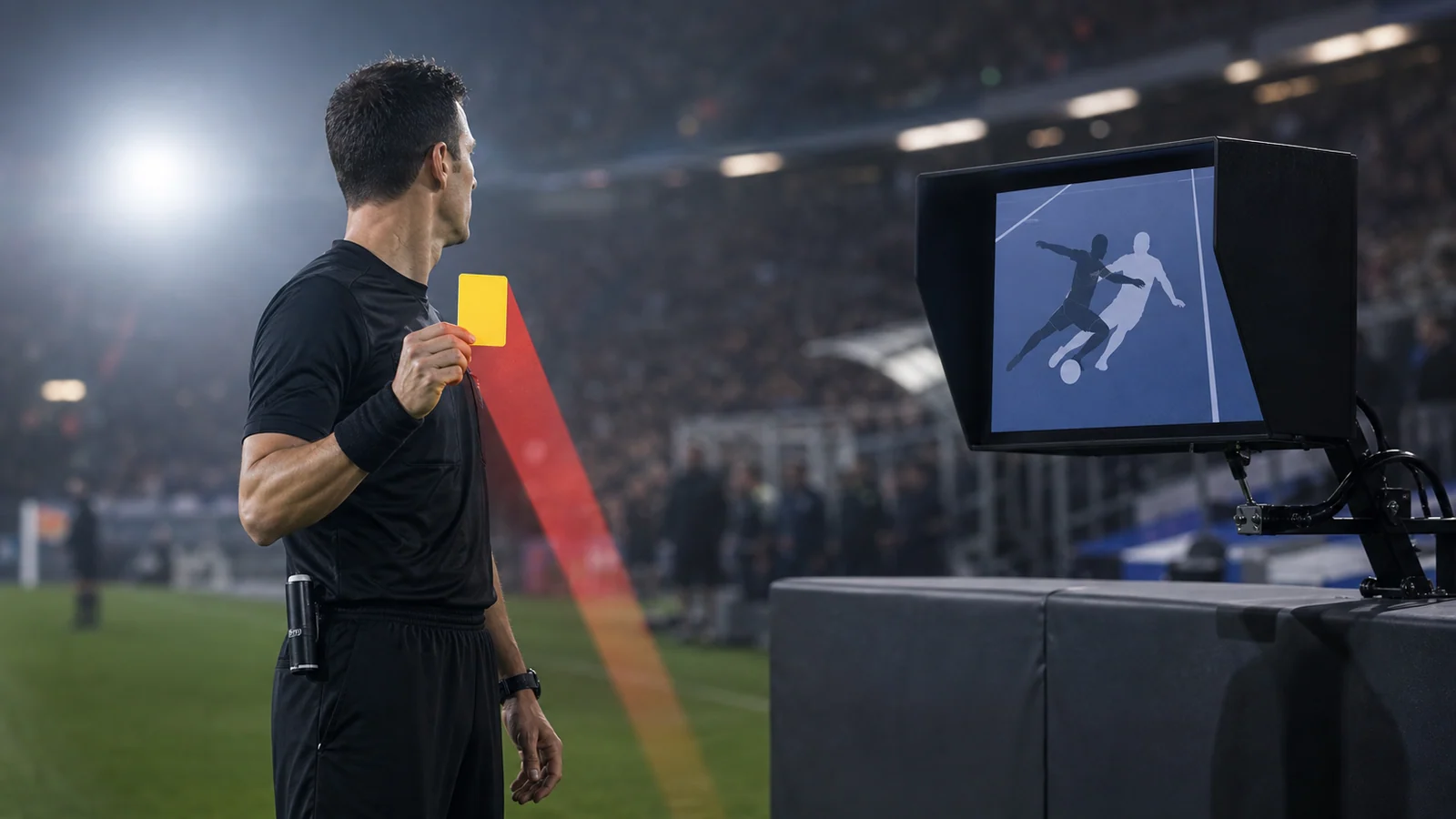
Yes, but only in one tightly defined direction. Under the 2026/27 Laws of the Game, VAR may assist when a referee has shown a clearly incorrect second yellow card and that card has resulted in the player being sent off.
VAR cannot intervene simply because replay suggests the referee missed a challenge that might have deserved a second yellow. The new power corrects a clearly wrong dismissal; it does not turn every cautionable incident into a video-review decision.
Why a second yellow differs from a direct red
A player who receives two yellow cards in one match is shown a red card and sent off. The sending-off is the consequence of two cautions. A direct red card is a separate judgement that an offence itself deserves immediate dismissal.
VAR has long focused on match-changing categories such as goals, penalties and direct red cards. The 2026 change recognises that a clearly wrong second caution also changes a match by removing a player, while keeping the review test deliberately narrow.
Can VAR overturn a second yellow card?
IFAB gives the example of an attacker wrongly receiving a second yellow after a defender pretends to have been fouled. VAR may recommend a review, the referee may cancel the second yellow and resulting red, and the actual act of simulation can then be punished.
The original decision is not overturned just because replay offers another plausible interpretation. The protocol retains the clear-and-obvious-error threshold, and the referee makes the final decision after receiving VAR information or conducting an on-field review.
Can VAR give a yellow card the referee missed?
If a player who already has a yellow commits a possible second caution and the referee misses it, VAR cannot step in merely to create that second yellow. IFAB's current protocol answers this scenario directly: a potential missed second caution is outside the new intervention.
That asymmetry is intentional. Video review may rescue a player from a clearly incorrect dismissal, but it does not monitor every ordinary booking decision. Expanding review to every yellow card would create many more stoppages and subjective re-refereeing.
What the 2026 final does and does not prove
FIFA's official final report records that Argentina's Enzo Fernández was sent off after receiving a second yellow near the end of normal time. That fact explains why many viewers searched for the updated VAR rule after the match.
The match report does not say the dismissal was produced, checked or confirmed through this new VAR provision. It would therefore be wrong to use the existence of the card as proof of a particular review process. The rule and the match event should be kept separate unless officials publish more detail.
The simplest way to remember the boundary
Think correction, not detection. VAR can correct a clearly wrong second yellow that has already caused a red card. It cannot detect and award a second yellow that the on-field referee never gave.
That one sentence avoids two common mistakes: claiming second yellows are completely unreviewable, and claiming VAR can now review every yellow-card challenge. Neither description matches the 2026/27 protocol.
Sources and further reading
This article was written for Curiosity Desk. We do not copy other publishers or invent quotes. If a material error is found, we correct it openly.
Read the full standards →One answer should lead to a better question
Bring your curiosity to the group
Curious Minds is our public Facebook community for surprising science, strange history, Australian wildlife and everyday questions. No copied posts, no personal-friend invitations and no link dumping.
- Three self-contained discussion prompts each week
- Sourced answers and honest uncertainty
- Respectful conversation without spam