Semi-automated does not mean referee-free
The 2026 World Cup used an advanced form of semi-automated offside technology to identify player positions and speed up clear decisions. It did not replace the referee, rewrite the offside law or decide every disputed situation by computer.
The system was strongest at the geometric part of the problem: where eligible parts of a player's body were when a teammate played the ball. Human officials remained responsible for the legal and contextual question of whether that position became an offside offence.
The stadium tracked movement in three dimensions
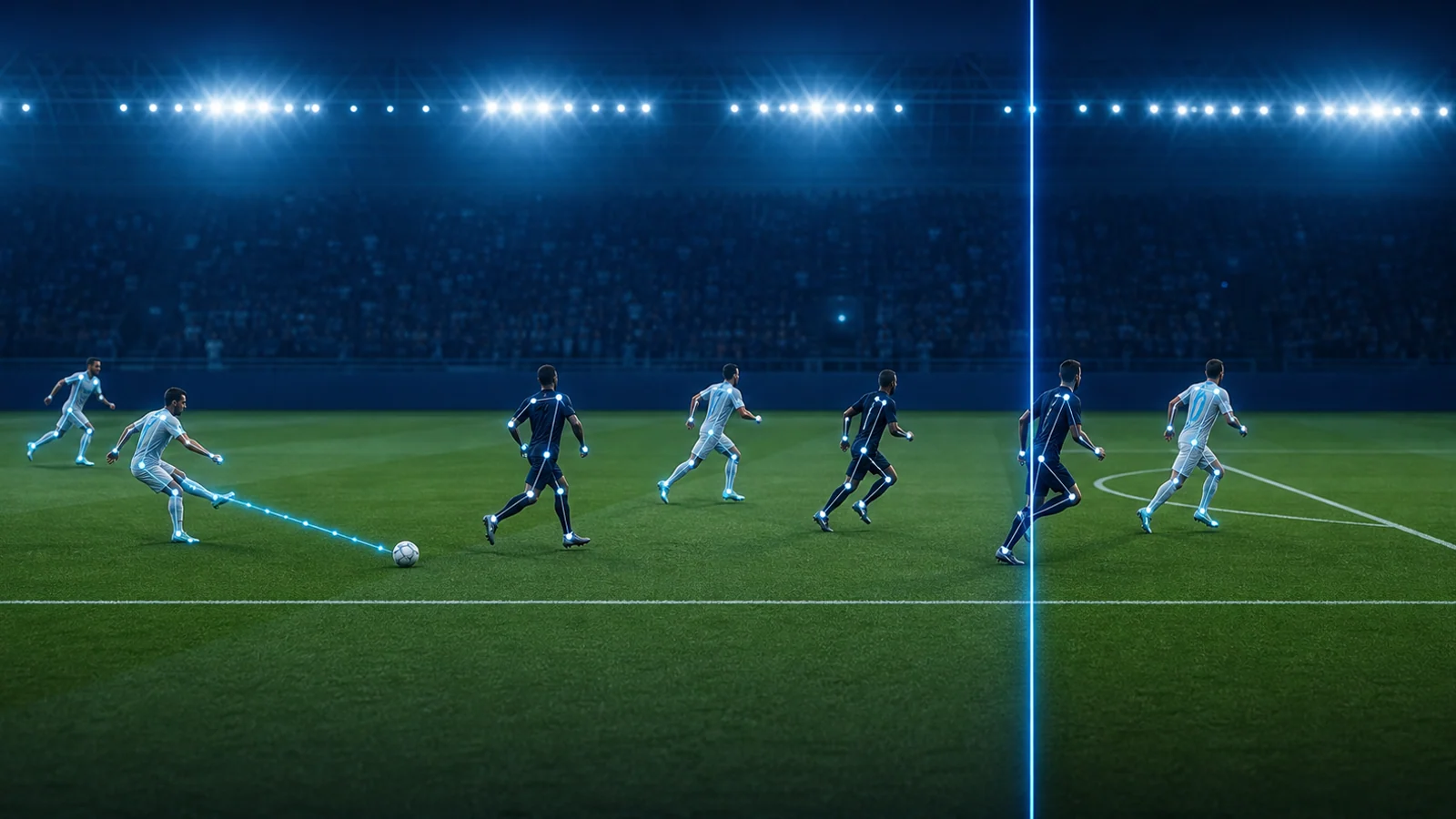
FIFA said each of the 16 tournament stadiums used 16 optical tracking cameras. Together they produced more than 150 million tracking data points per match, allowing the movement of players and the ball to be reconstructed in three dimensions.
Every participating player was also 3D scanned before the tournament. Those scans created recognisable digital avatars for the decision system and for broadcast replays, making it easier for viewers to see which body positions were being compared.
Clear positional offsides reached the field faster
At the 2022 World Cup, semi-automated information was sent to the video assistant referee. FIFA said the advanced 2026 version could send clear positional offsides directly to match officials on the field, allowing an assistant referee to flag sooner.
The practical goal was to reduce the long period in which play continued after an offside position had already occurred. Faster alerts could shorten uncertainty and reduce the risk of a player being injured during action that would later be cancelled.
Law 11 still decides when position becomes an offence
Being in an offside position is not itself an offence. Under Law 11, the player must become involved in active play by touching the ball, interfering with an opponent or gaining an advantage from particular rebounds, deflections or saves.
Hands and arms are excluded when determining position. The relevant moment is generally the first point of contact when a teammate plays or touches the ball. Technology can help locate bodies at that instant, but it cannot remove the need to interpret the next action.
Interference is the hard human judgement
A player can affect a goalkeeper without touching the ball by blocking the line of vision or clearly attempting to play a nearby ball in a way that affects the opponent. Those are contextual decisions rather than simple coordinate comparisons.
FIFA specifically said the faster automated signal was limited to positional offsides. For possible interference, officials could use the 3D reconstruction to examine whether a player blocked the goalkeeper's view, but the final judgement still belonged to the match officials.
Why the animated replay is not the decision itself
The broadcast graphic explains a decision after tracking data and officiating have been combined. It is a communication layer, not a separate robot referee. The recognisable avatars and reconstructed lines help viewers understand which players and body parts were involved.
The most accurate description is therefore a partnership: cameras and models measure position at enormous speed, the system moves clear information to officials, and humans apply the parts of Law 11 that depend on involvement, interference and the sequence of play.
Sources and further reading
This article was written for Curiosity Desk. We do not copy other publishers or invent quotes. If a material error is found, we correct it openly.
Read the full standards →One answer should lead to a better question
Bring your curiosity to the group
Curious Minds is our public Facebook community for surprising science, strange history, Australian wildlife and everyday questions. No copied posts, no personal-friend invitations and no link dumping.
- Three self-contained discussion prompts each week
- Sourced answers and honest uncertainty
- Respectful conversation without spam