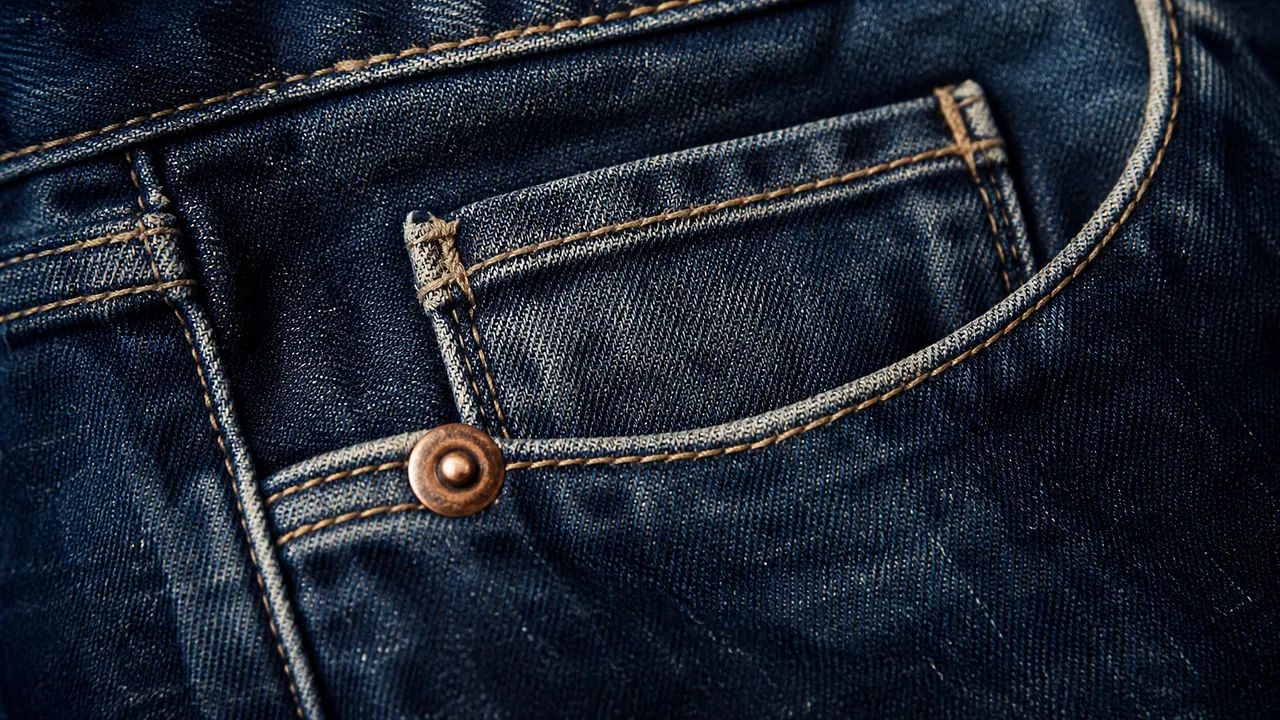
See the mechanism
Two details, two jobs, one durable garment
Workwear fails at stress points
Pocket corners and seams take repeated loads, so miners and labourers needed trousers that resisted tearing.
Rivets reinforce the join
Copper rivets spread and secure the connection at vulnerable points where stitching alone could pull apart.
The small pocket carries time
The compact front pocket was sized for a watch carried on the body before wristwatches became ordinary.
The pattern becomes identity
Manufacturing continuity and cultural recognition kept both features after daily tools and clothing habits changed.
Two strange details share one workwear origin
Look closely at a typical pair of blue jeans and two features seem oddly permanent. Copper-coloured studs sit at the corners of the pockets, and a miniature pocket is stitched inside the larger right front pocket. Most wearers no longer need either feature for its original purpose, yet manufacturers continue to reproduce them because they belong to the design language of jeans.
The metal pieces are rivets. They reinforce places where repeated pulling can make a stitched seam start to open. The small pocket was created for a pocket watch, an everyday object in the late nineteenth century. Together they reveal what jeans were before they became global casual clothing: durable trousers organised around the tools, strain and possessions of working life.
The original problem was thread under repeated strain
Tailor Jacob Davis developed the reinforcement idea and worked with dry-goods merchant Levi Strauss to patent it. Their US Patent No. 139,121 was issued on 20 May 1873 for an improvement in fastening pocket openings. The patent explains that pocket seams could rip or start because hands and carried objects repeatedly placed pressure on the ends of the opening.
The solution was mechanically simple. A metal rivet or eyelet passed through the layers of cloth at a high-stress point and was headed on both sides. This bound the pieces together so that the force did not fall only on the sewing thread. A rivet did not make fabric indestructible, but it made a small vulnerable corner much harder to pull apart.
Why the rivets sit where they do
A pocket opening behaves differently from the middle of a flat panel. Each time a hand enters, the edge bends and the corner concentrates the load. Heavy objects increase the pull. A seam can remain intact along most of its length while beginning to separate at that endpoint. Placing a rivet at the corner spreads the load through metal and several layers of cloth.
This explains why jeans do not need rows of rivets everywhere. More hardware would add weight, cost and discomfort without solving a new problem. The useful locations are the points where seams change direction or receive repeated pressure. Modern bar-tack stitching can provide reinforcement too, but visible copper rivets remain both functional hardware and a recognisable historical signature.
The tiny pocket once held a pocket watch
Levi Strauss & Co.'s archive identifies the small pocket on the right front as a watch pocket. Pocket watches were common possessions when the first riveted waist overalls were made. The small compartment kept a watch from moving around with coins, tools or other objects in the larger pocket and made it easier to reach.
Its position also gave the watch pocket its own reinforced corners. The object it served later changed. Wristwatches became ordinary, and people began using the pocket for coins, tickets, keys, guitar picks or nothing at all. The feature survived because a familiar garment can keep a historic function as a visual cue even after everyday behaviour moves on.
It was not originally the fifth pocket
The miniature compartment is often called the fifth pocket, but that name confuses the sequence. Company archive records say the original riveted trousers had two main front pockets, the watch pocket and one rear pocket. That makes four. The second rear pocket was added in 1901, and it was the actual fifth pocket to join the design.
The mistake persists because modern jeans present five visible compartments, and the smallest one feels like an extra. Its scale makes it look like a later novelty. In reality, it reaches back to the earliest layout. The pocket that appears least useful today is one of the oldest surviving parts.
Some rivets disappeared or moved out of sight
Hardware that protects cloth can create a different problem. Exposed back-pocket rivets scratched saddles and furniture, so Levi Strauss & Co. began covering them in 1937. The company later replaced those concealed back-pocket rivets with bar-tack stitching after the metal could still wear through. During the Second World War, watch-pocket rivets were also removed to conserve metal.
These changes show that the design was never frozen. Manufacturers balanced strength, comfort, material supply and damage to surrounding objects. The famous front rivets remained visible because they performed well and helped people recognise the garment. Other reinforcements became hidden in stitching while the overall five-pocket pattern stayed familiar.
A repair idea became a worldwide visual language
The first claim was practical: stop pocket seams from tearing under pressure. The long-term result was cultural. Jeans moved from workwear into leisure, music, youth culture, uniforms and fashion. People who never carry a pocket watch still expect the small compartment. People doing light office work still recognise copper rivets as a sign that trousers are jeans.
That is why the details have lasted. They are not random decoration, and they are not proof that every modern pair is constructed exactly like an 1873 garment. They are visible fossils of a successful engineering decision. One reinforces the point where cloth failed. The other protects an object that most wearers no longer own. Both make the history readable without a label.
Evidence boundary
What the evidence supports—and where it stops
Patent, manufacturer and museum histories connect riveted stress points to early workwear and identify the small original pocket as a watch pocket in the five-pocket design.
Modern jeans vary in construction and the tiny pocket has acquired new uses. Survival of a feature explains design continuity; it does not mean every present-day pair is made exactly like an 1870s garment.
Sources and further reading
This article was written for Curiosity Desk. We do not copy other publishers or invent quotes. If a material error is found, we correct it openly.
Read the full standards →One answer should lead to a better question
Bring your curiosity to the group
Curious Minds is our public Facebook community for surprising science, strange history, Australian wildlife and everyday questions. No copied posts, no personal-friend invitations and no link dumping.
- Three self-contained discussion prompts each week
- Sourced answers and honest uncertainty
- Respectful conversation without spam