The short answer is hidden in the shape
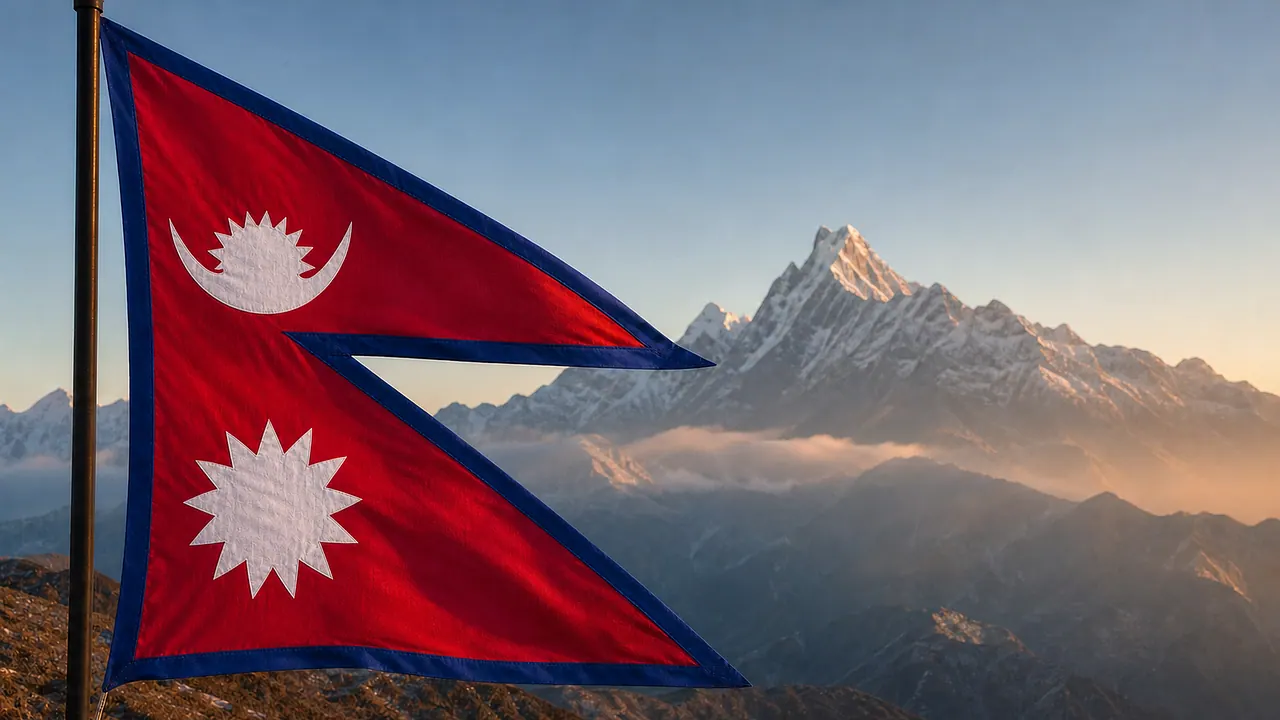
Nepal's national flag is formed from two joined triangular pennants, one above the other. It is commonly described as the world's only non-rectangular national flag. A more exact description is that it is the only current national flag whose outline is not a quadrilateral. Switzerland and Vatican City use square flags, but a square still has four straight sides. Nepal's flag has the indented outline of a double pennant.
The design is not an informal exception that printers are free to approximate. Article 8 of Nepal's 2015 Constitution describes a crimson base with deep-blue borders, a white crescent-moon emblem in the upper section and a white twelve-rayed sun in the lower section. Schedule 1 then gives a detailed construction method using lines, arcs and measured points. The unusual outline is part of the law.
It began as pennants, not as a damaged rectangle
Modern flag charts make a rectangle look like the natural starting point, so Nepal's flag can appear to be a rectangle with a triangular bite removed. Historically, that reverses the story. Pennants and triangular banners have long been used across South Asia. Nepal retained a double-pennant form while rectangular national flags became the international norm.
This is why the flag is best understood from the pole outward. Two pointed banners share one vertical edge. The upper pennant is smaller, while the lower one projects farther. Joining them creates the familiar five-cornered outline with an inward notch. The geometry is not decorative trimming around a rectangular field. It is the structure from which the entire flag is built.
The constitution works like a drawing algorithm
Schedule 1 does something rare in constitutional text: it teaches the reader how to draw a national symbol. The instructions begin with a crimson cloth, establish a lower line, raise a perpendicular line from the hoist and mark points that determine the two triangular portions. Additional arcs construct the moon and sun. A border of prescribed proportion is added around the shape.
Following the method produces proportions that are less convenient than a simple two-to-three rectangle. That inconvenience is evidence of precision, not a mistake. A casual designer who squeezes the flag into a standard box, moves the notch or substitutes generic clip-art symbols is not merely changing the style. The designer is changing a geometry that Nepal has formally specified.
The moon and sun are also precisely defined
The upper white emblem is not a generic crescent pasted onto the cloth. The constitutional construction describes the crescent and a group of eight visible rays. The lower emblem is a white sun with twelve rays. Older forms of the emblems were sometimes shown with faces, but the modern design uses the simplified celestial forms.
Popular explanations often say the sun and moon express a wish that Nepal will endure as long as those celestial bodies. Other interpretations connect the moon with the Himalayas or calmness and the sun with the warmer southern lowlands or resolve. These readings are culturally familiar, but the safest factual distinction is important: the constitution defines what must appear, while not every circulating explanation has the same legal status.
Crimson and blue carry national meaning
The field is crimson, Nepal's national colour, and is commonly linked with courage and the country's rhododendron. A deep-blue border surrounds the double pennant and is widely associated with peace. White makes the two celestial emblems visible against the red field. Together the colours create one of the most recognisable national designs even when the flag is seen at a small size.
The border matters to the outline. On a rectangular flag, an inaccurate border may look like a printing flaw. On Nepal's flag, the blue edge visually explains the two connected pennants and preserves the notch between them. Removing or thickening it carelessly changes how the shape is read.
The modern standard preserved an older identity
Nepal adopted the modern standard in 1962, and the 2015 Constitution retained the form. The standardisation did not invent a novelty for international attention. It formalised a flag tradition already associated with Nepal and removed uncertainty about proportions and emblems. That distinction helps explain why the design survived pressures toward uniform rectangular flags.
National flags have to work on buildings, uniforms, documents, ships, websites and international displays. Standard shapes are easier to manufacture and align. Nepal accepted the practical complexity because the double pennant had become part of the country's identity. The result shows that global standardisation can be strong without being complete.
Why the flag remains such a powerful curiosity
The usual viral fact is true but incomplete: Nepal has the only national flag that is not rectangular or square. The more interesting fact is that the shape is not random. It carries an older banner tradition into a modern constitutional system, complete with a reproducible geometric method. What looks like an exception is actually continuity.
That changes the question. Instead of asking why Nepal refused to use a rectangle, ask why most other states converged on one. Rectangles are convenient, familiar and compatible with maritime and European flag traditions. Nepal's flag makes the alternative visible. Two pennants, carefully joined and measured, can represent a modern country without fitting the template used by everyone else.
Sources and further reading
This article was written for Curiosity Desk. We do not copy other publishers or invent quotes. If a material error is found, we correct it openly.
Read the full standards →One answer should lead to a better question
Bring your curiosity to the group
Curious Minds is our public Facebook community for surprising science, strange history, Australian wildlife and everyday questions. No copied posts, no personal-friend invitations and no link dumping.
- Three self-contained discussion prompts each week
- Sourced answers and honest uncertainty
- Respectful conversation without spam