The first surviving photograph barely looks like one
Joseph Nicéphore Niépce's View from the Window at Le Gras shows rooftops, a courtyard and distant land seen from an upstairs room in France. The image is faint, silvery and difficult to read. Buildings seem to receive light from more than one direction. Yet this modest plate is generally described as the earliest surviving camera-made photograph from nature.
Niépce made it around 1826 or 1827. France is marking 2026 as the bicentennial period of photography, while museums and historians still use cautious dates because the experiment was not documented like a modern laboratory test. What matters is that the image survived. Earlier attempts to let light draw a scene had a habit of disappearing.
The hardest problem was not forming an image
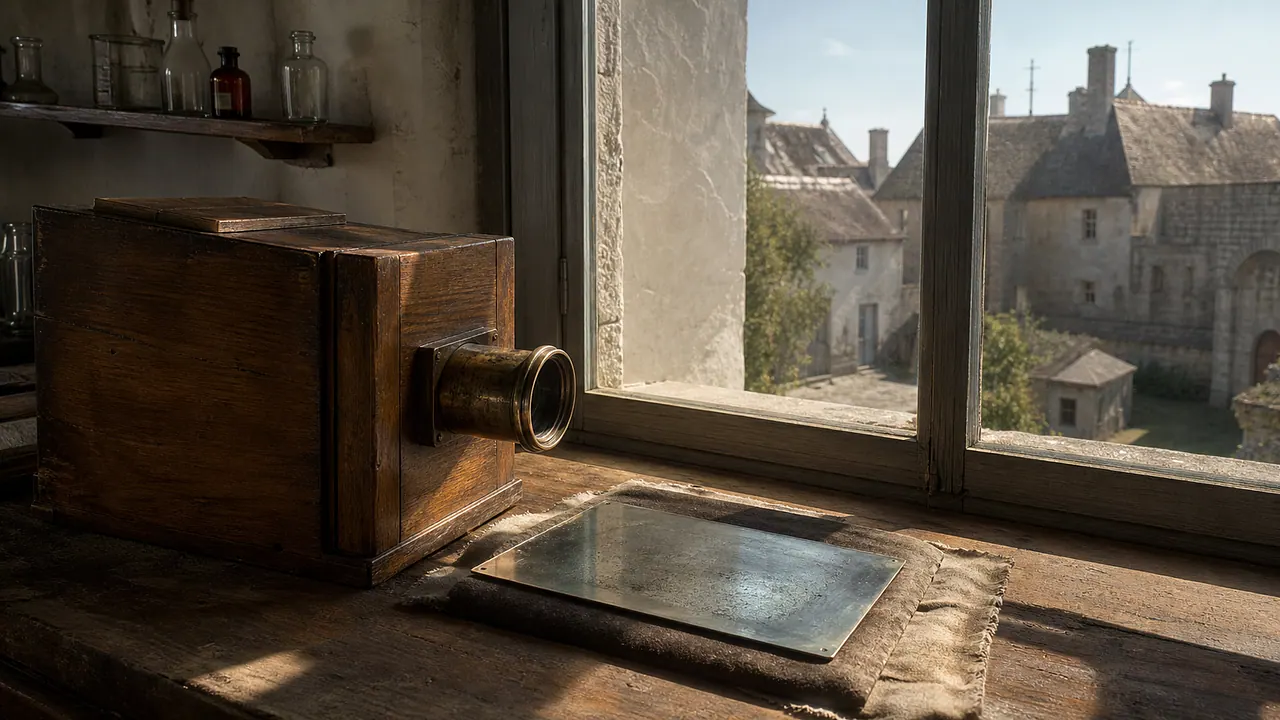
A camera obscura could project an outdoor scene centuries before Niépce. Light passing through a small opening creates an inverted image on the opposite surface. Artists used such devices as drawing aids. The challenge was finding a material that would react to the projected light and then stop reacting when the camera was opened.
Silver compounds could darken in light, but an unfixed image kept changing until the whole surface became dark. A useful photograph needed two stages: exposure had to create differences across the surface, and processing had to make those differences permanent enough to view in ordinary light. Niépce's breakthrough was a workable, if painfully slow, answer to the second problem.
He coated pewter with a material used in asphalt
Niépce polished a pewter plate and coated it with bitumen of Judea, a naturally occurring asphalt-like substance. Light makes the coating harder and less soluble. Inside the camera, brighter areas of the projected scene hardened the bitumen more strongly, while darker areas left it softer.
After exposure, Niépce washed the plate with a solvent mixture that removed more of the softer coating. The remaining pattern revealed the image through differences between the bitumen and reflective metal. He called the process heliography, or sun writing. It created a direct image on the plate rather than a flexible negative from which unlimited positive prints could easily be made.
Why did the exposure take so long?
Bitumen is extraordinarily insensitive compared with later photographic materials. The camera lens admitted only a limited amount of light, and the projected image had to harden enough coating to survive washing. Niépce therefore left the plate exposed for many hours. The familiar claim of an eight-hour exposure is often repeated, but scholars have questioned the exact duration and some estimates are longer.
The picture itself provides a clue. Sunlight appears to strike more than one side of the buildings, as if the sun travelled across the sky while the plate remained in the camera. A modern camera freezes one brief arrangement of light. Niépce's camera accumulated changes from a large part of the day, possibly over an even longer interval.
The image changes as the viewer moves
View from the Window at Le Gras is not a paper print with dark ink where shadows belong. It is a thin surface pattern on reflective metal. Depending on the angle of illumination and viewing, parts of the image can appear positive, negative or almost invisible. That is one reason reproductions may look clearer or more contrasty than the object itself.
The strange appearance is not simply damage or poor artistic judgement. It follows from the process. Hardened bitumen, exposed pewter and reflected light must work together for the scene to become visible. The object sits somewhere between an etched plate, a mirror and the photographic images that came later.
First does not mean photography was finished
Niépce later worked with Louis Daguerre. After Niépce's death, Daguerre developed the daguerreotype, announced in 1839, which produced much more detailed images with shorter exposures. William Henry Fox Talbot developed paper-negative processes that made multiple positive prints possible. Photography became practical through many experiments, materials and competing systems.
This is why historians use careful phrases such as earliest surviving permanent camera photograph from nature. Other light-made images existed, and some earlier experiments may have been lost. Niépce's plate is not the first moment anyone imagined photography. It is the rare physical survivor that proves one early method succeeded.
A slow failure by modern standards changed visual history
As a camera, Niépce's system was inconvenient. It could not photograph a moving person, deliver an instant result or show the scene clearly under every light. But judging it by speed misses the key achievement. For the first time, a view formed by a camera remained on a material object long enough to enter history.
Every later improvement attacked one of its weaknesses: more sensitive surfaces shortened exposure, lenses gathered more light, negatives enabled copies, chemical fixing improved stability and digital sensors made the result immediate. The barely visible rooftops at Le Gras are powerful because they show the starting constraint. Before photographs could become effortless, inventors first had to persuade light to leave a mark that would not vanish.
Sources and further reading
This article was written for Curiosity Desk. We do not copy other publishers or invent quotes. If a material error is found, we correct it openly.
Read the full standards →One answer should lead to a better question
Bring your curiosity to the group
Curious Minds is our public Facebook community for surprising science, strange history, Australian wildlife and everyday questions. No copied posts, no personal-friend invitations and no link dumping.
- Three self-contained discussion prompts each week
- Sourced answers and honest uncertainty
- Respectful conversation without spam