See the mechanism
One atmosphere, two kinds of source
Light enters moving air
Layers of different temperature and density bend incoming light by slightly changing amounts.
A star behaves like a point
A narrow bundle is easily shifted or brightened as turbulent cells cross its path.
A planet has a tiny disc
Many adjacent light paths reach the eye from different parts of the resolved planetary disc.
Distortions average
Those neighbouring fluctuations partly cancel, so the planet usually appears steadier.
The star is steady; the moving air is not
Watch Sirius on a restless night and it can appear to pulse, jump and flash blue, green or red. The surprising part is that the ordinary twinkle is not a rapid change inside Sirius. Over those fractions of a second, the starlight arriving at the top of Earth's atmosphere is essentially steady. The flicker begins during the final journey through the air above the observer.
The atmosphere is not a single, motionless lens. It contains moving cells of air with different temperatures, densities and amounts of water vapour. Those differences slightly change the refractive index, so each cell bends incoming light by a different amount. As wind rearranges the cells, the apparent position and intensity of a star change rapidly. Astronomers call the brightness fluctuation scintillation, while the broader image motion and blurring are part of atmospheric seeing.
A point source lets one distorted path dominate
Stars are enormous, but their distance makes nearly all of them unresolved to unaided eyes and ordinary small telescopes. Sirius therefore reaches us as what looks like a single point of light. When turbulence redirects that narrow apparent image, there is no visible stellar disk beside it to supply many other independent patches of light. A small change in the path can affect a large share of what the observer sees from moment to moment.
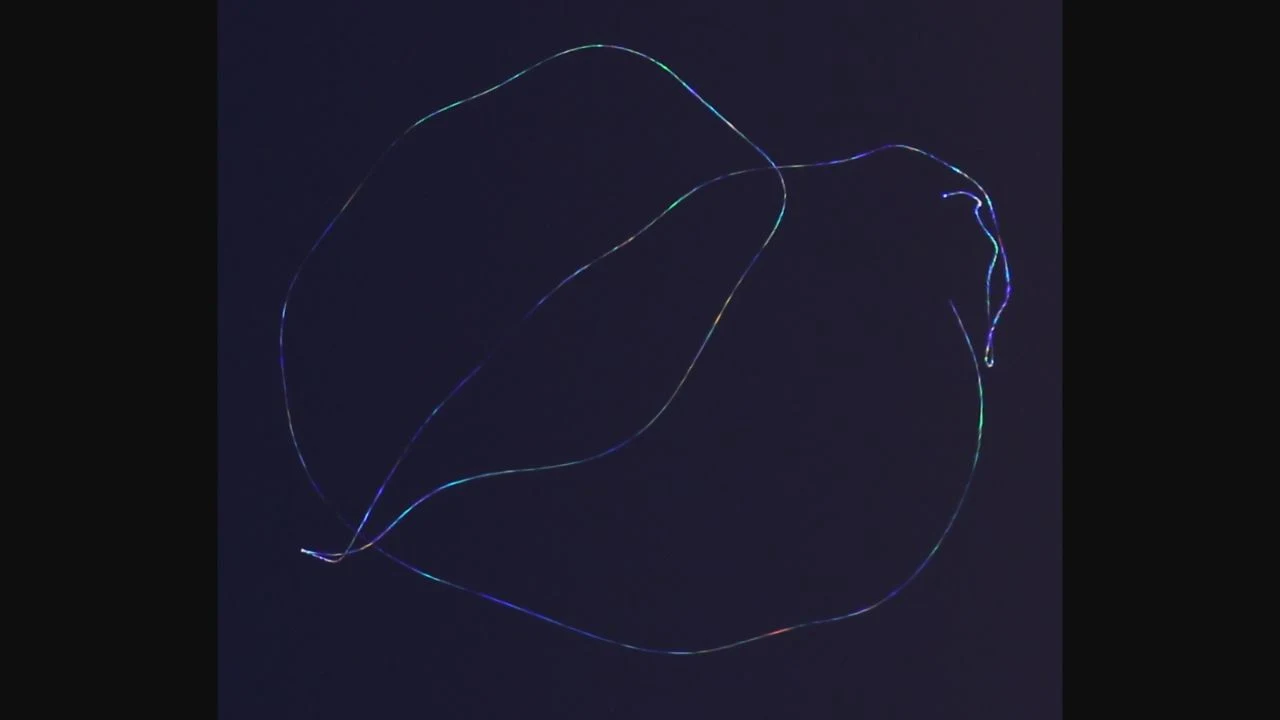
A long camera exposure does not freeze those changes. It records many displaced versions of the point and smears them together. In very short exposures through a large telescope, the image can break into a shifting pattern of bright speckles. NASA's Astronomy Picture of the Day describes these as moving subimages created by the atmosphere. The photograph on this page uses deliberate camera movement to separate Sirius's rapid colour changes into a trace; the looping line is not the star travelling across the sky.
A planet's tiny disk averages the turbulence
A planet is also far too small for its disk to look obvious to the naked eye, yet it is an extended source rather than a true point. Light leaves many adjacent parts of that tiny disk and crosses slightly different cells of air. One part may brighten while another dims or shifts in a different direction. When those contributions reach the eye together, much of the fluctuation averages out, so Venus, Jupiter and the other bright planets usually appear steadier than nearby stars.
Usually is important. A planet can twinkle when it is low in the sky, when the air is especially turbulent or when the observing conditions make its small disk comparable with the scale of the atmospheric distortion. That means steadiness is a useful clue, not a guaranteed planet detector. A bright object that flickers near the horizon has not disproved the rule; the averaging has simply become less effective under difficult air.
The horizon can turn Sirius into a colour-shifting impostor
Twinkling usually becomes stronger near the horizon because the light crosses a longer slanting path through the atmosphere. That path encounters more layers and more opportunities for turbulence to redirect it. NASA notes that Sirius is sometimes reported as a flashing unidentified object when it is low, because its brightness makes the rapid changes unusually conspicuous.
Different wavelengths of visible light are refracted by slightly different amounts. Under strong scintillation, red, green and blue components can be displaced or intensified in quick succession, producing the colour flashes seen in Sirius. The effect weakens as a star climbs higher and its light takes a shorter path through the air. Above the atmosphere there is no atmospheric twinkle at all, which is one reason a space telescope can deliver exceptionally stable stellar images.
Astronomers build machines to untwinkle the sky
Ground observatories cannot remove the atmosphere, so they first choose sites with high elevation, dry air and relatively stable conditions. They also use adaptive optics. A system measures how turbulence has distorted the light from a reference source, then changes the shape of a deformable mirror many times per second. The corrections can recover much of the sharpness that changing air would otherwise erase.
A convenient natural reference star is not always close to the object being studied. Some observatories therefore aim lasers into the upper atmosphere to excite sodium atoms and create artificial guide stars. Sensors observe how those spots are distorted and use the result to drive the mirror corrections. The lasers do not stop a real star from twinkling and the guide stars are not objects in space. They give the telescope a live measurement of the moving atmosphere, turning the nuisance that makes Sirius sparkle into something engineers can partly measure and undo.
Evidence boundary
What the evidence supports—and where it stops
Atmospheric optics and repeated observation support the point-source versus extended-disc explanation; the linked astronomy sources show the same distinction in independent educational accounts.
Usually is important. A planet low on the horizon can scintillate because its light crosses much more turbulent air, and powerful telescopes can resolve effects hidden from unaided eyes.
Sources and further reading
This article was written for Curiosity Desk. We do not copy other publishers or invent quotes. If a material error is found, we correct it openly.
Read the full standards →One answer should lead to a better question
Bring your curiosity to the group
Curious Minds is our public Facebook community for surprising science, strange history, Australian wildlife and everyday questions. No copied posts, no personal-friend invitations and no link dumping.
- Three self-contained discussion prompts each week
- Sourced answers and honest uncertainty
- Respectful conversation without spam