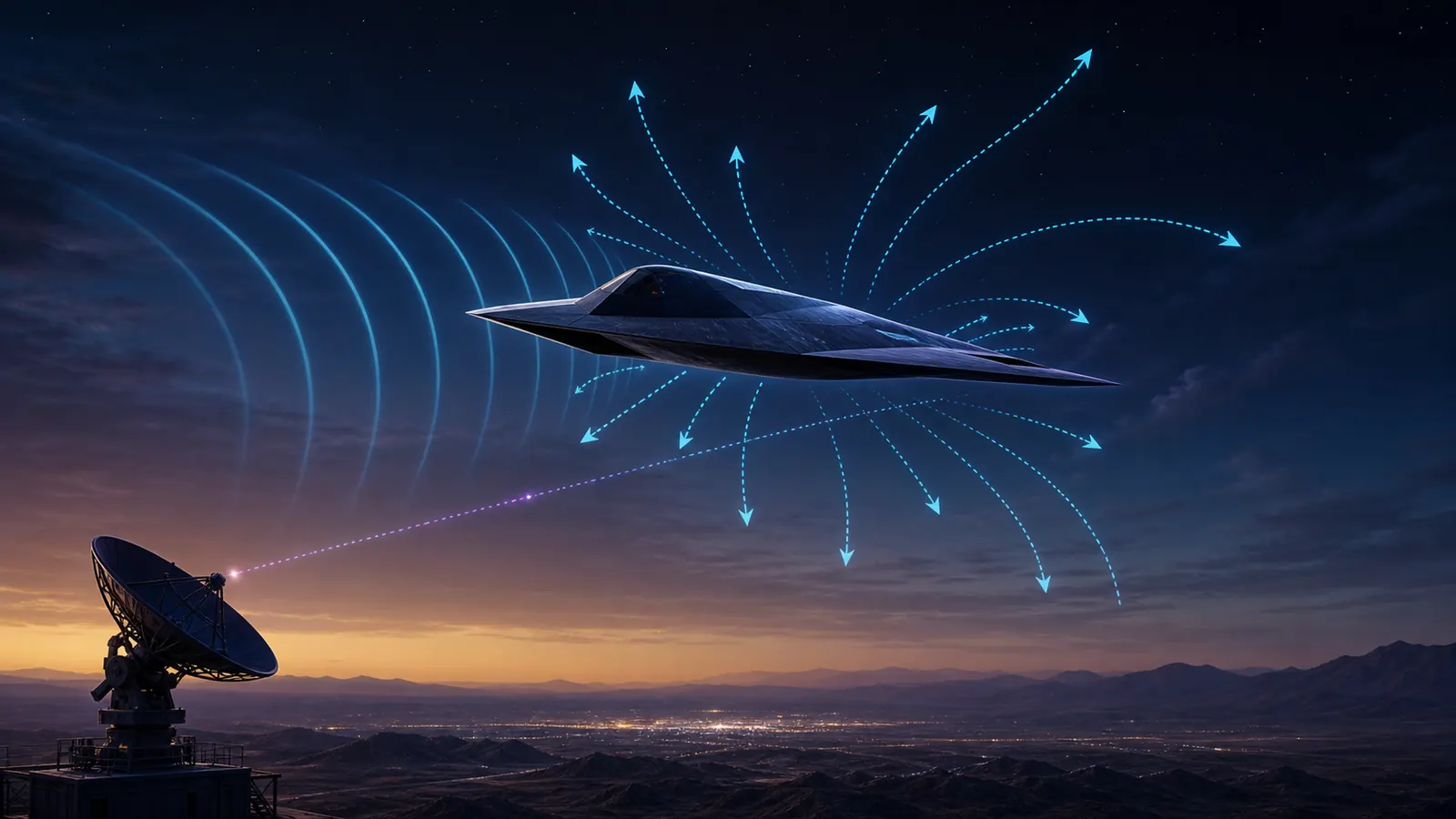
Radar asks a question and listens for how loudly the aircraft answers
A radar transmits electromagnetic energy and listens for a return. When the wave meets an aircraft, some energy reflects in many directions. The portion that arrives back at the receiver helps reveal that an object is present. Radar cross section describes how strongly a target reflects under particular conditions; it is not simply the aircraft's physical size.
A large aircraft can therefore produce a much smaller return than its dimensions suggest. Designers align surfaces and edges so strong reflections travel away from likely receivers instead of back toward them. Inlets hide reflective engine faces, sensors and weapons are integrated or carried internally, and gaps or protrusions are carefully controlled. Stealth is a property of the whole configuration, not a cloak added after an ordinary aircraft is finished.
Shape does much of the work, while materials manage what remains
Early low-observable aircraft used obvious flat facets because available computers could calculate their radar behaviour. Modern designs use smoother blended surfaces while preserving controlled angles and edge alignment. Radar-absorbent materials and structures can reduce some remaining energy, but the popular idea of one magic black paint hides a demanding system of layers, joints, coatings and tolerances.
The United States Air Force describes the F-35 as difficult to detect, track or target rather than invisible. It attributes low observability to the exterior contours, composite panels and radar-absorbent material together. Maintenance matters because a damaged coating, poorly fitted panel or open access point can change a carefully managed signature. The aircraft has to remain stealthy after rain, heat, vibration and repeated missions.
One radar view is not every radar view
Radar return changes with angle, frequency, polarisation, distance and configuration. A surface that redirects energy from a receiver in front may behave differently when observed from the side or by separated transmitters and receivers. Opening a weapons bay, carrying an external store or exposing a reflective component can create a temporary increase. Designers try to control signatures across useful aspects, but exact performance is sensitive and often classified.
This is why statements such as 'radar detected it' need context. Initial awareness, a stable track, identification and a targeting-quality solution are not identical achievements. A sensor may notice an uncertain return without maintaining the precision needed for another system to act. Stealth aims to shorten detection range, disrupt tracking and reduce the time available to respond. It does not require every radar screen to remain perfectly blank.
An aircraft leaves more than one kind of footprint
Radar is only part of observability. Engines and surfaces emit heat. Condensation can form a visible trail. An aircraft produces sound and may transmit radio energy. Mission planners combine low-observable design with altitude, routing, electronic warfare and disciplined communications. A design that reduces one signature may face trade-offs in aerodynamics, cost, cooling or maintenance.
Future detection systems will keep changing frequencies, geometry, networking and processing, while aircraft designers respond with new shaping, materials and tactics. There is no final invisible plane and no single radar that erases stealth as an idea. The enduring contest is about information: how far away can a defender form a reliable picture, how long can it hold that picture, and how much freedom remains for the aircraft before the faint echo becomes a usable track?
Detection, tracking and targeting are three different victories
A sensor may register that something unusual exists without locating it precisely enough to follow. A network may then combine several weak observations into a track, but a weapon system still needs timely, accurate information to engage. Stealth is useful when it delays or breaks that chain. It does not have to create a blank radar screen; even shrinking reliable detection distance can reduce the defender's time to understand and respond.
That is also why dramatic claims about one radar frequency deserve caution. Lower-frequency systems may interact differently with an aircraft's shape and help indicate a presence, while higher-resolution tracking and guidance impose other requirements. Public information cannot reveal every classified capability, so honest explanations must stop at the physics and documented design principles. The future will be measured not by invisibility, but by how long a faint return remains too uncertain to use.
Sources and further reading
This article was written for Curiosity Desk. We do not copy other publishers or invent quotes. If a material error is found, we correct it openly.
Read the full standards →One answer should lead to a better question
Bring your curiosity to the group
Curious Minds is our public Facebook community for surprising science, strange history, Australian wildlife and everyday questions. No copied posts, no personal-friend invitations and no link dumping.
- Three self-contained discussion prompts each week
- Sourced answers and honest uncertainty
- Respectful conversation without spam