One atmosphere creates two apparently opposite colours
At noon, look away from the Sun and the clear sky is blue. Near sunset, look toward the Sun and the remaining direct light can be orange or red. These are not two unrelated effects. Both begin when white sunlight enters Earth's atmosphere and encounters molecules far smaller than the wavelengths of visible light.
The useful distinction is where the light has travelled. The blue sky is mostly sunlight that has been redirected into your line of sight. The red sunset is mostly the part of the direct beam that survived a much longer journey through air. The atmosphere has not dyed either scene. It has sorted the light by wavelength and direction.
Tiny molecules redirect short wavelengths most strongly
Sunlight contains a continuous range of visible wavelengths. Red light sits toward the longer-wavelength end; blue and violet sit toward the shorter end. When light meets particles much smaller than its wavelength, Rayleigh scattering applies. Its strength rises very steeply as wavelength gets shorter, so air molecules scatter blue light several times more efficiently than red light.
That scattered blue arrives from across the sky, which is why empty air appears coloured even though the darkness of space lies beyond it. The Sun itself still sends a mixture of wavelengths along the direct path. This also explains why the sky would look black from an airless world: without a substantial atmosphere, there is little material available to redirect sunlight toward an observer looking away from the Sun.
Violet scatters even more, so why is the sky not purple?
A simple Rayleigh calculation might seem to predict a violet sky because violet wavelengths are shorter than blue. What we perceive is the result of more than the scattering curve. The spectrum of sunlight reaching the ground is not equally strong at every visible wavelength, some violet is absorbed during the journey through the upper atmosphere and human eyes are much less sensitive to deep violet than to blue and green.
Those factors combine with the overlapping responses of the eye's colour receptors, so the broad daylight sky is normally perceived as blue. Near the horizon it often becomes pale or almost white. Light arriving from that direction crosses more air, is scattered more than once and mixes with light redirected by aerosols and the ground, reducing the deep blue saturation seen higher overhead.
Sunset lengthens the path and filters the direct beam
When the Sun is high, its light reaches the ground along a relatively short path through the dense lower atmosphere. When the Sun approaches the horizon, the path becomes long and slanted. More of the blue and violet wavelengths are scattered away from the direct line between the Sun and your eyes. The surviving beam is therefore weighted toward yellow, orange and red.
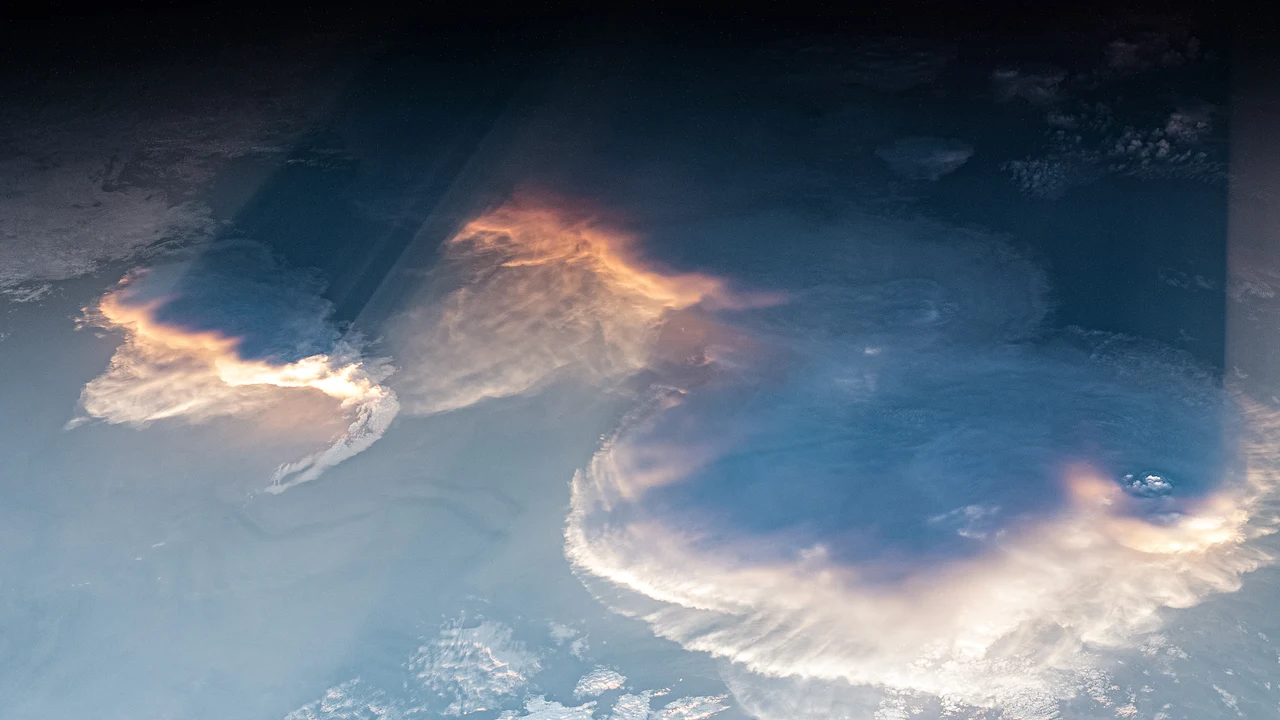
The blue light has not been destroyed. Much of it has been redirected elsewhere in the sky. This is why the same event can place cool colour above you and warm colour near the horizon. NASA's ISS photograph on this page captures low-angle sunlight, bright clouds and long crepuscular shadows from above the Arabian Peninsula. The rays look as if they spread outward, although they are nearly parallel beams made visible by perspective and scattering.
Dust, smoke and clouds change the result, but not in one simple way
Air is never made only of nitrogen and oxygen molecules. It also contains aerosols such as sea salt, dust, smoke and pollution, plus water droplets and ice crystals in clouds. Their sizes and compositions affect how they scatter or absorb different wavelengths. Warm light can illuminate the undersides of clouds after the Sun itself has dropped from view, producing a dramatic red or orange ceiling.
It is tempting to say that more pollution always makes a better sunset, but the evidence is more complicated. A moderate or high-altitude aerosol layer can create intense colour or a lingering afterglow, while abundant haze or smoke in the lower atmosphere can absorb and scatter so much light that a sunset becomes dim and washed out. The governing idea remains the same: the colour records which wavelengths survived, which were redirected and what was suspended in the light's path that evening.
Sources and further reading
- NASA Space Place: Why is the sky blue? ↗
- NASA Earth Observatory: Crepuscular rays and light scattering ↗
- NASA Earth Observatory: Aerosols, tiny particles with big impact ↗
- NOAA Global Monitoring Laboratory: Global radiation and aerosols ↗
- Bureau of Meteorology: Capturing a glowing sunset from high above the clouds ↗
- Met Office: Why the sky is blue and sunsets red ↗
- UCAR Center for Science Education: The colours of the sky ↗
This article was written for Curiosity Desk. We do not copy other publishers or invent quotes. If a material error is found, we correct it openly.
Read the full standards →One answer should lead to a better question
Bring your curiosity to the group
Curious Minds is our public Facebook community for surprising science, strange history, Australian wildlife and everyday questions. No copied posts, no personal-friend invitations and no link dumping.
- Three self-contained discussion prompts each week
- Sourced answers and honest uncertainty
- Respectful conversation without spam