The blue is a warning, not the resting colour
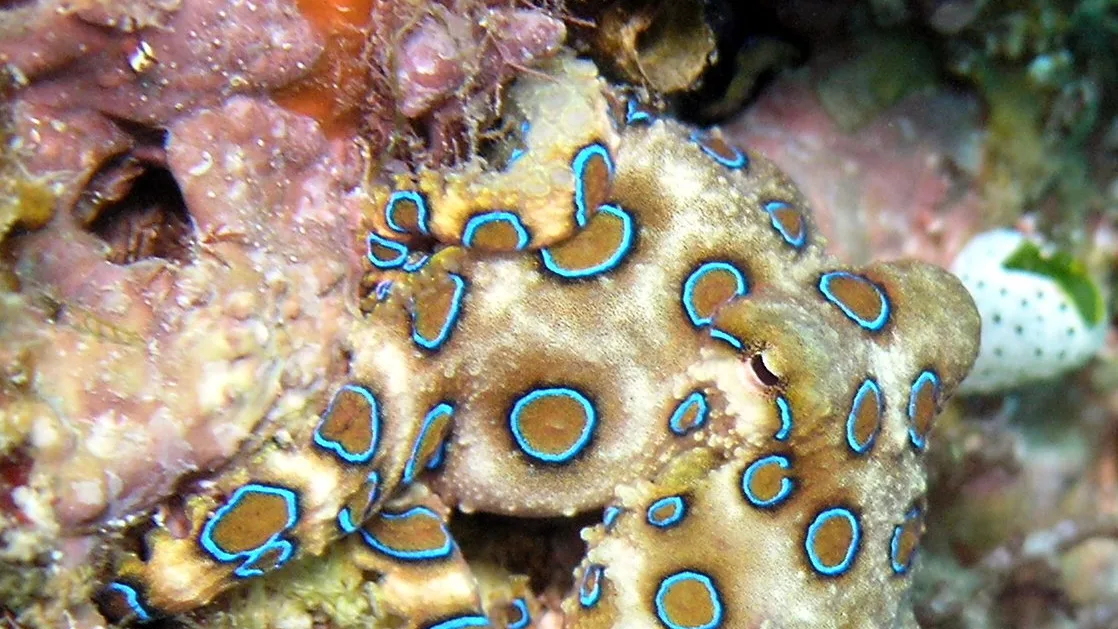
A blue-ringed octopus can be far less conspicuous than its name suggests. Species found around Australia are generally brown at rest and hide in crevices, beneath ledges or among rock-pool rubble. When disturbed, the bright markings become visible against a high-contrast body pattern.
There are several blue-ringed species, and their markings are not identical. The skin mechanism studied in greatest detail belongs to the greater blue-ringed octopus, Hapalochlaena lunulata. It can display roughly 60 iridescent rings across its head, mantle and arms in as little as 0.3 seconds.
The ring is a reflector hidden by muscle
Inside each ring are iridophores, microscopic structures built from layers that reflect blue-green light. They are not pigment sacs switching from brown to blue. The reflectors are physically present before the flash, folded into specialised skin and hidden from view.
Muscles above the ring normally pull skin across the iridophores. To reveal the signal, those muscles relax while muscles around the ring contract, exposing the reflective layers. Dark chromatophores beneath and beside the ring expand to increase contrast, making the electric blue stand out from the surrounding skin.
It is a last warning from a shy animal
The colour display is described as aposematic, meaning it warns another animal about a dangerous defence. Blue-ringed octopuses use potent venom to subdue crabs and small fish. The warning makes biological sense because a predator that backs away can avoid injury while the small octopus avoids a costly struggle.
Dangerous does not mean aggressive. The Australian Museum describes blue-ringed octopuses as shy animals that usually move for cover when they encounter people. Bites are associated especially with handling. The safest response to a display is therefore simple: give the animal space and never pick it up.
The bite may not hurt while breathing is at risk
A blue-ringed octopus bite can be easy to miss because it is often painless. Australia's Healthdirect lists numbness around the mouth, tongue, face or neck, along with a tight chest and trouble breathing, among the possible symptoms. The venom can interfere with the muscles needed for breathing.
That combination makes waiting for pain especially dangerous. A person can require urgent help even when the bite mark is small or uncertain. Treat a suspected bite as an emergency rather than relying on how the person feels in the first few moments.
The safest rock-pool rule is never handle
Leave small octopuses, shells, bottles and crevices undisturbed when exploring a rock pool. Supervise children closely and observe wildlife without blocking its escape route. Bright rings are not an invitation to move closer for a photograph; they are a signal to increase distance.
For a suspected bite in Australia, Healthdirect advises calling triple zero, applying a pressure immobilisation bandage when the bite is on a limb, keeping the person calm and still, and providing CPR if needed. Follow the emergency operator's instructions. This summary supports awareness but does not replace accredited first-aid training.
Sources and further reading
This article was written for Curiosity Desk. We do not copy other publishers or invent quotes. If a material error is found, we correct it openly.
Read the full standards →One answer should lead to a better question
Bring your curiosity to the group
Curious Minds is our public Facebook community for surprising science, strange history, Australian wildlife and everyday questions. No copied posts, no personal-friend invitations and no link dumping.
- Three self-contained discussion prompts each week
- Sourced answers and honest uncertainty
- Respectful conversation without spam