The photograph shows a singer, not an underwater loudspeaker
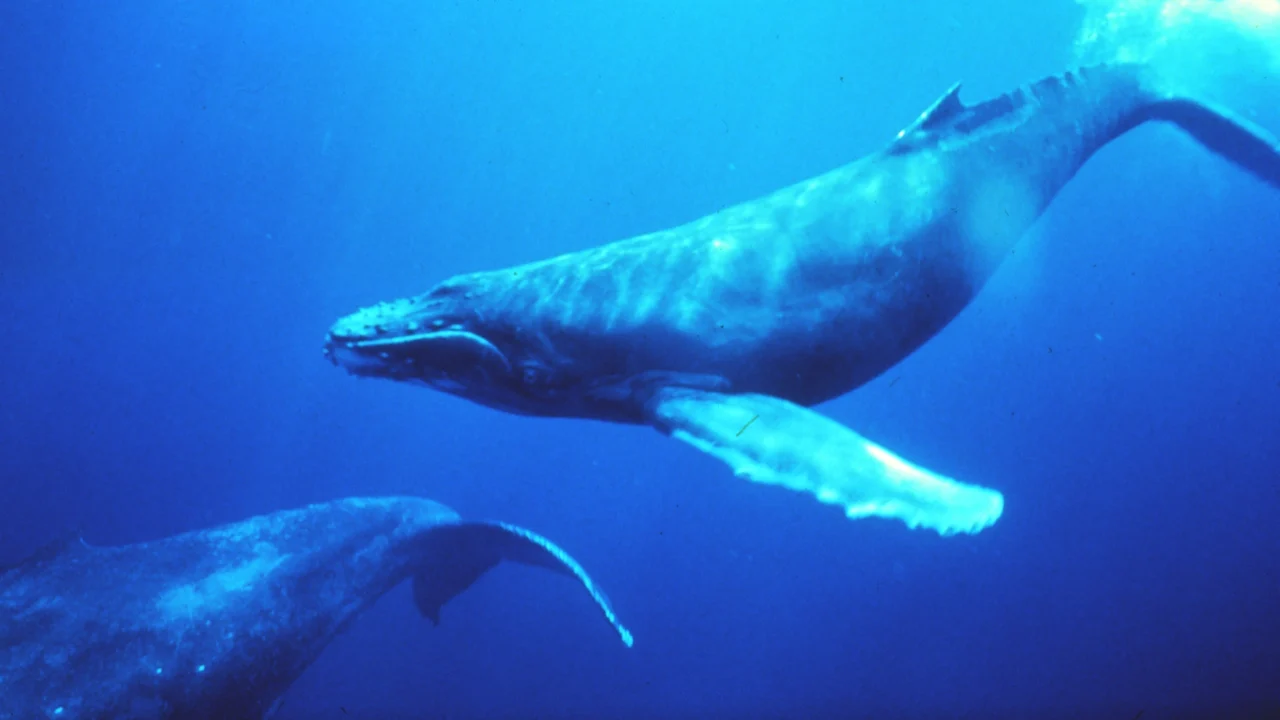
The humpbacks above were photographed in the head-down posture associated with singing in Hawaii. A male can remain submerged and repeat an organised display while sound moves outward through water that may be dark, turbid and visually impenetrable. For another whale, hearing can reach far beyond sight.
That observation is often inflated into one fixed claim such as a whale song travelling across an entire ocean. Real range is conditional. A signal can be physically present but too weak to detect, detected by a large military array but not heard by a whale, or heard without producing any behavioural response. Those are different thresholds.
Sound speed is not the reason sound lasts
NOAA gives a typical sound speed of about 1,500 metres per second in seawater, compared with roughly 340 metres per second in air. The faster speed explains why a pulse arrives sooner. It does not by itself explain why that pulse remains useful over a long distance.
Range depends on how energy spreads, is absorbed, reflects from boundaries and competes with background noise. Temperature, salinity and pressure change sound speed, while frequency strongly affects absorption. A careful explanation therefore starts with the path and the listening conditions, not the familiar fact that sound moves faster underwater.
Low notes usually pay a smaller absorption penalty
As sound travels, its energy spreads over a growing area. Seawater also converts some acoustic energy into heat. That absorption is generally much lower for the low frequencies used in many baleen whale calls than it is for high-frequency sound, so a deep note can retain measurable energy over a longer path.
This does not mean every large whale makes the same kind of signal. Humpback song contains units across a broad band and is structurally elaborate. Blue and fin whales produce exceptionally low-frequency calls that are especially suited to long-range detection. Sperm whales and dolphins use clicks for different tasks and frequencies. The word whale hides several acoustic systems.
The ocean can bend a sound back towards its path
Sound speed near the surface often falls with depth as water becomes colder. Deeper down, rising pressure eventually makes speed increase again. Where the speed reaches a minimum, refraction can bend sound back towards that layer instead of letting it continually escape upward or downward.
This region is called the deep sound channel or SOFAR channel. A sound trapped around it can avoid repeated collisions with the sea surface and seabed, reducing some transmission loss. The channel's depth and strength vary with latitude, season and local water structure, and a calling whale is not guaranteed to occupy or couple efficiently into it.
A coastal humpback and a deep-ocean blue whale face different maps
Humpbacks often sing on relatively shallow breeding grounds. There, the seabed, islands, sloping terrain and surface conditions create multiple paths, echoes and shadow zones. Researchers commonly describe humpback songs as audible over several kilometres, but the active space changes from one site and moment to another.
Low-frequency blue and fin whale calls in deep water can behave very differently. A Southern Ocean study measured average source levels near 189 decibels referenced to one micropascal at one metre for calls around 15 to 29 hertz. Underwater decibels use a different reference from airborne sound, so those figures should not be compared directly with a jet engine or concert speaker.
Six hundred kilometres was a detection, not a translated conversation
A landmark northeast Pacific study used the United States Navy's SOSUS hydrophone system to detect and locate blue whale calls. Aircraft were directed to the predicted area and confirmed vocalising whales. Reviews of the work report a confirmed detection range of about 600 kilometres for a blue whale using the large array.
That result demonstrates extraordinary propagation and receiver sensitivity. It does not prove two whales held a conversation at 600 kilometres, that every call travels that far, or that a single small hydrophone would make the same detection. Communication range additionally depends on the receiving animal's hearing, attention, masking and the information carried by the signal.
Humpback song is a changing display, not a decoded sentence
Adult male humpbacks produce the famous long, repeated song. Individual sounds form phrases, repeated phrases form themes and ordered themes form a song. Males in a population tend to converge on a shared song type while continuously incorporating changes learned from one another.
The display is associated with breeding and sexual selection, but researchers still debate the balance between attracting females, spacing males and signalling to rivals. Calling it a love song presents an unresolved function as fact. Scientists can map structure, copying and behavioural context without translating a theme into a human-style sentence.
A song crossed 14,000 kilometres by being copied
Researchers comparing recordings found humpback song themes spreading eastward from Australia through South Pacific populations and eventually appearing in Ecuador. The endpoints were about 14,000 kilometres apart. This is a remarkable case of animal culture moving across an ocean basin.
It is not evidence that one singer in Australia was heard directly in Ecuador. The change appeared across years as whales met on migration routes and at shared stopovers, learned songs and carried them to another breeding ground. Cultural transmission can cover a much greater cumulative distance than the audible range of one performance.
Noise raises the acoustic horizon
A receiver detects a song by separating it from the surrounding soundscape. Wind, waves, rain, other animals and human activity all contribute. Ship engines add substantial low-frequency energy in the same broad region used by many baleen whale signals, so a call can disappear into noise before its physical vibration disappears.
A study of migrating humpbacks off eastern Australia modelled this communication network and found vessel noise could reduce the area over which social signals remained available. Whales may change timing, level, frequency or behaviour under some conditions, but compensation is not free and cannot erase every mask. Quieter habitat can effectively restore distance without changing the singer.
The honest answer is a range of ranges
Whale sound can travel far because low frequencies are absorbed slowly and ocean layers can guide energy, while powerful sources and sensitive receivers extend detection. Yet depth, bathymetry, season, water chemistry, sea state and noise can change the result. One number cannot describe every call or ocean.
That variability makes the science more useful, not less impressive. Networks of hydrophones can reveal migration, population-specific call types and changing soundscapes even when no whale is visible. The ocean is not a perfect telephone line. It is a moving acoustic landscape that whales and researchers must continually read.
Sources and further reading
- NOAA Ocean Service: How far sound travels in the ocean ↗
- NOAA Fisheries: Understanding sound in the ocean ↗
- Journal of the Acoustical Society of America: Long-range detection and localisation of blue whale calls ↗
- Journal of the Acoustical Society of America: Blue and fin whale source levels and propagation range ↗
- Royal Society Open Science: Humpback song transmission across 14,000 kilometres of the South Pacific ↗
- Proceedings of the Royal Society B: Migratory convergence and humpback song learning ↗
- Biology Letters: Vessel noise and the humpback communication network ↗
- NOAA Hawaiian Islands Humpback Whale National Marine Sanctuary: Song behaviour and function ↗
This article was written for Curiosity Desk. We do not copy other publishers or invent quotes. If a material error is found, we correct it openly.
Read the full standards →One answer should lead to a better question
Bring your curiosity to the group
Curious Minds is our public Facebook community for surprising science, strange history, Australian wildlife and everyday questions. No copied posts, no personal-friend invitations and no link dumping.
- Three self-contained discussion prompts each week
- Sourced answers and honest uncertainty
- Respectful conversation without spam