Quick anatomy
Blue blood and three hearts at a glance
- Oxygen carrier
- Copper-rich hemocyanin
- Blood colour
- Blue when oxygenated
- Gill pumps
- Two branchial hearts
- Body pump
- One systemic heart
The three pumps form one connected closed circulatory system.
Why is octopus blood blue?
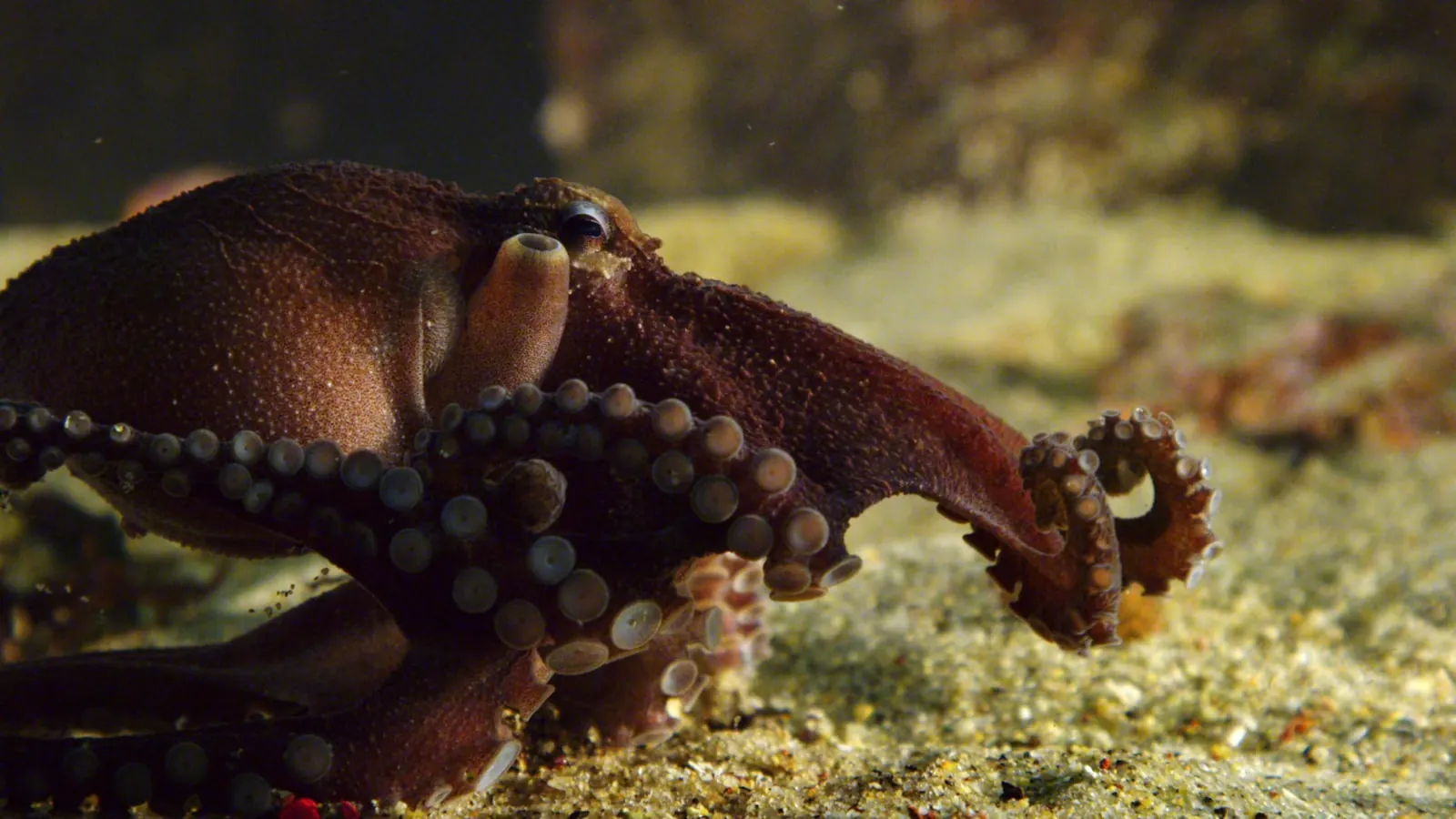
Octopus blood looks blue when oxygen binds to hemocyanin, a large protein that uses copper at its oxygen-binding sites. Human blood depends on iron-containing haemoglobin packed inside red blood cells. Cephalopod hemocyanin is dissolved directly in the circulating fluid.
Hemocyanin is also spelled haemocyanin. The colour does not come from seawater, ink or camouflage, and the fluid is not always vivid blue. In a study of three octopod species, researchers photographed reduced haemolymph as translucent and oxygenated haemolymph as turquoise blue.
Why does an octopus have three hearts?
Two smaller branchial hearts sit beside the gills. They receive oxygen-poor blood and push it through the gill capillaries, where carbon dioxide leaves and oxygen enters. The oxygenated blood then reaches the larger systemic heart, which sends it through the rest of the body.
These are three real muscular pumps in a closed circulatory system, but they are not interchangeable. The branchial pair raises pressure across the gills. The systemic heart supplies the muscles, skin, digestive organs and nervous system. Saying that an octopus has three hearts is therefore a compact description of two linked circulation circuits.
Does an octopus's main heart stop when it swims?
A popular fact says the systemic heart simply switches off whenever an octopus swims. The evidence is more complicated. Classic experiments recorded the trio of hearts in free-moving octopuses and found that nervous control can adjust cardiac output during exercise. A developmental study of Octopus insularis embryos documented temporary pauses in the systemic heart, while earlier literature cited much longer pauses in a different species.
Those observations do not establish a universal rule that every adult octopus stops its main heart each time it swims. The safer conclusion is that the systemic heart can pause under some conditions and that heart control varies with species, developmental stage, activity, temperature and oxygen. Jet propulsion is energetically expensive, but it should not be explained with a one-line heart myth.
Copper is a different solution, not an inferior one
Hemocyanin and haemoglobin solve the same broad problem through different molecular structures. The Smithsonian Ocean Portal explains that cephalopods use copper-based hemocyanin to bind oxygen, while humans use iron-based haemoglobin. One system should not be treated as an unfinished version of the other.
Evolution modifies inherited chemistry within particular environments and body plans. Molluscs were using copper-based respiratory proteins long before an octopus lineage acquired its modern intelligence, flexible arms and rapid colour change.
Cold water makes the chemistry more interesting
Cold water and limited oxygen create a difficult transport problem. A Journal of Experimental Biology study of the Antarctic octopus Pareledone charcoti found that its blood contains a high concentration of hemocyanin and can support oxygen transport across the temperature range the animal experiences. That is evidence of adaptation within the copper-based system, not proof that all octopus species respond identically.
Hemocyanin is also sensitive to acidity. As seawater chemistry and carbon dioxide change, the molecule's grip on oxygen can change with them. The blue colour therefore points to more than a memorable fact: it identifies the protein at the centre of a finely balanced respiratory system.
A closed circuit inside a body with no bones
An octopus has no rigid skeleton to protect large vessels, yet its tissues still require a continuous oxygen supply. Blood must pass through fine gill vessels before travelling around a body that can squeeze through narrow gaps and change shape dramatically. Separate pumps help organise that route.
Cephalopods are unusual among molluscs because their blood moves through a closed system of vessels. The branchial hearts, gills and systemic heart keep pressure moving in sequence. That internal plumbing helps a soft animal combine dramatic shape changes with fast, coordinated motion.
Blue blood and three hearts describe one connected system
The blue colour identifies the oxygen-carrying molecule. The three hearts reveal the route that molecule travels: through the gills for oxygen, then through the systemic heart to the body. The two headline facts are really the chemistry and plumbing of the same system.
Octopuses demonstrate that familiar biological tasks can have unfamiliar engineering. Oxygen transport does not require red blood, and a powerful circulatory system does not require one central pump. The animal looks strange from a human point of view because its lineage found a workable answer of its own.
Sources and further reading
This article was written for Curiosity Desk. We do not copy other publishers or invent quotes. If a material error is found, we correct it openly.
Read the full standards →One answer should lead to a better question
Bring your curiosity to the group
Curious Minds is our public Facebook community for surprising science, strange history, Australian wildlife and everyday questions. No copied posts, no personal-friend invitations and no link dumping.
- Three self-contained discussion prompts each week
- Sourced answers and honest uncertainty
- Respectful conversation without spam