The animal in the photograph has one body-wide nervous system
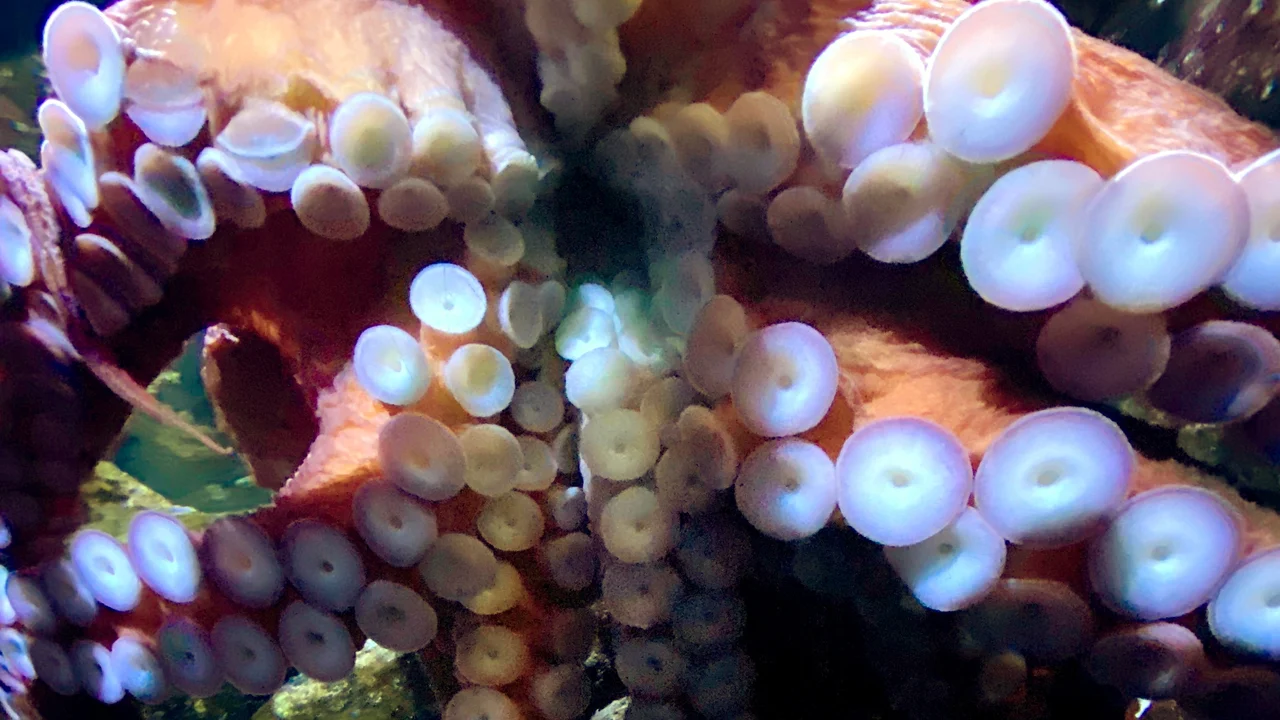
The octopus above is spreading soft arms and suckers across aquarium glass. No rigid bones define an elbow, wrist or finger. Every patch of an arm can bend, lengthen, shorten, twist and grip.
Online captions often solve that control problem by giving the animal nine brains, one central brain and one in each arm. It is a memorable shortcut, but it turns a network into separate minds. The real anatomy is stranger and more useful: control is distributed through connected levels of one nervous system.
Most neurons are outside the central brain, but numbers need context
Classic estimates for an adult common octopus describe roughly 500 million neurons, with around 300 million in the arms. Those figures vary with species, age and body size. Octopuses continue adding neurons as they grow, so there is no universal count stamped into every animal.
What survives the uncertainty is the unusual distribution. A vertebrate concentrates much of its processing in a brain and spinal cord. An octopus places enormous neural resources beside its muscles and sensory surfaces. Local events do not all need a detailed round trip through the central brain before anything can happen.
Each arm contains a nerve cord, not a miniature copy of the brain
A large axial nerve cord runs along each arm. It contains cell bodies and processing tissue, while additional intramuscular nerve cords spread through the arm and ganglia serve the suckers. Connections carry information toward the central nervous system, away from it and along neighbouring regions of the arm.
The organisation repeats around successive suckers, but it is not eight sealed boxes. Pathways at the arm bases and within the brain connect the system. Calling an axial nerve cord an arm brain erases the hierarchy and makes local motor circuits sound like independent centres of memory, personality and intent.
An isolated arm revealed a motor program already waiting inside
In a landmark 2001 study, researchers mechanically or electrically stimulated octopus arms whose connection with the brain had been severed. The arms could produce extension movements with the travelling bend seen in natural reaching. The basic movement pattern did not require moment-by-moment instructions from the central brain.
That result demonstrates peripheral motor organisation, not an independent conscious decision. A spinal reflex in a vertebrate also operates without asking the cortex to calculate every muscle contraction. The octopus version is exceptionally rich because the limb has far more freedom and sensory machinery, but local competence should not be renamed a separate mind.
The central brain can choose the goal while the arm solves the geometry
Higher motor centres in the octopus do not contain the simple point-for-point body map familiar from many vertebrates. Experiments and anatomy instead support a hierarchy. Central regions help select an arm, a target and a broad behaviour; intermediate and peripheral circuits organise the detailed pattern needed to reach, fetch or explore.
That division dramatically reduces the information the central brain must specify. It can request an extension toward food without calculating the force of every muscle fibre along a boneless arm. Sensory feedback in the arm continually meets those broader commands, so neither the brain nor the arm works alone.
A sucker touches and chemically samples at the same time
Octopus suckers are not passive suction cups. Their sensory epithelium contains distinct cells responsive to touch and chemicals. In 2020, researchers identified a family of cephalopod-specific chemotactile receptors that detect poorly soluble molecules on surfaces.
This contact-based sense is often described as tasting by touch. The phrase is useful as long as it is not taken literally as a human tongue on every sucker. Chemical and mechanical signals are filtered locally and influence exploring and grasping, giving an arm detailed information before the central brain could inspect every contacted object.
The sucker network is built from repeating local modules
Modern anatomical work shows swellings in the axial nerve cord aligned with suckers, plus a sucker ganglion in each sucker stalk. A 2025 study identified sensory and motor markers within this local circuitry. Another recent study mapped segmentation and connections repeated along the arm.
Repeated modules make biological sense. A sucker must attach, release and adjust while nearby suckers do something different. Yet neighbouring modules and long nerve tracts remain connected. Local control gives the system detail and speed; communication turns hundreds of local actions into one useful arm movement.
A flexible arm temporarily invents joints
A muscular hydrostat behaves more like a tongue or elephant trunk than a hinged limb. With almost limitless possible shapes, controlling every degree of freedom would be an enormous calculation. During reaching, a bend can travel down the arm in a stereotyped wave, simplifying a three-dimensional problem into a smaller set of commands.
When an octopus brings captured food toward its mouth, it can stiffen parts of the arm into a temporary, quasi-jointed structure. A 2005 Nature study showed that the animal dynamically placed these functional joints according to where the food was held. The skeleton appears only as a control strategy, then disappears when the arm relaxes.
Local action does not answer the consciousness question
An arm can withdraw, explore, grasp and generate motor patterns with substantial autonomy. None of those findings provides a direct test for a private consciousness inside that arm. Behaviour can reveal information processing, but it cannot by itself divide subjective experience into nine owners.
Researchers therefore use words such as distributed, peripheral and semi-autonomous. Those terms describe where computation occurs without pretending to know what each circuit feels. The scientifically safer statement is already astonishing: much of the animal's sensing and movement is organised at the edge of its body.
The lesson for robots is coordination, not eight competing pilots
Soft-robotic arms face the same explosion of possible shapes. Engineers study octopus control because local sensing and reusable movement patterns could let a flexible machine respond to contact without sending every calculation to one processor. The biological system supplies principles, not a ready-made circuit diagram.
The myth says each arm has a mind of its own. The evidence says something more precise: an octopus keeps intelligence close to the problem, lets local circuits handle detail and uses central control to organise goals. Its arms are not eight independent animals. They are capable partners in a nervous system spread through the body.
Sources and further reading
- Integrative and Comparative Biology: Review of octopus arm motor control ↗
- Journal of Comparative Physiology A: Motor control pathways in the common-octopus arm ↗
- Science: A peripheral motor program can generate octopus arm extension ↗
- Nature: A flexible octopus arm temporarily forms a quasi-jointed structure ↗
- Cell: Molecular basis of chemotactile sensation in octopus suckers ↗
- Nature Communications: Neuronal segmentation repeated along cephalopod arms ↗
- Journal of Comparative Neurology: Molecular and structural circuitry of the octopus sucker ganglion ↗
- Current Opinion in Neurobiology: Evolution and growth of cephalopod nervous systems ↗
- Nature: The octopus genome and its neural and morphological novelties ↗
This article was written for Curiosity Desk. We do not copy other publishers or invent quotes. If a material error is found, we correct it openly.
Read the full standards →One answer should lead to a better question
Bring your curiosity to the group
Curious Minds is our public Facebook community for surprising science, strange history, Australian wildlife and everyday questions. No copied posts, no personal-friend invitations and no link dumping.
- Three self-contained discussion prompts each week
- Sourced answers and honest uncertainty
- Respectful conversation without spam