The first surprise was not the hot water; it was the crowd
When researchers reached the Galápagos Rift vents in 1977, they expected an unusual geological system. What startled them was the biology: clams, crabs, mussels and unfamiliar tubeworms crowded around warm fluid in a place far below the reach of sunlight. The deep sea outside such sites was known to receive only a sparse rain of organic material from the surface. Here was a dense oasis with no plants in sight.
The discovery did not reveal animals living on heat alone. It exposed a different route into a food web. Microbes were using chemical reactions to manufacture organic matter, a form of primary production called chemosynthesis. Animals then grazed those microbes, ate one another or formed intimate partnerships with bacteria inside their own bodies.
A vent is a circulation system driven through hot rock
Cold seawater enters cracks in the ocean crust near spreading ridges, volcanic arcs and other tectonically active regions. It moves through hot rock, changes chemically and can dissolve metals and other compounds before rising back toward the seafloor. The emerging fluid is seawater transformed by heat and water-rock reactions, not liquid magma escaping into the ocean.
Some vent fluids exceed 340 degrees Celsius yet remain liquid because the pressure kilometres below the surface raises the boiling point. The surrounding deep water may be only a few degrees above freezing. That extraordinary contrast exists across a narrow mixing zone. Vent animals do not sit inside the hottest jet; they occupy cooler gradients where the chemicals they need meet tolerable water.
The black smoke is mineral dust being made in real time
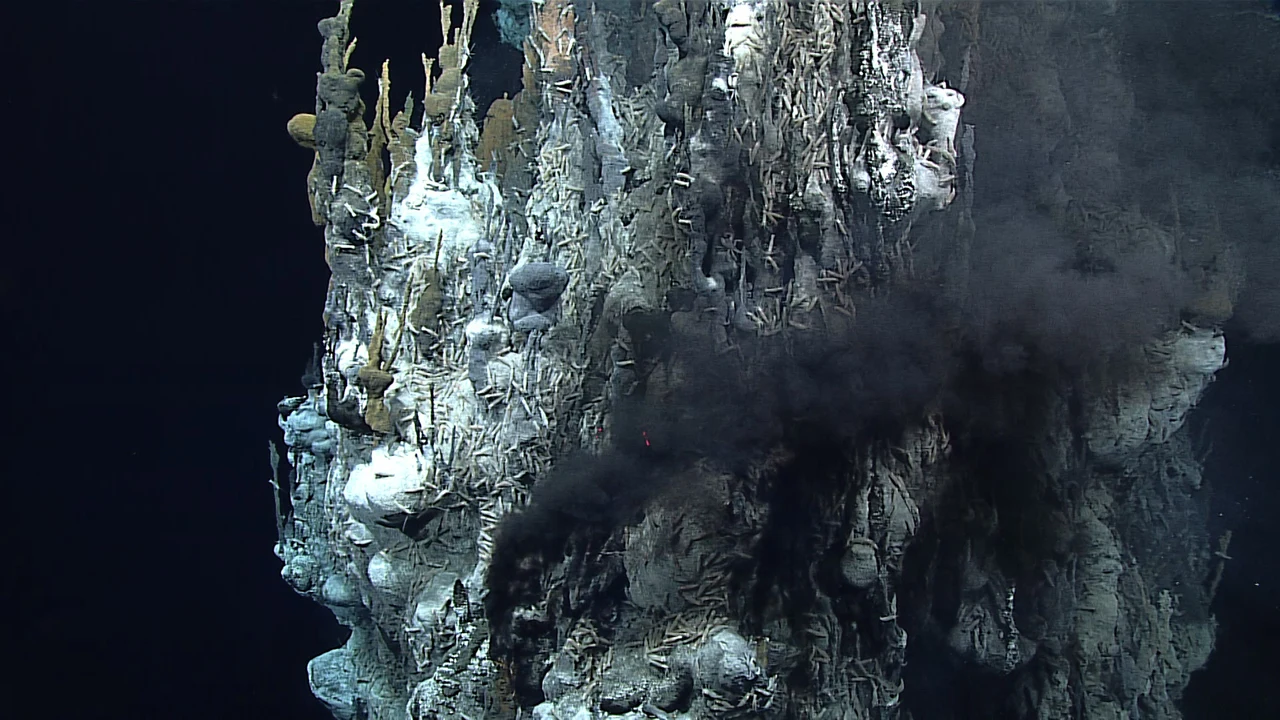
A black smoker is not burning. When hot, clear hydrothermal fluid meets cold seawater, dissolved metals and sulfur combine and precipitate as extremely fine mineral particles. The dark plume is a cloud of newly formed solids, especially metal sulfides, suspended in water. Some material settles and adds layers to the chimney around the opening.
Different chemistry produces different colours and structures. NOAA distinguishes dark iron-sulfide black smokers from paler chimneys rich in compounds of barium, calcium and silicon. The name describes what the mixing fluid looks like, not a universal recipe. A vent field can contain forceful smokers, gentle shimmering flows and inactive mineral towers within a relatively small area.
Microbes exploit a chemical imbalance instead of collecting light
At the surface, photosynthetic organisms use light energy to fix carbon dioxide into organic matter. At a vent, chemoautotrophic bacteria and archaea obtain energy by transferring electrons between reduced chemicals from the crust and suitable compounds in seawater. Sulfide, hydrogen and methane can all participate in different microbial pathways. The microbes then use that energy to build cell material from inorganic carbon.
That is more precise than saying the microbes simply eat toxic rock. Chemosynthesis is a network of metabolisms, not one magic reaction shared by every vent. The productive zone appears where ingredients from hot, oxygen-poor vent fluid mix with colder seawater. In that boundary, chemical disequilibrium becomes usable biological energy and microbial mats or symbionts become food for larger organisms.
A giant tubeworm has no mouth, gut or anus
The giant tubeworm Riftia makes the partnership impossible to miss. An adult lacks a digestive tract. Instead, a large internal organ called the trophosome contains billions of chemosynthetic bacteria. The worm's bright red plume exchanges compounds with the surrounding water, and specialised haemoglobin helps transport oxygen, carbon dioxide and hydrogen sulfide to the symbionts without the sulfide poisoning the animal.
The bacteria use those ingredients to make organic compounds that nourish themselves and their host. Mussels and clams at some vents also carry bacterial partners, while snails, shrimp, crabs and other animals graze microbial growth or feed higher in the web. The cast changes by ocean region: eastern Pacific sites are famous for tubeworms, while some Atlantic vents are dominated by shrimp. There is no single vent community copied around the globe.
No sunlight does not mean no connection to the sunlit ocean
The primary chemical energy at a deep vent can be captured without a photon reaching the seafloor. That is the revolutionary part. But many prominent sulfur-oxidising microbes and the animals that host them also use dissolved oxygen. Much of the ocean's oxygen was produced by photosynthesis near the surface and then carried through circulation into deep water.
Some vent microbes use anaerobic pathways and do not need oxygen, so the qualification should not be turned into the opposite myth. The accurate statement is that vent ecosystems can make new organic matter in darkness using geochemical energy. It is too broad to claim that every organism in the visible oasis would remain completely independent of all surface photosynthesis if the rest of Earth's biosphere disappeared.
Vents are evidence of possibility, not proof of where life began
Vent fields are dynamic. Flow can move, chimneys can collapse, volcanic eruptions can bury a community and a once-active site can go quiet. Larvae and microbes must disperse between scattered habitats and rebuild where suitable chemistry appears. A crowded vent is therefore not an ancient world frozen in place; it is a temporary biological city tied to a changing geological power supply.
Hydrothermal systems are leading laboratories for origin-of-life and ocean-world research because minerals, chemical gradients and natural compartments can promote interesting prebiotic reactions. NASA experiments have produced organic molecules under simulated early-ocean vent conditions. That supports the plausibility of the setting, not a historical verdict. Vents remain one serious hypothesis among competing ideas about where life's first chemistry crossed into biology.
Sources and further reading
- NOAA Ocean Service: What is a hydrothermal vent? ↗
- NOAA Ocean Exploration: Photosynthesis and chemosynthesis ↗
- NOAA Ocean Exploration: Unique vent ecosystems ↗
- NOAA Ocean Exploration: Chemosynthesis at hydrothermal vents ↗
- NOAA Ocean Exploration: Hydrothermal vent in the Mariana back-arc ↗
- Woods Hole Oceanographic Institution: The 1977 discovery ↗
- Woods Hole Oceanographic Institution: Vent biology and biogeography ↗
- Woods Hole Oceanographic Institution: Photosynthesis and chemosynthesis ↗
- NASA: Simulating early ocean vents under pressure ↗
- Woods Hole Oceanographic Institution: Testing an origin-of-life vent theory ↗
This article was written for Curiosity Desk. We do not copy other publishers or invent quotes. If a material error is found, we correct it openly.
Read the full standards →One answer should lead to a better question
Bring your curiosity to the group
Curious Minds is our public Facebook community for surprising science, strange history, Australian wildlife and everyday questions. No copied posts, no personal-friend invitations and no link dumping.
- Three self-contained discussion prompts each week
- Sourced answers and honest uncertainty
- Respectful conversation without spam