A birthday arrives before the planet finishes turning
A year and a day measure two different motions. A year is the time a planet takes to complete one orbit around the Sun. A sidereal day is the time it takes to rotate once relative to the distant stars. On Earth those clocks are familiar: roughly 365 days for an orbit and 24 hours for a turn. Venus reverses the order people expect.
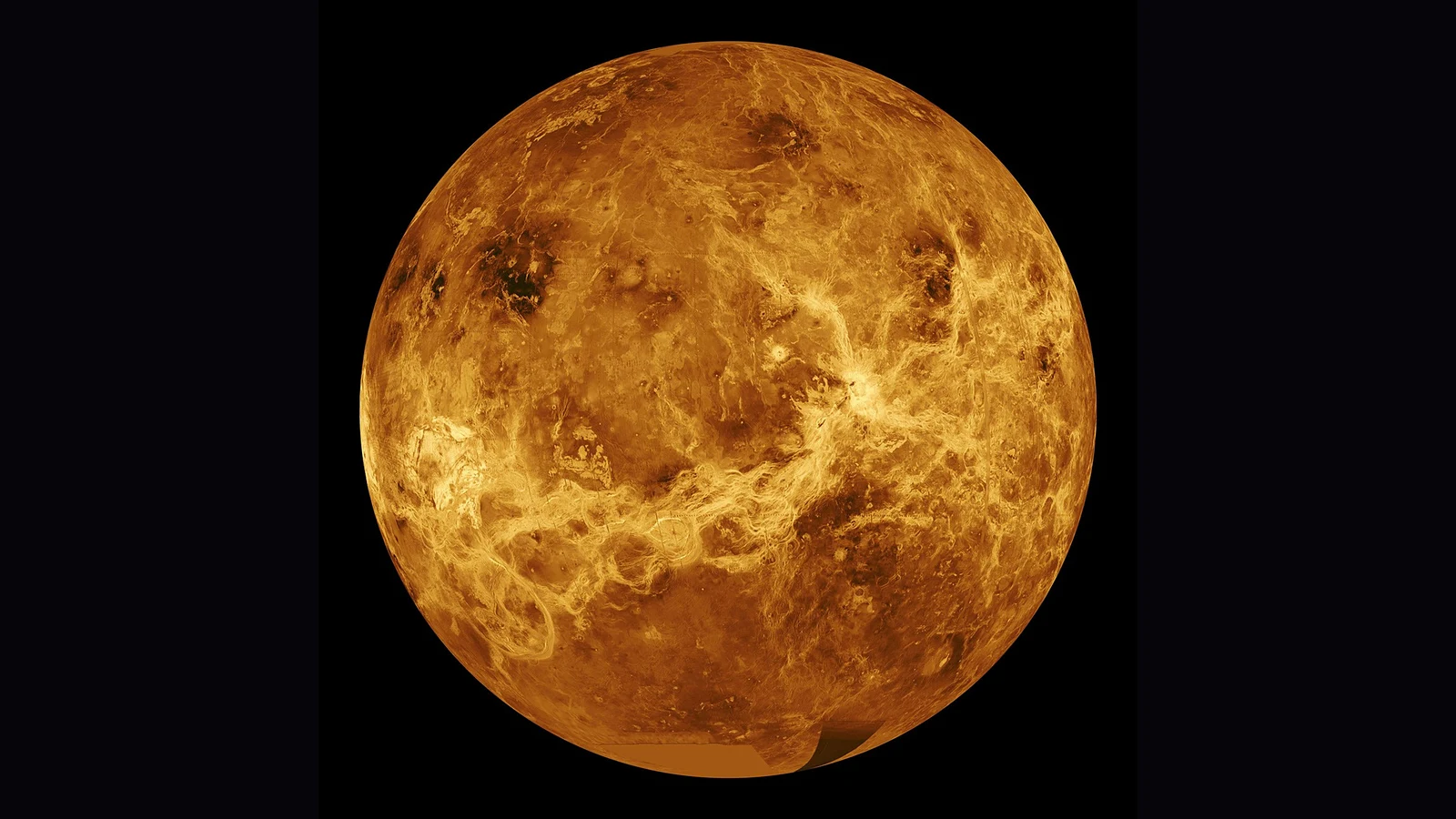
NASA lists a Venus orbit at about 225 Earth days and a complete rotation at about 243 Earth days. If a marker on the surface could survive the heat and pressure, Venus would finish an entire trip around the Sun before that marker completed one turn relative to the stars. The headline is not a trick of units. The rotation really is slower than the orbit.
But one sunrise is not 243 days away
There is a second kind of day: the solar day, measured from one noon or sunrise to the next. The planet is moving around the Sun while it rotates, so the direction to the Sun keeps changing. On Venus, those two motions combine to make the solar day about 117 Earth days, much shorter than the 243-day sidereal rotation but still almost four Earth months.
That distinction explains why two apparently conflicting Venus facts can both be correct. The planet takes 243 Earth days to turn once against the stars, yet an observer would wait about 117 Earth days between successive sunrises. Whenever a space fact says “day,” the first useful question is: day measured against the stars, or day measured against the Sun?
The Sun would rise in the west
Venus rotates in the opposite direction to Earth and most other planets, a motion called retrograde rotation. From the surface, the Sun would therefore appear to rise in the west and set in the east. The motion would be extraordinarily slow, but the surface would not offer a peaceful place to watch it.
Venus has a dense carbon-dioxide atmosphere, crushing surface pressure and temperatures hot enough to melt lead. Its bright clouds make it look serene from Earth while hiding one of the harshest rocky-planet environments we know. The slow, backwards sky is only one part of a world that resembles Earth in size but not in present conditions.
Why the backwards spin is still an open story
Scientists can measure the rotation much more confidently than they can reconstruct how it began. Large early impacts may have altered the planet's spin, while gravitational and atmospheric effects could have continued changing it. Models have to explain both the slow rate and the retrograde direction.
That uncertainty should not be replaced with one dramatic claim. Planet formation was violent, and Venus also has a massive atmosphere that exchanges momentum with the solid planet. Several processes may have contributed over billions of years. The honest version is more interesting: our nearest planetary neighbour keeps a basic part of its history hidden.
The fact changes how you imagine a world
We usually picture a day as the smallest familiar planetary clock and a year as the large one wrapped around it. Venus shows that nature is not required to keep those clocks in that order. Rotation and orbit are independent motions shaped by a planet's history.
Now follow the idea one step farther. Mars can place a blue glow around the setting Sun, the Moon is steadily widening its orbit, and the oldest light in the universe reaches us as microwaves. Space becomes genuinely mind-bending when the headline leads to the mechanism instead of ending at the fact.
Sources and further reading
This article was written for Curiosity Desk. We do not copy other publishers or invent quotes. If a material error is found, we correct it openly.
Read the full standards →One answer should lead to a better question
Bring your curiosity to the group
Curious Minds is our public Facebook community for surprising science, strange history, Australian wildlife and everyday questions. No copied posts, no personal-friend invitations and no link dumping.
- Three self-contained discussion prompts each week
- Sourced answers and honest uncertainty
- Respectful conversation without spam