The Moon is farther away than it was last year
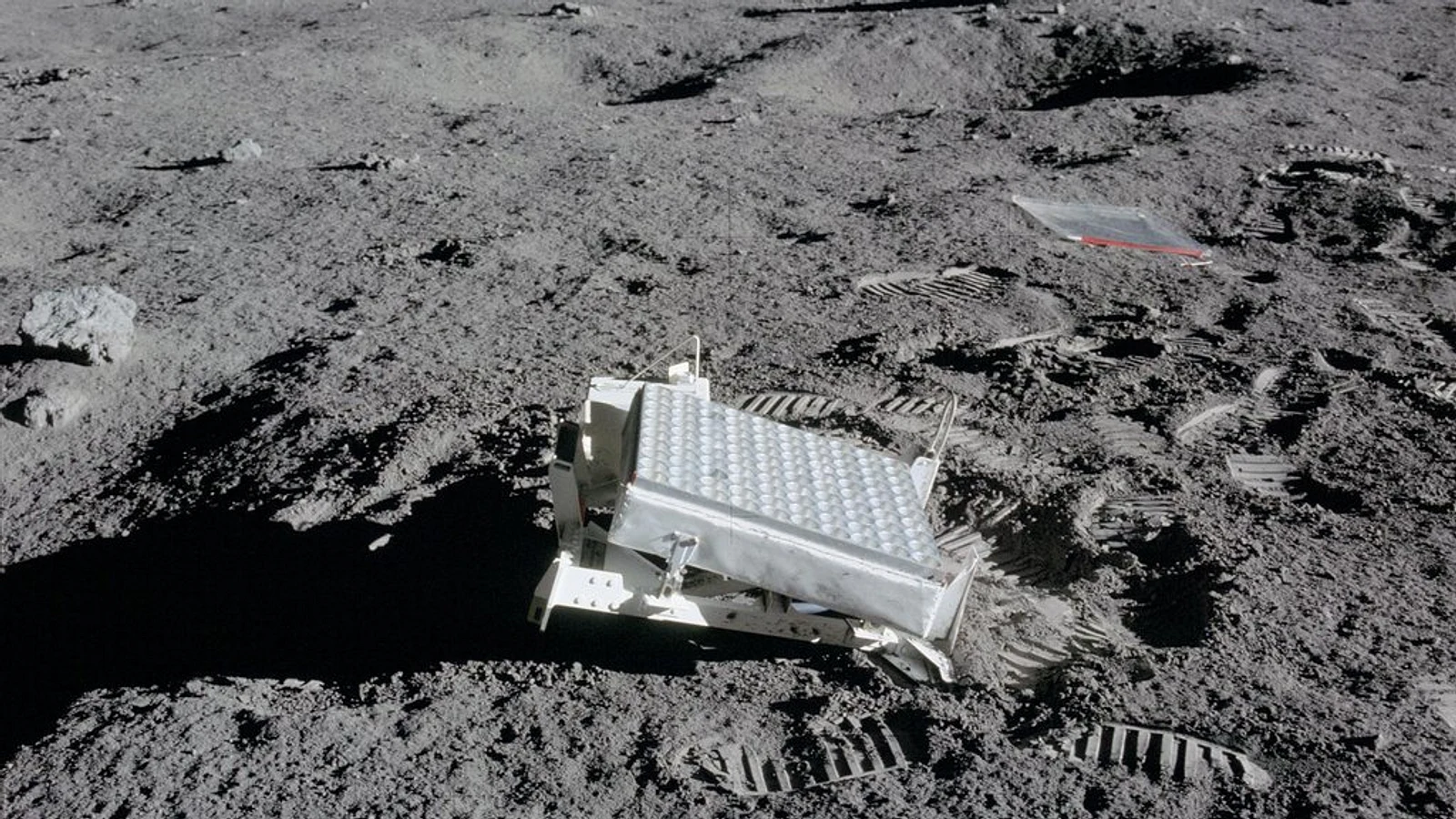
The change is about the width of a small biscuit each year: roughly 3.8 centimetres. That sounds impossible to measure across an average distance of about 384,400 kilometres, but astronauts and robotic missions left special retroreflectors on the lunar surface. They return incoming laser light toward its source.
Observatories fire short laser pulses at those arrays and time the round trip. Light travels nearly 300,000 kilometres each second, so an extremely precise travel time becomes an extremely precise distance. Repeating the measurement across years revealed that the average Earth-Moon gap is growing.
The ocean tide is slightly ahead of the Moon
The Moon's gravity raises tides in Earth's oceans and deforms the solid Earth as well. If Earth did not rotate, the tidal bulges would tend to line up with the Moon. Earth turns much faster than the Moon travels around us, so friction carries the bulge slightly ahead of the direct Earth-Moon line.
That offset matters. Gravity from the leading bulge pulls the Moon forward along its orbit. Adding orbital energy and angular momentum does not simply make the Moon race around at the same distance; it shifts the Moon into a wider orbit. A wider lunar orbit is the slow-motion result of countless tides.
Earth pays for the transfer with a longer day
The exchange has another side. The Moon pulls back on the tidal bulge, applying a brake to Earth's rotation. Our planet's day lengthens by a tiny amount as rotational angular momentum moves into the Moon's orbit. The two changes are parts of one coupled system, not unrelated facts.
The effect is far too small to notice from one morning to the next. Across geological time, however, tiny changes accumulate. Evidence from ancient tidal deposits and biological growth rhythms indicates that Earth once had shorter days and the Moon was closer.
Do not multiply 3.8 centimetres forever
The present recession rate is not a fixed conveyor belt running unchanged through all of history. Continents move, ocean basins open and close, sea depth changes and the efficiency of tidal dissipation changes with them. Different arrangements of land and water can strengthen or weaken the transfer.
That is why a simple calculation based on today's rate gives a misleading age for the Moon. The Moon formed much closer to Earth, but its outward journey did not occur at one constant speed. A measurement can be precise today without being a universal rate for every past and future era.
A human-made mirror exposes a planetary engine
The retroreflectors are passive. They need no battery and do not transmit a signal of their own. Their carefully arranged corner cubes simply send light back toward the instrument that fired it. A device placed decades ago can therefore keep answering a modern question every clear observing night.
The most astonishing part is not only that the Moon moves. It is that a laser pulse lets us watch angular momentum pass through an entire planet-moon system. Read next about Venus and even the meaning of a “day” stops feeling permanent.
Sources and further reading
This article was written for Curiosity Desk. We do not copy other publishers or invent quotes. If a material error is found, we correct it openly.
Read the full standards →One answer should lead to a better question
Bring your curiosity to the group
Curious Minds is our public Facebook community for surprising science, strange history, Australian wildlife and everyday questions. No copied posts, no personal-friend invitations and no link dumping.
- Three self-contained discussion prompts each week
- Sourced answers and honest uncertainty
- Respectful conversation without spam