A Mars relay changes the shape of a long-distance call
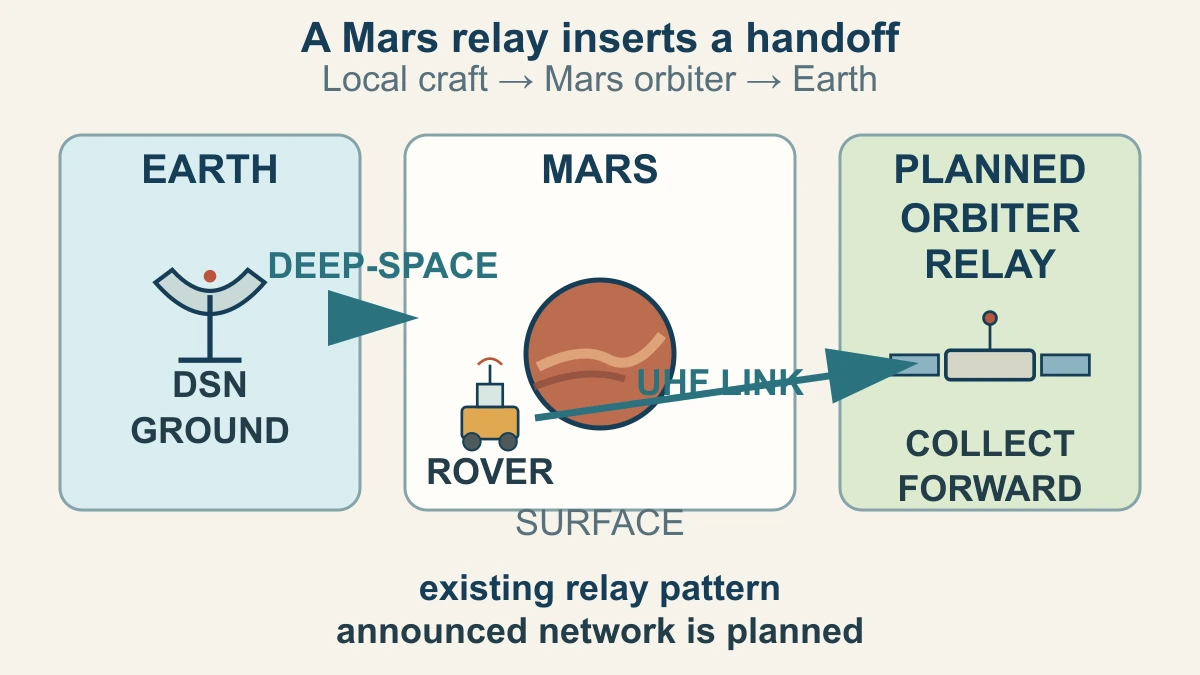
The short answer is architectural. Instead of asking every rover, lander, orbiter or other Mars-area spacecraft to complete a long radio link to Earth whenever its own geometry and hardware allow, a Mars-orbit telecommunications relay could sit between the local mission and the ground network. A surface craft would send data to the relay over a shorter proximity link; the relay could then point a separate deep-space link toward Earth. NASA's 1 September 2026 contract release describes the planned Mars Telecommunications Network as a high-performance telecommunications spacecraft orbiting Mars, intended to transmit science data, imagery, navigation information and critical mission communications for spacecraft operating on or around Mars.
That handoff is not a wholly new idea. NASA technical records document Mars orbiters relaying UHF data from Mars Exploration Rovers, with the orbiters forwarding the collected information to Earth. The older arrangements involved particular spacecraft, partner interfaces and scheduled contacts; they are historical evidence that a Mars relay can be a useful communications pattern, not a description of the final Blue Origin system. The new proposal would make that pattern a planned service layer rather than leaving each mission to assemble every relay relationship by itself.
The practical benefit is therefore not a magical stronger signal. It is a better-placed middle point. A relay in Mars orbit can see different surface or near-Mars missions as it moves around the planet, collect their transmissions and offer an Earth-facing path when the geometry and schedule are suitable. NASA's SCaN material still matters because the relay would join a larger system of antennas, navigation services and mission operations. The Mars-side spacecraft would add a handoff; it would not replace Earth's ground communications network or remove the need for careful pointing and coordination.
The data can wait for the next link
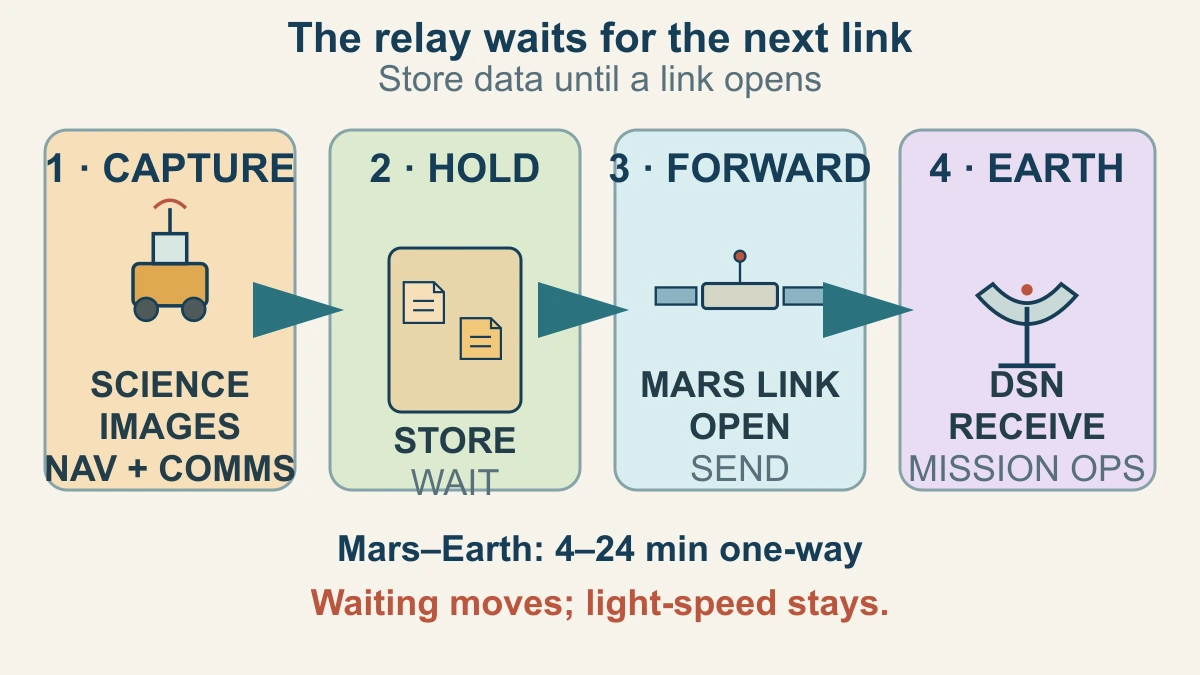
When the Mars side receives a mission's transmission, it does not need to complete the whole Earth leg at that exact instant. It could hold the data until the next usable contact, then forward it. NASA's current explanation of Delay/Disruption Tolerant Networking calls this store-and-forward: a node stores information while the next node is unavailable and sends it when a path opens. That logic is useful for deep-space work because contact windows, spacecraft position, pointing and local operations do not behave like a permanent terrestrial broadband connection.
The relay can also give different kinds of mission traffic a common route. NASA's contract release names science data, imagery, navigation information and critical mission communications; those labels describe the intended service scope, not a promise that every future mission will receive the same data rate or priority. In a simplified path, a rover or lander sends a bundle to the orbiter, the orbiter checks or stores it, and the orbiter forwards it through the Earth-facing link to a Deep Space Network or other authorised ground asset. The exact protocols, radio bands, capacity and scheduling rules remain part of the future implementation.
A relay changes where data wait, not the speed limit set by light. NASA's communications guidance gives Mars-Earth one-way signal times of roughly four minutes at the closest separation and roughly 24 minutes at the greatest separation. A Mars orbiter can improve availability, contact planning and the organisation of many mission links, but it cannot make a command arrive immediately or make a delayed answer feel like a local conversation. That is why the strongest promise is operational flexibility: more deliberate opportunities to move information, within the same physics-bound interplanetary link.
The contract is a milestone, not a finished network
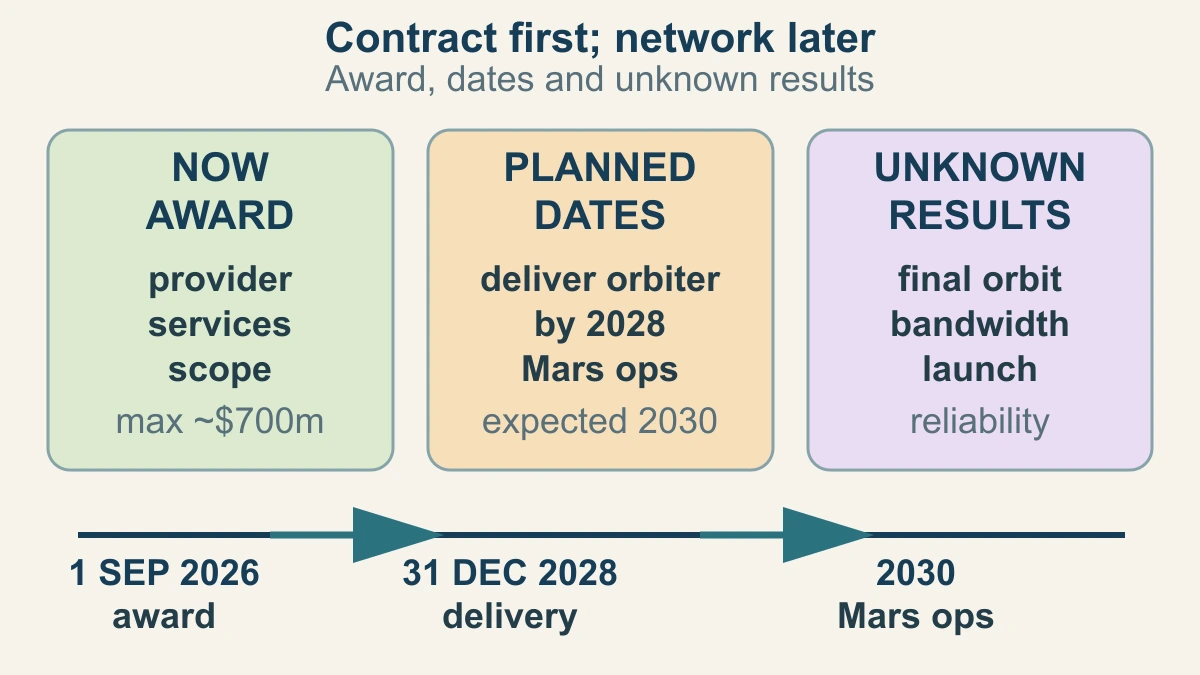
NASA's release establishes a contract award and its stated scope. It says Blue Origin is to design, develop, integrate, launch and operate the network, with a firm-fixed-price maximum potential value of about 700 million dollars. The release gives a delivery requirement for a high-performance Mars telecommunications orbiter no later than 31 December 2028 and says the system is expected to be operational at Mars by 2030. Those are announced contract terms and programme expectations. They are not a photograph of a completed spacecraft, a successful launch, a live data link or a measured performance result.
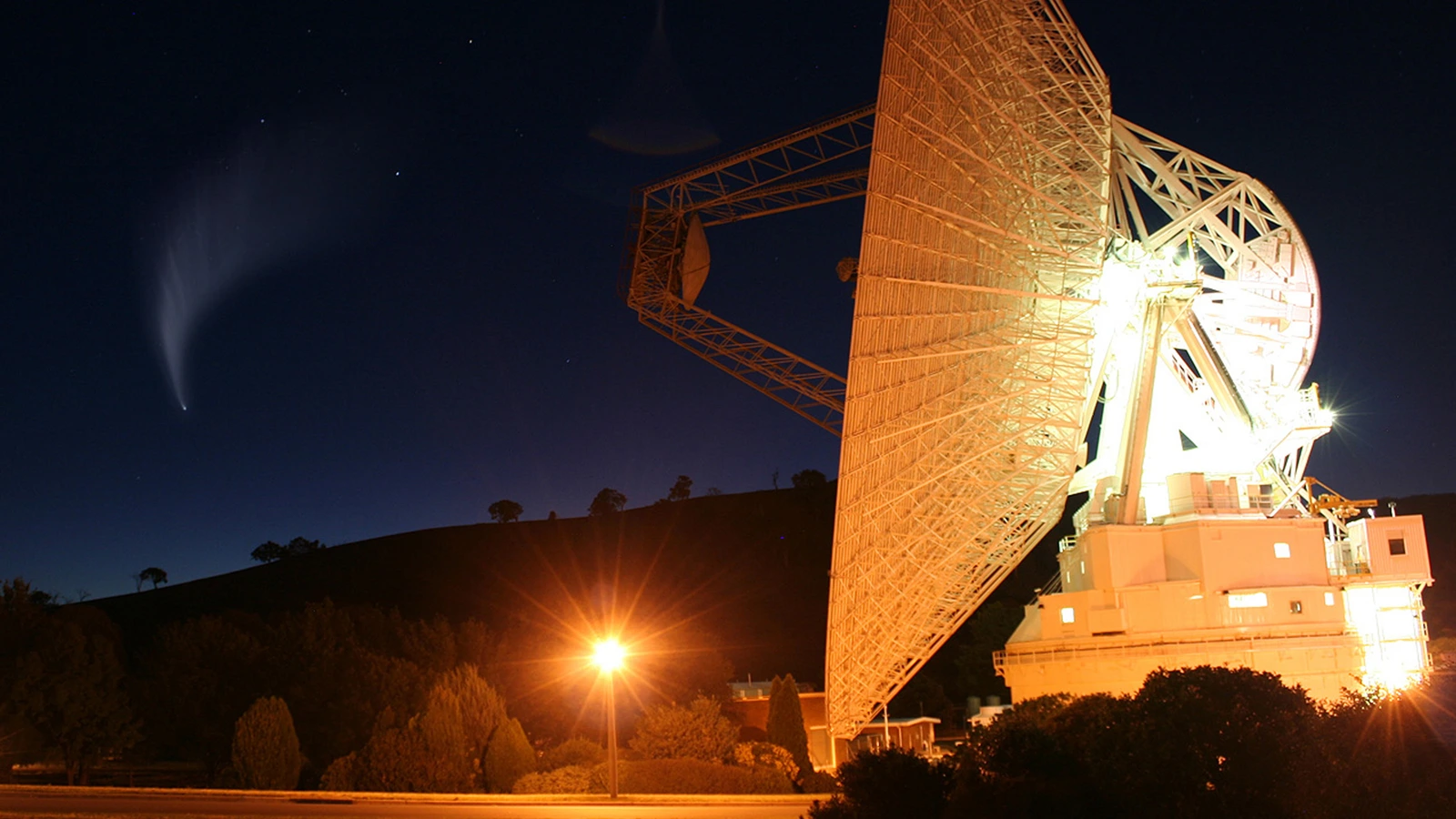
The same boundary applies to the architecture. The announcement describes an orbiting telecommunications spacecraft and the services it is intended to provide, but it does not establish the final orbit, the complete radio design, the eventual number of supported contacts, the achieved bandwidth, the reliability under Mars conditions or the outcome of launch and operations. NASA's current Deep Space Network expansion is a useful comparison: a new Earth antenna can add capacity and scheduling flexibility while remaining a separate piece of the communications chain. More ground equipment does not, by itself, prove that a future Mars relay will work as planned.
So the honest answer is conditional but concrete. Established now: NASA has announced the provider, the intended service, the contract scope and the expected dates. New in this explanation: a relay could make future Mars missions easier to communicate with by collecting local traffic, storing it through gaps and forwarding it through Earth-side antennas. Uncertain: the final spacecraft, network operations and observed performance. Not proved: a functioning Mars network, guaranteed high bandwidth, faster-than-light communication or any Blue Origin result. The next meaningful evidence would be the design and operations record, not a stronger headline.
Sources and further reading
- NASA — NASA Selects Blue Origin as Mars Telecommunications Network Provider ↗
- NASA — SCaN: Communicating with Missions ↗
- NASA — Delay/Disruption Tolerant Networking ↗
- NASA — Space Communications: 7 Things You Need to Know ↗
- NASA — Deep Space Network ↗
- NASA Technical Reports Server — A Martian Telecommunications Network ↗
- NASA Technical Reports Server — Enabling International Data Relay at Mars ↗
- NASA — New Next-Gen Dish Adds Muscle to NASA's Deep Space Network ↗
- NASA — Guidelines for using NASA Images and Media ↗
This article was written for Curiosity Desk. We do not copy other publishers or invent quotes. If a material error is found, we correct it openly.
Read the full standards →One answer should lead to a better question
Bring your curiosity to the group
Curious Minds is our public Facebook community for surprising science, strange history, Australian wildlife and everyday questions. No copied posts, no personal-friend invitations and no link dumping.
- Three self-contained discussion prompts each week
- Sourced answers and honest uncertainty
- Respectful conversation without spam