A retroreflector gives visiting spacecraft a reference point
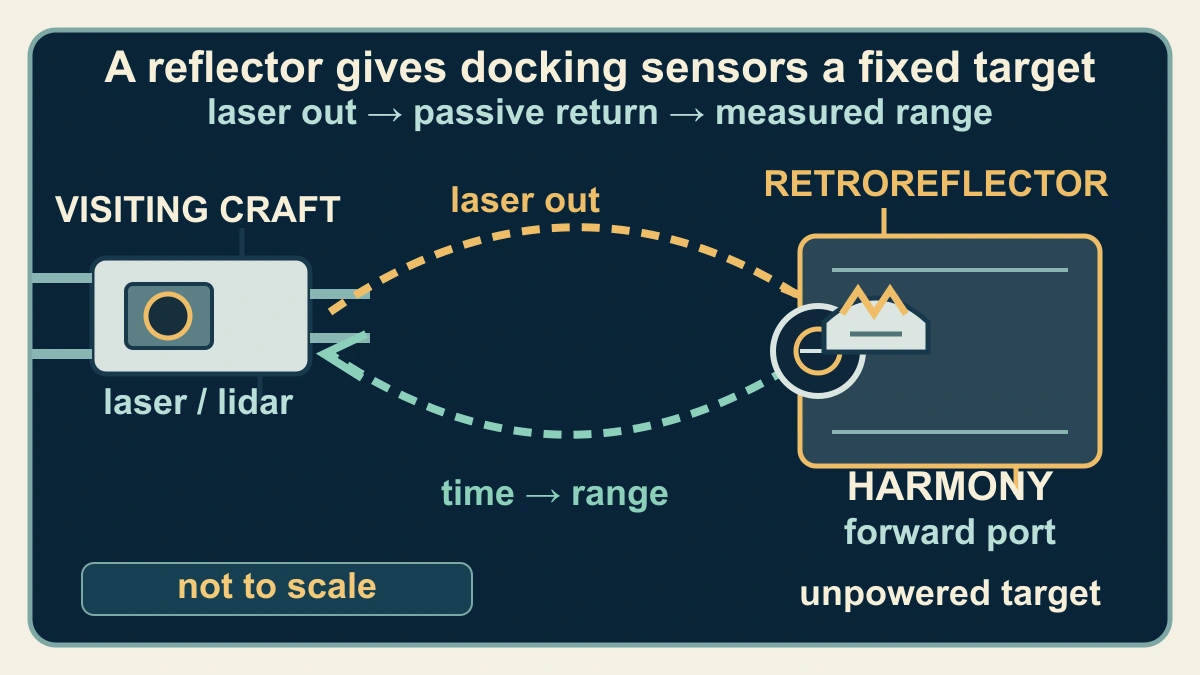
NASA is planning to replace a retroreflector on the forward port of the International Space Station's Harmony module during the September 1, 2026 spacewalk. In practical terms, that could give visiting spacecraft a passive reference target to illuminate while they approach the station. The honest verb is could: NASA's notices describe a planned task, not a completed installation or a measured improvement. This article follows the mechanism behind the possible upgrade without turning an advance plan into an outcome.
A retroreflector does not steer the visiting craft or broadcast a signal of its own. NASA explains that these small passive arrays reflect laser light back toward its source from a wide range of angles. A sensor can time the return and use that interval to estimate distance. In the ISS case, the useful change is a clearer physical reference at a known station location: a spacecraft can compare a measured range with the other observations used during rendezvous.
That makes the device one input to navigation rather than an autonomous navigation system. NASA's rendezvous engineering overview describes a sensor suite that can include lidar and produces range, bearing and pose information for processing. A reflector can support the ranging part of that picture, while the visiting vehicle, its software and the rest of its sensors still determine how to approach and dock. The replacement therefore has a precise promise: improve or refresh a reference target, not magically guide a spacecraft by itself.
One EVA touches two different evidence layers
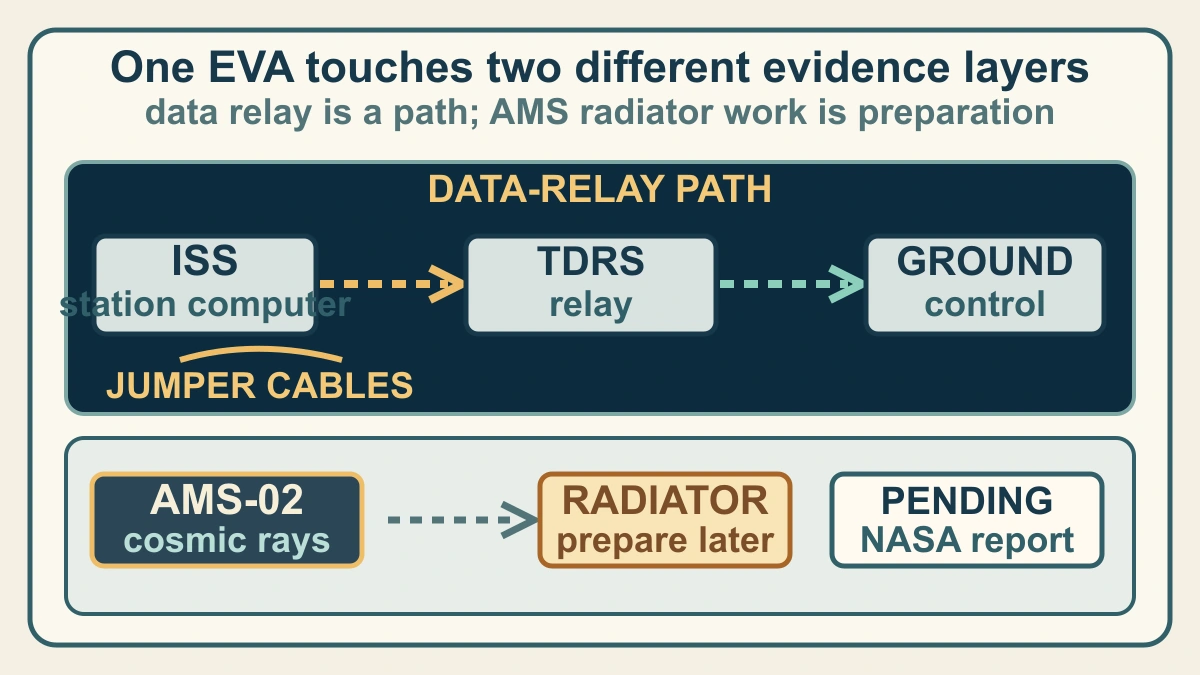
The NASA spacewalk advisory groups several tasks into one EVA: replace the retroreflector on Harmony's forward port, install data-relay jumper cables, prepare a radiator for future Alpha Magnetic Spectrometer maintenance and replace a high-definition camera. Those jobs share an airlock and a crew timeline, but they do not produce one single kind of upgrade. Navigation, communications, detector maintenance and imaging are different evidence layers that should be read separately.
The jumper cables are part of a path, not a new satellite network. NASA describes the Space Network as a relay system in which station signals travel to Tracking and Data Relay Satellites and then to ground antennas and mission control. A cable task can support that station-to-relay connection, but the planning notice alone cannot show how much performance changed, whether a link was already available, or whether the installation was completed. Those are later-result questions.
AMS-02 is a cosmic-ray particle detector on the ISS, so preparing its radiator for later maintenance is not the same as repairing the detector or producing a new science measurement. The advisory also names a camera replacement, another distinct piece of hardware. The useful reading of the headline is therefore plural: one spacewalk could refresh a navigation reference and prepare or support science and data hardware, but no current source proves that every named task has delivered a benefit.
The plan has a clear evidence boundary
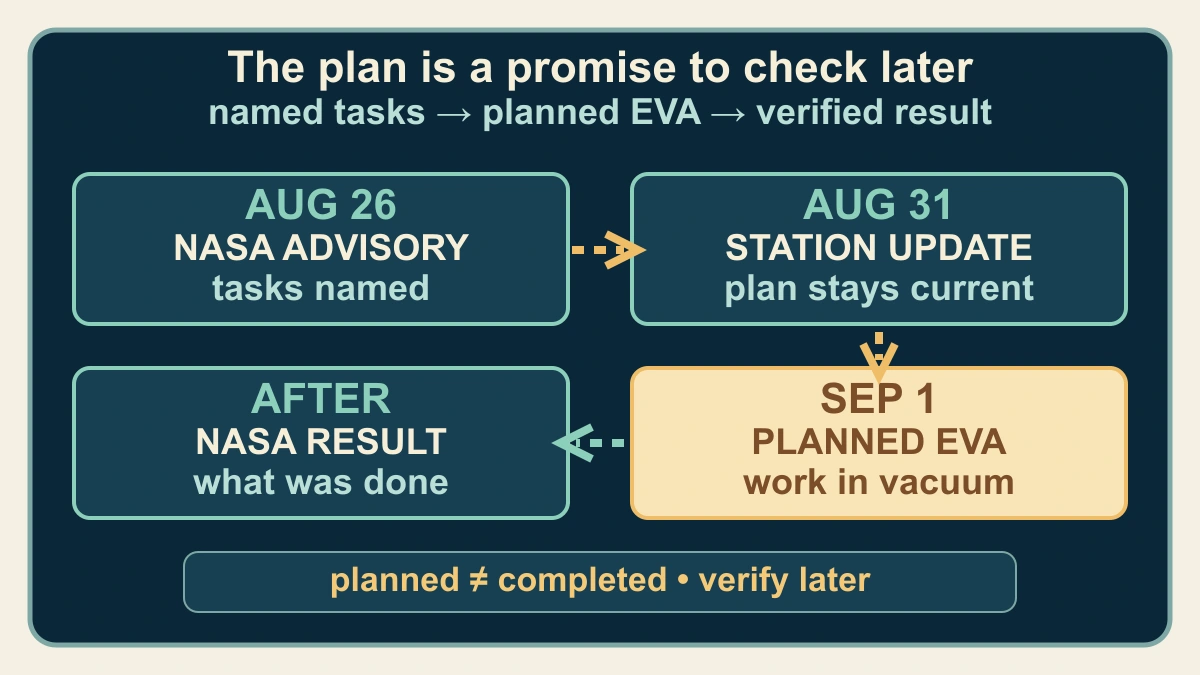
NASA's August 26 media advisory laid out the task list and planned live coverage. Its August 31 station update then said the crew was go for Tuesday's maintenance spacewalk, expected to begin September 1, with the navigation aid, cosmic-particle-detector preparation and data-relay jumpers among the work. Together, those pages establish what NASA planned to attempt and why the tasks matter. They do not read like a post-EVA completion report.
The supported claims are narrow and useful: a retroreflector is a passive laser-ranging target; Harmony is the relevant station module; relay jumpers belong to the station communications path; AMS-02 is a cosmic-ray detector; and the listed work was scheduled. The unproven claims are equally important: that the EVA occurred as planned, that the reflector was installed, that the jumpers were connected, that the radiator preparation was completed, or that navigation performance improved by a measured amount.
A later NASA station post, mission record or equivalent primary result should establish what the crew actually completed and whether any engineering or operational measure changed. Until that evidence appears, could is not empty hedging: it is the accurate status of a live plan. The curiosity payoff is knowing exactly what to watch next—an official result that moves this story from named intention to verified hardware work and, only if measured, an observable upgrade.
Sources and further reading
- NASA: Expedition 75 is Go for Tuesday's Navigation and Science Maintenance Spacewalk ↗
- NASA: NASA Sets Spacewalk for Station Maintenance, Live Coverage Planned ↗
- NASA: Spacewalk Preps Continue to Finish Antenna Installation Job Next Week ↗
- NASA: Harmony Module ↗
- NASA: The Space Network: Cell Towers for Astronauts ↗
- NASA: How NASA Uses Simple Technology to Track Lunar Missions ↗
- NASA: Space Rendezvous ↗
- NASA: Alpha Magnetic Spectrometer ↗
- NASA: Alpha Magnetic Spectrometer Hits Ten Years of Space Station Research ↗
- NASA: Guidelines for Using NASA Images and Media ↗
This article was written for Curiosity Desk. We do not copy other publishers or invent quotes. If a material error is found, we correct it openly.
Read the full standards →One answer should lead to a better question
Bring your curiosity to the group
Curious Minds is our public Facebook community for surprising science, strange history, Australian wildlife and everyday questions. No copied posts, no personal-friend invitations and no link dumping.
- Three self-contained discussion prompts each week
- Sourced answers and honest uncertainty
- Respectful conversation without spam