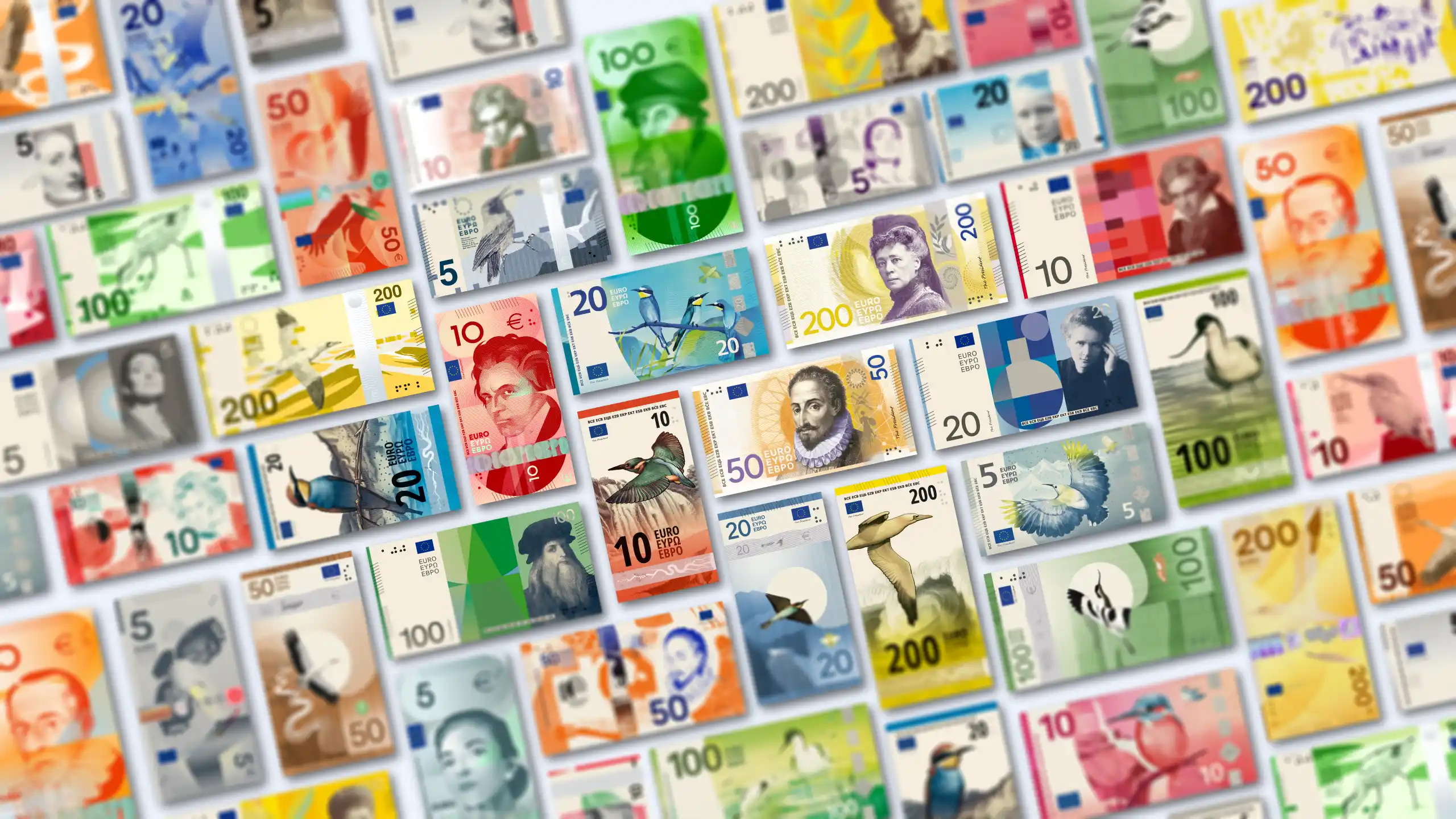
Ten designs have appeared, but Europe still has no winning note
The European Central Bank revealed ten shortlisted proposals for the next euro banknote series on 23 July 2026. The colourful images look finished enough to spend, yet none is the final design. They are competing visual systems. The ECB is collecting public preferences until 21 September, and its Governing Council expects to select the future design around the end of 2026.
Even that decision will not put a new €20 note into a cash machine the following morning. The ECB says development and production will begin after the choice and that it will take several years before the notes enter circulation. The shortlist is therefore a rare public view of a banknote midway between an idea and an industrial object.
The shortlist is much bigger than the number ten suggests
Each proposal is not one banknote. It is a coordinated series covering the €5, €10, €20, €50, €100 and €200 denominations. Ten proposals multiplied across six values means the public is effectively comparing sixty fronts, together with their reverse sides and the visual rules that make each family feel connected.
That is why a single attractive portrait cannot settle the contest. A banknote system has to remain clear when notes are stacked, folded, worn, viewed quickly or handled by somebody with limited vision. Colours, numerals, recurring patterns and denomination-specific motifs must work alone and as a sequence. The strongest proposal must tell one story six times without making the six values easy to confuse.
Five series tell Europe's story through culture
One theme is called European culture. Its fronts connect each denomination with a notable European and a cultural field: Maria Callas and the performing arts on €5, Ludwig van Beethoven and music on €10, Marie Curie and education on €20, Miguel de Cervantes and libraries on €50, Leonardo da Vinci and museums or exhibitions on €100, and peace campaigner Bertha von Suttner with public squares on €200.
The reverse sides turn those individual figures into shared spaces, such as theatres, schools, libraries, exhibitions and public squares. That pairing changes the meaning of a portrait. The person is not presented simply as a famous face. Each face introduces a place where culture is made, learned, performed or encountered by other people.
Five other series follow a river from mountain to sea
The second theme, Rivers and birds, behaves like a journey across the six denominations. It begins with a mountain spring and a wallcreeper on the €5 note, moves through a waterfall and kingfisher on €10, a confined river valley and bee-eaters on €20, a meandering river and white stork on €50, and a river mouth with an avocet on €100. The €200 reaches the sea with a northern gannet over ocean waves.
European institutions appear on the reverse sides, from the European Parliament on €5 to the European Court of Auditors on €200. The combination links border-crossing rivers and migrating birds with institutions intended to connect countries. Designers were free to build different visual languages around that fixed narrative, which is why two proposals can show the same species and still feel unrelated.
The public survey advises the decision; it does not automatically make it
The ECB's online survey is open from 23 July until 21 September 2026. Its FAQ says anyone can participate regardless of age, nationality or country of residence, and the survey is available in all 24 official European Union languages. The system is designed to count each participant's preference only once. A separate representative survey is also being run by an independent research company.
The distinction between consultation and election matters. The Governing Council will consider the public responses before selecting the final design, but the most-clicked picture is not automatically declared the winner. Representative evidence, expert assessment and the requirements of a working banknote remain part of the decision. Public taste has influence without being the only engineering specification.
A banknote design has to survive more than an art jury
The contest began with 1,241 applications from designers across the European Union. Twenty-five designers advanced to the design phase and submitted 39 complete proposals. An independent jury with members nominated by euro-area national central banks assessed pseudonymised entries and selected five proposals for each theme. The jury considered creativity, thematic consistency, accessibility and public appeal while the designers also had to meet technical, legal and thematic requirements.
Those constraints explain why the project cannot be judged like a poster competition. A banknote must communicate value quickly, remain usable across languages and carry a coherent identity through six denominations. It must also leave room for security and production features. The public artwork is explicitly labelled as design proposals, not proof that every visible element will appear exactly that way on the final issued notes.
Security is one reason a convincing picture is still unfinished
Central banks regularly upgrade banknotes to stay ahead of counterfeiting techniques. The ECB says the next series will introduce advanced security features that make notes harder to copy and easier for the public to check. Those features involve more than a portrait and colour palette. They have to work with the material, printing process, machine authentication and the ways people inspect cash in everyday use.
The familiar look of current euro notes already works alongside practical signals such as different sizes, strong colour contrast, large numerals and tactile features. The redesign gives the ECB another chance to improve accessibility for blind and partially sighted people, reduce environmental impact and keep the denominations distinct. A proposal can therefore be beautiful and still require substantial technical development before it becomes money.
Why the winning design will still take years to reach a wallet
After the Governing Council chooses a design, the Eurosystem still has to turn that visual proposal into a producible, secure and durable banknote series. Materials, security elements, accessibility, high-volume printing and compatibility with the equipment that handles cash all have to be resolved together. The ECB has not announced a circulation date and says the first notes will appear only several years after the design decision and production process.
Current notes do not suddenly become invalid because a shortlist has been published. The images circulating now show possible future series, not notes that shops must accept or customers can order. Until the ECB announces the chosen design, production plan and launch, any social post claiming a particular finalist is Europe's new money is moving faster than the official process.
The most useful way to compare the proposals
Instead of choosing only the prettiest €20, compare each six-note family. Can the values be distinguished at a glance? Does the story remain clear from €5 to €200? Are portraits, birds, institutions and shared spaces readable rather than crowded? Does the system still make sense when one note is removed from the polished presentation and used on its own?
The shortlist is compelling because it exposes the hidden job of money. A banknote is a public artwork, a national or regional symbol, an accessibility tool, a security product and an object expected to survive ordinary handling. The ten proposals are not final because selecting the image is only one part of designing something millions of people must trust without stopping to admire it.
Sources and further reading
- European Central Bank: ten shortlisted designs and public survey ↗
- European Central Bank: FAQ on the banknote redesign process ↗
- European Central Bank: Design Contest Jury report ↗
- European Central Bank: selected themes and denomination motifs ↗
- European Central Bank: future banknotes and design proposals ↗
This article was written for Curiosity Desk. We do not copy other publishers or invent quotes. If a material error is found, we correct it openly.
Read the full standards →One answer should lead to a better question
Bring your curiosity to the group
Curious Minds is our public Facebook community for surprising science, strange history, Australian wildlife and everyday questions. No copied posts, no personal-friend invitations and no link dumping.
- Three self-contained discussion prompts each week
- Sourced answers and honest uncertainty
- Respectful conversation without spam