Free-power fact check
The Solar Sharer Offer in seven answers
- Where
- NSW, South East Queensland and South Australia
- Who
- Residential customers with a smart meter
- Rooftop solar needed
- No
- NSW and South East Queensland
- 11 am to 2 pm
- South Australia
- 12 pm to 3 pm
- Start date
- 1 July 2026
- Automatic enrolment
- No, it is an opt-in standing offer
Checked 27 July 2026. Retail plans and eligibility can change, so confirm the current offer with the retailer and Energy Made Easy.
The short answer: free electricity is real, but only inside one offer
Australia's Solar Sharer Offer is a regulated, opt-in standing electricity offer that includes a three-hour free-usage period in the middle of the day. It began with the 2026–27 Default Market Offer on 1 July 2026.
The offer is available to eligible residential customers with smart meters in New South Wales, South East Queensland and South Australia. A household does not need rooftop solar. The idea is to let more people use abundant daytime solar energy, including renters and homes whose own roofs cannot carry panels.
It is not a promise of free electricity across Australia and it does not make the entire bill disappear. The daily supply charge, electricity used outside the free period and any other charges in the plan still matter.
What are the exact three free hours?
The Australian Energy Regulator set the free period at 11 am to 2 pm in New South Wales and the Energex area of South East Queensland. In the SA Power Networks area of South Australia, it runs from 12 pm to 3 pm.
Those are fixed local-time windows. They are designed to overlap the part of the day when solar output is often plentiful and the electricity system wants more flexible demand. The offer requires a smart meter because the retailer must know when the household used each unit of electricity.
Customers must opt in. Someone who already has an electricity plan is not automatically moved onto the Solar Sharer Offer simply because a smart meter is installed.
Why would anyone give electricity away at midday?
Electricity is unusual because supply and demand must be balanced continuously. Australian roofs and solar farms can produce a large amount of power around the middle of a sunny day, while household demand often climbs later when people return home, cook and heat or cool their houses.
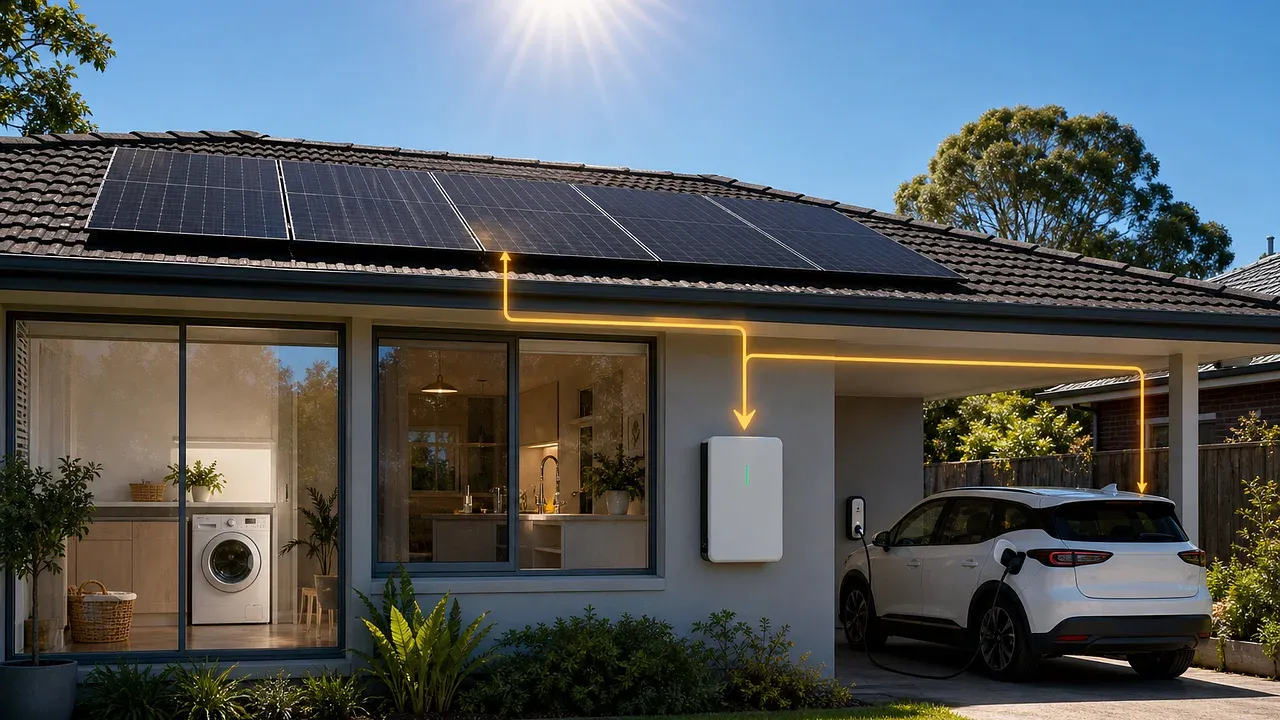
The Solar Sharer Offer tries to move flexible jobs into the solar-rich window. Charging an electric vehicle, running a dishwasher or heating water at midday can absorb energy when it is more abundant instead of adding to the evening peak.
AEMO's first-quarter 2026 data shows the same shift at grid scale. Between 10 am and 4 pm, average battery charging was 872 megawatts higher than a year earlier. During the 4 pm to 9 pm peak, average battery discharge rose by 818 megawatts to 1,115 megawatts. Storage was effectively moving part of the daytime supply into the evening.
What is free, and what can still cost more?
The energy usage component inside the designated window is free under the regulated offer. The household can still pay a daily supply charge, and every kilowatt-hour used outside that window is priced under the rest of the time-of-use tariff.
That creates the most important comparison. A plan with an exciting free period can still be poor value for a household that uses most electricity in the morning and evening if its other rates or supply charge are higher than an alternative plan.
The AER publishes annual comparison prices using benchmark consumption, but it warns that those figures are not a cap on an individual bill. The result for one home depends on its actual consumption and how much of that consumption can genuinely be shifted.
Who is most likely to save?
The offer is best suited to a smart-meter household with substantial flexible usage. An electric vehicle, home battery, pool pump, electric hot-water system, dishwasher, washing machine or air conditioner may be able to use more energy during the free period without increasing total consumption.
A household that is empty during the day may still benefit from safe built-in timers, manufacturer-approved scheduling or an energy-management system. Appliances should be operated according to their instructions, and high-load equipment should not be improvised, overloaded or left in an unsafe state simply to chase a tariff window.
Homes with little flexible demand may save less. Rooftop-solar owners also need to compare the value of self-consumption, battery charging and any feed-in payment rather than assuming every daytime unit should be redirected in the same way.
How to compare the offer without being fooled by the word free
Start with a recent bill and, if available, the smart meter's interval data. Estimate how many kilowatt-hours currently fall inside the free window, which tasks could realistically move there and how much electricity would remain in the priced morning and evening periods.
Then compare the daily supply charge, every usage rate, the free window, contract terms and the annual comparison price. The AER's Energy Made Easy service lists generally available plans in the regions it covers and lets customers compare offers using household details.
Do not increase consumption merely because one period has a zero usage rate. The useful saving comes from moving electricity that the household already needs, not finding new reasons to waste it.
Does this prove renewable energy always makes bills cheaper?
No single retail tariff proves that every renewable project, network upgrade or household bill will be cheaper. Retail prices combine wholesale energy, networks, environmental costs, retail costs, metering and other factors, and those components can move in different directions.
The offer does demonstrate a real feature of Australia's changing grid: solar energy can be so abundant at midday that shifting demand into those hours becomes valuable. AEMO's 2026 system plan says renewables connected by transmission, firmed with storage and backed by gas form the least-cost development path under government policy as coal plants retire.
CSIRO's 2025–26 GenCost report reaches a related but more specific conclusion about new generation: renewables supported by storage remain the lowest-cost pathway to a net-zero electricity system, while battery costs are falling. That is a system-planning result, not a guarantee about any one household's next bill.
The useful next step takes five minutes
Check whether the supply address is in a participating region and whether the property has a smart meter. Ask the retailer for the Solar Sharer Offer rates in writing, including the daily supply charge and every rate outside the free period.
Compare the complete plan on Energy Made Easy rather than accepting a sales description based on the free hours alone. If the household can move real existing demand into the window and the rest of the tariff remains competitive, three free hours can be meaningful. If it cannot, another plan may still be better.
Sources and further reading
- Australian Energy Regulator: 2026–27 Default Market Offer and Solar Sharer announcement ↗
- Australian Energy Regulator: current Default Market Offer prices and comparison guidance ↗
- Australian Energy Regulator: Solar Sharer Offer fact sheet ↗
- AEMO: Quarterly Energy Dynamics Q1 2026 battery and generation data ↗
- CSIRO: GenCost 2025–26 findings on renewables and storage ↗
- Australian Government energy department: free-power option explainer ↗
This article was written for Curiosity Desk. We do not copy other publishers or invent quotes. If a material error is found, we correct it openly.
Read the full standards →One answer should lead to a better question
Bring your curiosity to the group
Curious Minds is our public Facebook community for surprising science, strange history, Australian wildlife and everyday questions. No copied posts, no personal-friend invitations and no link dumping.
- Three self-contained discussion prompts each week
- Sourced answers and honest uncertainty
- Respectful conversation without spam