The feeling contains its own contradiction
You enter a room for the first time, yet the arrangement feels known. The sensation can be so immediate that it seems to arrive before thought. At the same time, you know the place is new. Déjà vu is not ordinary remembering because there is no recoverable event attached to the familiarity. It is the collision between a convincing signal of oldness and a separate judgment of newness.
That combination is common enough to study, but its frequency depends on how researchers ask about it. A 2024 systematic review and meta-analysis included 46 studies and estimated that about 74 per cent of healthy participants had experienced non-seizure déjà vu. Older estimates were often lower. Definitions, age, culture and self-report all affect the number, so it should be read as a pooled research estimate rather than a precise count of humanity.
Recognition is not one yes or no signal
Recognition can include at least two experiences that usually cooperate. Recollection supplies details about where and when something happened. Familiarity supplies a more general feeling that it has been encountered before. A face can look familiar even when a name and meeting place refuse to appear. Déjà vu resembles an unusually strong version of that source-free familiarity, combined with the knowledge that the present situation cannot be a literal memory.
This distinction explains why the feeling can be intense without containing useful information. Confidence is part of the experience, but confidence does not identify its source. Memory researchers can therefore ask a narrower question than what causes every episode: can an unnoticed resemblance make a genuinely new place feel familiar when the earlier source cannot be consciously recalled?
A place can echo another without looking like it
In a virtual reality experiment published in 2012, participants explored scenes and later encountered new scenes. Some of the new places had the same spatial configuration as an earlier place even though their objects and overall identity differed. When participants could not consciously recall the earlier scene, a matching layout still made the new one more likely to feel familiar and to produce reported déjà vu than a completely novel layout.
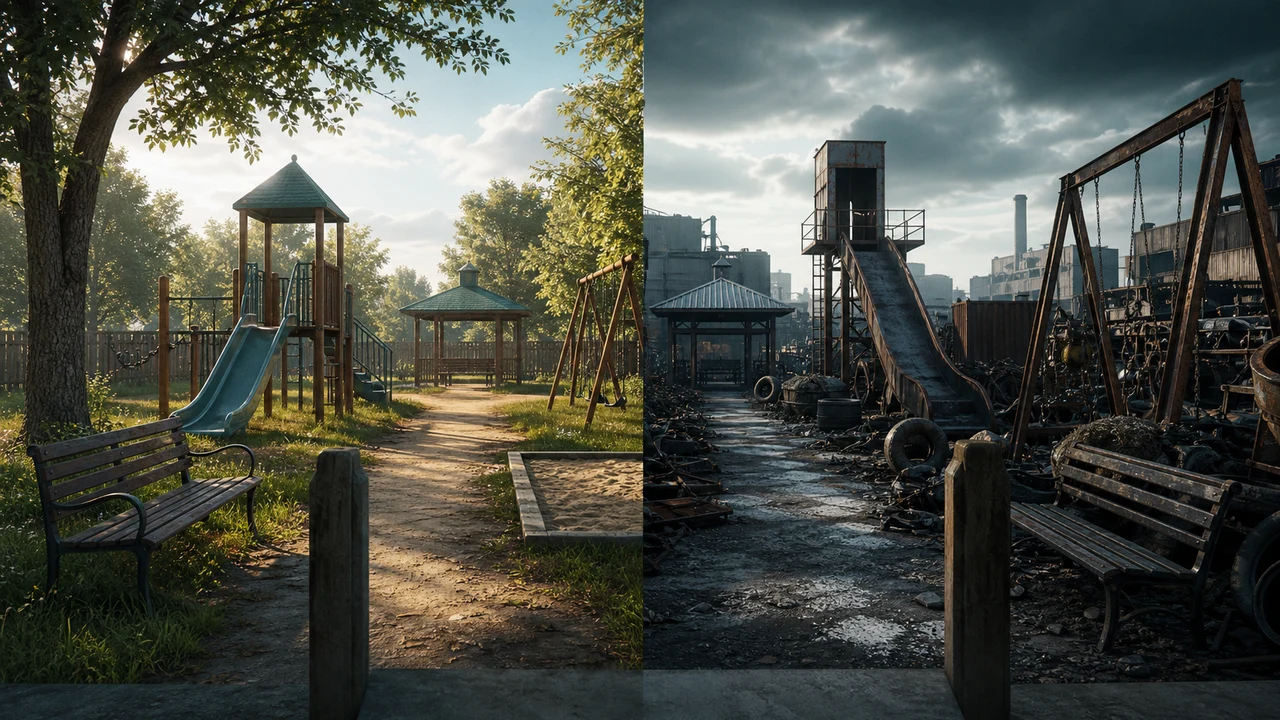
Imagine first walking through a playground and later entering a junkyard. A slide has become a metal ramp, a bench has become a worktable and a fence has become stacked machinery, yet the large objects occupy similar positions and guide the same route. Nothing needs to look copied. The earlier spatial pattern can create a weak echo without delivering a complete memory. The illustration above visualises that principle rather than reproducing the researchers' exact scenes.
A newer experiment rebuilt the hidden geometry
Researchers later created an open set of 64 pairs of configurally similar virtual scenes. Each test scene belonged to a different category from its study partner, but the major objects occupied corresponding locations. Published results from the updated procedure again found more familiarity and more déjà vu reports when the hidden layout matched an unrecalled earlier scene.
The result supports one route into the experience, not a universal cause. Natural episodes may be prompted by a room, a phrase, a face, a sequence of events or something researchers have not captured. Laboratory participants also have to report a private, fleeting state after being asked to look for it. The strength of the experiment is that it changes one feature and measures what follows. Its limit is that an analogue of déjà vu is not every spontaneous episode outside the laboratory.
The feeling of prediction failed a direct test
Déjà vu often comes with a second impression: the next moment feels as though it is already known. The virtual scenes allowed researchers to test that claim. At a turn in the route, participants guessed whether the path would continue left, right or straight. They felt more able to predict the answer during déjà vu, yet their actual choices did not rise above chance.
A follow-up study found that feelings of prediction appeared in just over half of reported déjà vu states and became more likely as familiarity felt stronger. Accuracy still did not improve. This is an unusually clean separation between feeling and performance. Déjà vu can make the future seem available without providing information about what the future will be.
The laboratory can reproduce ingredients, not issue a final verdict
Spatial resemblance is one evidence-backed explanation, but it is not the only serious proposal. Researchers have examined attention, partial perception, familiarity without a source, errors in memory monitoring and neurological activity. These ideas can overlap. A scene noticed incompletely on one pass might later produce familiarity, while a monitoring system detects that no valid memory should exist.
Popular explanations often turn a possibility into a finished mechanism. Claims that one eye always processes the scene first, that the brain stores the present as a memory too quickly or that all déjà vu is a tiny seizure are not established general explanations. The responsible answer is less dramatic and more useful: experiments identify processes capable of producing parts of the experience, while no single account has explained every ordinary case.
The sense that something is wrong may be part of the mechanism
A 2023 review proposed a conflict account of déjà vu. On this view, familiarity alone is not enough. The distinctive feeling emerges when an oldness signal clashes with knowledge that the scene is new and the mind registers the error. This could explain why déjà vu feels uncanny rather than simply comfortable. The moment includes a kind of internal correction: this feels remembered, but it should not.
The account fits experiments that create familiarity while confirming novelty, and it links déjà vu with broader research on memory errors and conflict monitoring. It remains a framework under investigation, not a scan that has located one déjà vu switch. Brain imaging and laboratory analogues can test parts of the proposal, but the subjective conflict is still reconstructed from behaviour and reports.
Ordinary déjà vu and seizure-related déjà vu are not interchangeable
Déjà vu can occur as part of a focal seizure, particularly in temporal-lobe epilepsy. That clinical fact has helped researchers study the biology of familiarity. It does not mean a brief ordinary episode is secretly a seizure. The 2024 meta-analysis found different patterns across healthy, non-seizure, between-seizure and seizure-linked reports and warned against treating them as one homogeneous experience.
The distinction matters because seizure-related episodes can appear with a cluster of other features. These may include sudden fear, an unusual smell or taste, a rising sensation in the abdomen, staring, loss of awareness or automatic mouth and hand movements. A memory theory for everyday déjà vu and a clinical account of a person's seizures can both be valid without being the same claim.
A fleeting curiosity can sometimes become a reason to seek care
Occasional, brief déjà vu without other symptoms is usually not considered concerning. A medical assessment becomes more sensible when episodes are frequent, last unusually long, begin as a new repeated pattern or arrive with confusion, loss of awareness, weakness, severe headache, shaking, unusual sensory experiences or repetitive movements. A first suspected seizure deserves prompt medical attention.
Those signs do not let an article diagnose epilepsy, migraine or any other condition. They identify a boundary where a personal history and professional assessment matter more than an internet explanation. If an episode is happening with immediate danger, injury or prolonged loss of awareness, use local emergency services. The point is not to make an ordinary experience frightening. It is to avoid dismissing a neurological pattern as mere weirdness.
The mystery is narrower and more interesting than the myth
Experiments have not found evidence that déjà vu reveals a past life, a parallel timeline or the next event. What they have revealed is remarkable enough: the mind can generate strong familiarity without recovering a source, notice the contradiction and briefly attach a sense of prediction to it. A new place can borrow the geometry of an old one while remaining consciously new.
The next time the feeling arrives, its certainty is the phenomenon rather than proof of a hidden memory. Déjà vu exposes a seam in recognition, where familiarity, recollection and error checking briefly fail to agree. Science has not reduced every episode to one cause, but it has turned an impossible-seeming memory into a series of questions that can be tested.
Sources and further reading
- Frontiers in Neurology: Systematic review and meta-analysis of déjà vu prevalence ↗
- Consciousness and Cognition: Spatial configuration, familiarity and déjà vu in virtual reality ↗
- Behavior Research Methods: Updated open virtual-reality paradigm for studying déjà vu ↗
- Psychological Science: Déjà vu as an illusion of prediction ↗
- Memory: Prediction feelings and familiarity strength during déjà vu ↗
- Neuroscience & Biobehavioral Reviews: A conflict account of déjà vu ↗
- Epilepsy Research and Treatment: Déjà experiences in temporal-lobe epilepsy ↗
- Mayo Clinic: Temporal-lobe seizure symptoms and causes ↗
- Cleveland Clinic: Déjà vu and signs that deserve medical attention ↗
This article was written for Curiosity Desk. We do not copy other publishers or invent quotes. If a material error is found, we correct it openly.
Read the full standards →One answer should lead to a better question
Bring your curiosity to the group
Curious Minds is our public Facebook community for surprising science, strange history, Australian wildlife and everyday questions. No copied posts, no personal-friend invitations and no link dumping.
- Three self-contained discussion prompts each week
- Sourced answers and honest uncertainty
- Respectful conversation without spam