The first clue is a disappearing fraction of starlight
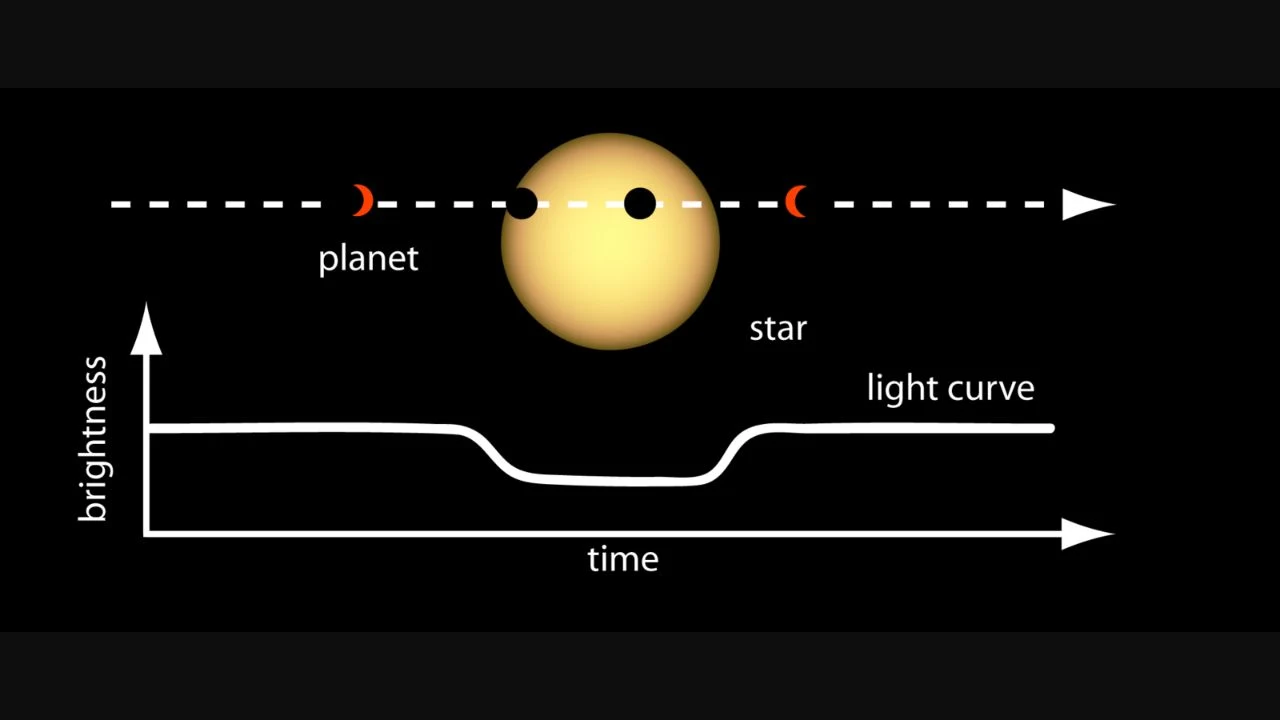
Most distant planets are not resolved as little disks next to their stars. A star is vastly brighter, and the two points appear extremely close together from Earth. The transit method avoids that glare problem by measuring all the light from the star and waiting for a planet to cross the star's face from our point of view. For a few hours, the planet blocks a small fraction of the light.
Astronomers plot those measurements as a light curve: brightness against time. A transit appears as a shallow dip with a descent, a flatter middle and a rise back toward the earlier level. The telescope has not taken a close-up picture of the planet. It has recorded a temporary shortage of photons, then used the shape and timing of that shortage as evidence for an otherwise unresolved world.
Repetition turns one dip into a possible orbit
A single dip is not enough to establish a planet. If similar dips return at regular intervals, the spacing reveals the orbital period: the time the planet takes to travel around its star. The duration and detailed shape of each transit also carry information about the crossing path and orbital geometry. Missions such as Kepler and TESS therefore monitor stellar brightness repeatedly rather than relying on one dramatic frame.
The geometry creates a built-in blind spot. A transit is visible only when the orbit is aligned closely enough for the planet to cross the star from the telescope's perspective. Large planets block more light, and planets on short orbits cross more often, so they are generally easier for a transit survey to find. A solar system seen from another angle could contain several planets while showing no transits at all.
The depth gives a radius only after the star is understood
In the simplest case, the fraction of light blocked is approximately the square of the planet's radius divided by the star's radius. A deeper dip therefore points to a larger planet relative to its star. But relative is the crucial word. Astronomers need a good estimate of the star's size before the same dip can become a useful estimate of the planet's actual radius.
A transit does not directly give the planet's mass. Radial-velocity observations can look for the small back-and-forth motion that an orbiting planet produces in its star, while other techniques may supply additional constraints. Combining mass with the transit radius gives an estimate of density, which helps distinguish a compact rocky world from a lower-density planet rich in gas. Each method answers a different part of the puzzle.
A planet candidate has to survive the impostor tests
Stars change brightness for reasons that have nothing to do with planets. Dark starspots can rotate into view. Two stars can eclipse each other. A background eclipsing binary can blend with the target star, and an instrument can introduce a false alarm. Some of these effects produce dips that look surprisingly planet-like until astronomers inspect the timing, colour, position and shape of the signal.
That is why discovery teams use the cautious term planet candidate before confirmation. They check whether every event repeats consistently, examine the image pixels for a shifting source and seek follow-up observations with another telescope or method. NASA's confirmation outline also includes expert review and entry into a recognised archive. The exciting claim comes at the end of that process, not at the first suspicious dip.
The shadow can even carry a faint atmospheric fingerprint
During a transit, a tiny portion of the star's light passes through the edge of a planet's atmosphere before reaching the telescope. Atmospheric molecules absorb particular wavelengths, making the planet appear slightly larger at those wavelengths. Astronomers compare spectra taken during and outside transit to build a transmission spectrum from those very small differences.
Webb observations of the hot gas giant WASP-39 b, for example, produced a transmission spectrum with a carbon-dioxide feature. That is a chemical measurement, not a photograph of clouds and not automatic evidence of life or habitability. Clouds, hazes, the star's own activity and the limits of the instrument all complicate the interpretation. The remarkable achievement is more precise: a world can remain unseen as a resolved object while its shadow reveals an orbit, a size and, in favourable cases, traces of the gases around it.
Sources and further reading
- NASA Science: What's a transit? ↗
- NASA Science: How we find and characterize exoplanets ↗
- NASA Science: Ten steps to confirm a planet around another star ↗
- NASA Roman Space Telescope: The transit method ↗
- NASA: Exoplanet Science Strategy ↗
- Space Telescope Science Institute: WASP-39 b transmission spectrum ↗
This article was written for Curiosity Desk. We do not copy other publishers or invent quotes. If a material error is found, we correct it openly.
Read the full standards →One answer should lead to a better question
Bring your curiosity to the group
Curious Minds is our public Facebook community for surprising science, strange history, Australian wildlife and everyday questions. No copied posts, no personal-friend invitations and no link dumping.
- Three self-contained discussion prompts each week
- Sourced answers and honest uncertainty
- Respectful conversation without spam