A black hole does not pull with a different kind of gravity
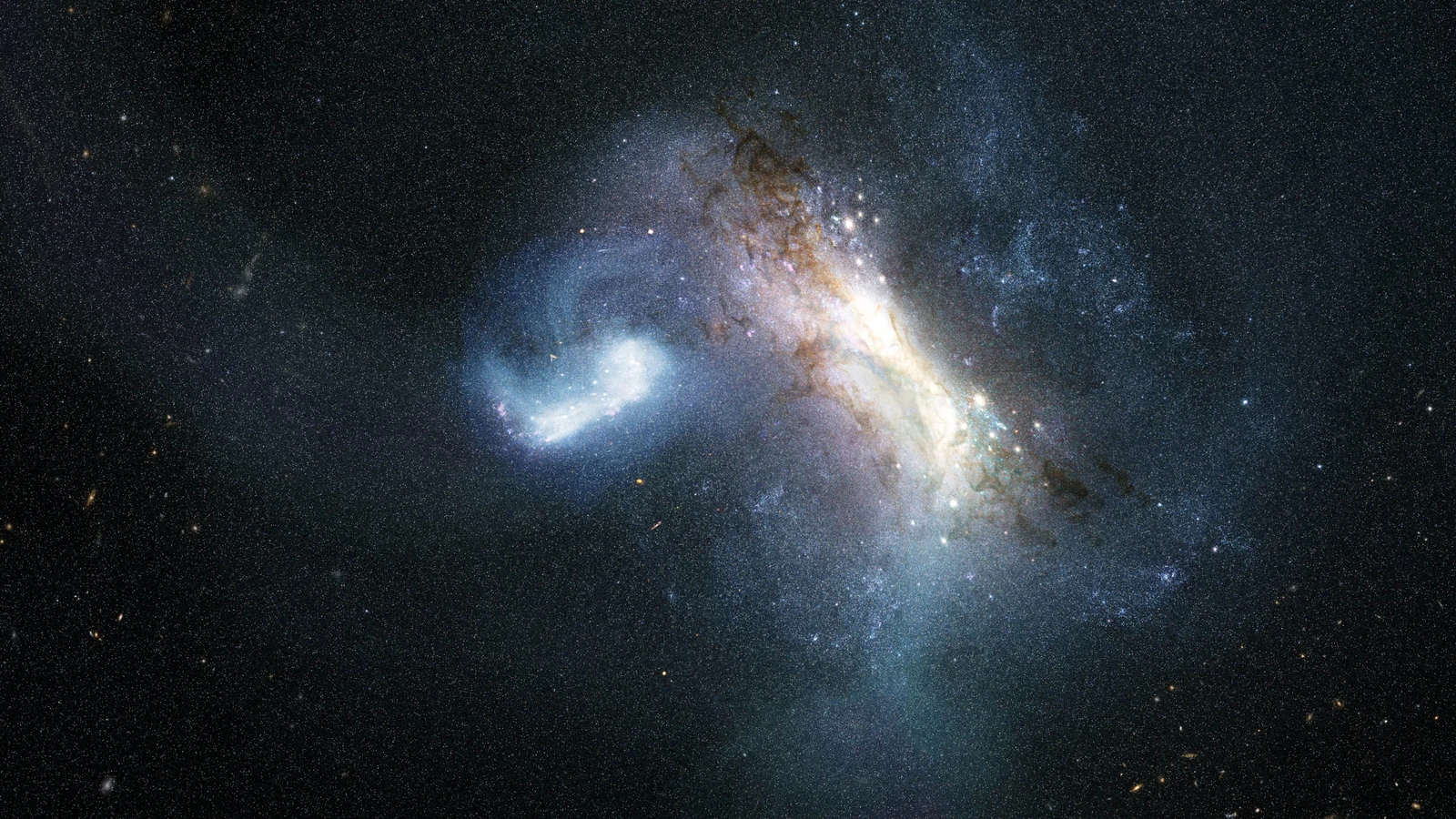
The popular picture is a drain in space, dragging stars and planets toward a bottomless opening. NASA gives a calmer description: black holes do not suck in surrounding matter. At a given distance, an isolated black hole pulls through gravity just as another object of the same mass would. It can bend an orbit, capture matter or be orbited itself, but it has no extra vacuum force reaching beyond ordinary gravity.
Imagine replacing the Sun instantly with a black hole of exactly one solar mass. This is a thought experiment, not a possible future for our Sun, which is not massive enough to collapse that way. Earth would lose its light and heat, but its orbit would remain approximately the same because the central mass had not changed. The black hole would be only kilometres across, yet from 150 million kilometres away its gravitational influence would match the Sun's.
The real difference is how close the mass is packed
A normal star spreads its mass through a large sphere and has a surface that stops an approaching object. A black hole compresses mass inside an event horizon, allowing matter to travel much closer to the centre before losing any path back out. Near that region, spacetime is strongly curved and the difference in gravity across a single object can become enormous. Those unequal pulls are tidal forces, not suction.
Strong tidal forces can stretch an object lengthwise and squeeze it sideways, a process nicknamed spaghettification. The exact experience depends on the black hole's mass and the route taken. Around a smaller stellar-mass black hole, lethal tides can arrive before the horizon. At a supermassive black hole, the horizon is much larger and local tidal differences there can be weaker, although survival deeper inside is still not an option described by known physics.
Falling matter usually has to lose an orbit first
Gas near a black hole often arrives with sideways motion, so it does not plunge directly inward. It circles in an accretion disk. Collisions, turbulence and magnetic fields redistribute energy and angular momentum, allowing some material to spiral closer while other material or energy moves outward. A passing star with enough speed and distance can simply swing around the black hole or settle into an orbit instead of being swallowed.
The disk can be one of the brightest objects in the universe. As gas is compressed, sheared and heated before crossing the horizon, it can release visible light, ultraviolet radiation and X-rays. The black hole itself is not glowing or reflecting. Some systems also launch narrow jets of particles from the region around the black hole, powered by magnetic fields and the rotating disk or black hole. The light show belongs to matter outside the horizon.
The famous orange ring is a shadow, not a photographed surface
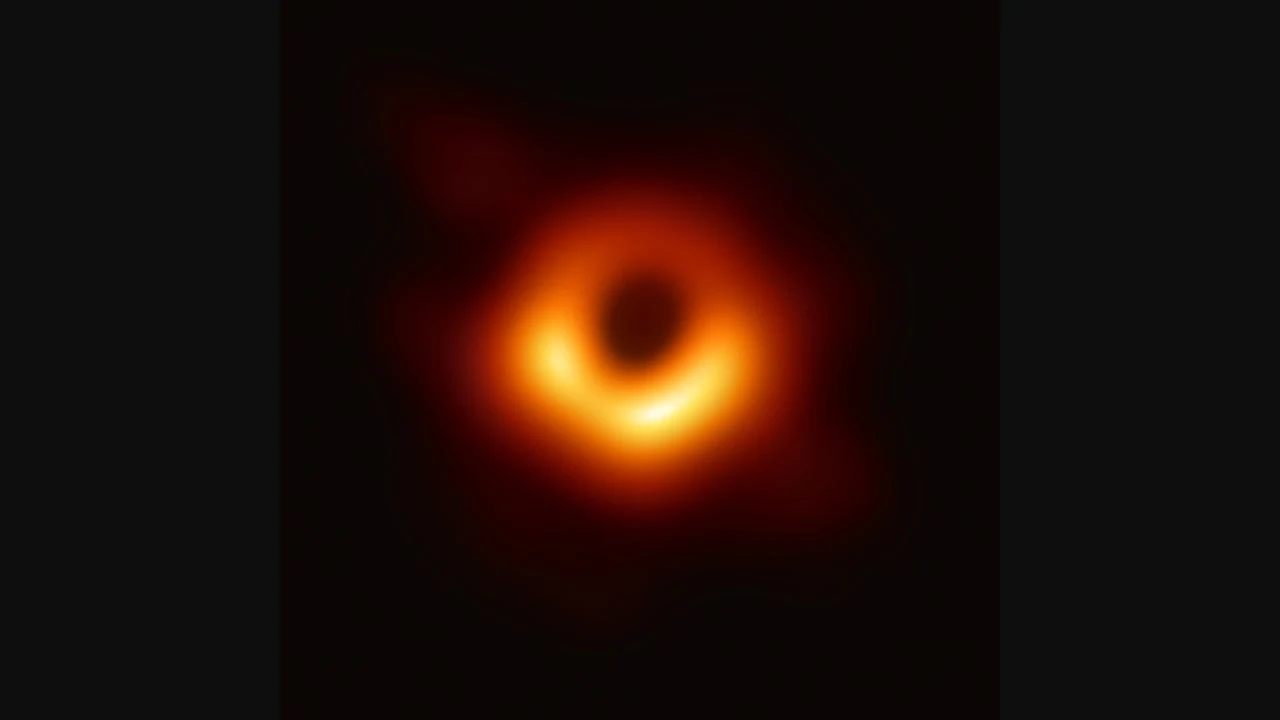
In 2019 the Event Horizon Telescope collaboration released the first image showing direct visual evidence of a black hole's shadow. It combined radio observations from telescopes spread across Earth to study M87*, a supermassive black hole about 55 million light-years away with a mass around 6.5 billion times that of the Sun. The orange ring is emission from hot material whose light has been bent into paths around the black hole.
The dark centre is not a photograph of material inside the event horizon. It is a shadow-like region created because the black hole captures some light while gravity redirects other rays around it. The event horizon itself is a boundary in spacetime, not a solid shell. Once matter or light crosses inward, no signal can return to tell distant observers what happened beyond that boundary.
Astronomers find an invisible object by watching everything around it
A black hole with no nearby material can be extremely difficult to see, but its effects leave several kinds of evidence. Astronomers track stars orbiting an unseen compact mass, measure X-rays from hot accretion flows and look for gravitational lensing when gravity magnifies a background source. These methods reveal mass and motion without requiring the object itself to emit light.
Merging black holes supply another signal. In 2015, the LIGO detectors measured gravitational waves from two black holes spiralling together, a changing distortion of spacetime that reached Earth more than a billion years later. Such observations confirm that black holes grow through mergers and captured matter, not by automatically vacuuming up their surroundings. Their power comes from ordinary gravity pushed into an extraordinary compact regime.
Sources and further reading
This article was written for Curiosity Desk. We do not copy other publishers or invent quotes. If a material error is found, we correct it openly.
Read the full standards →One answer should lead to a better question
Bring your curiosity to the group
Curious Minds is our public Facebook community for surprising science, strange history, Australian wildlife and everyday questions. No copied posts, no personal-friend invitations and no link dumping.
- Three self-contained discussion prompts each week
- Sourced answers and honest uncertainty
- Respectful conversation without spam