The sneeze is responding to light, not something floating in the air
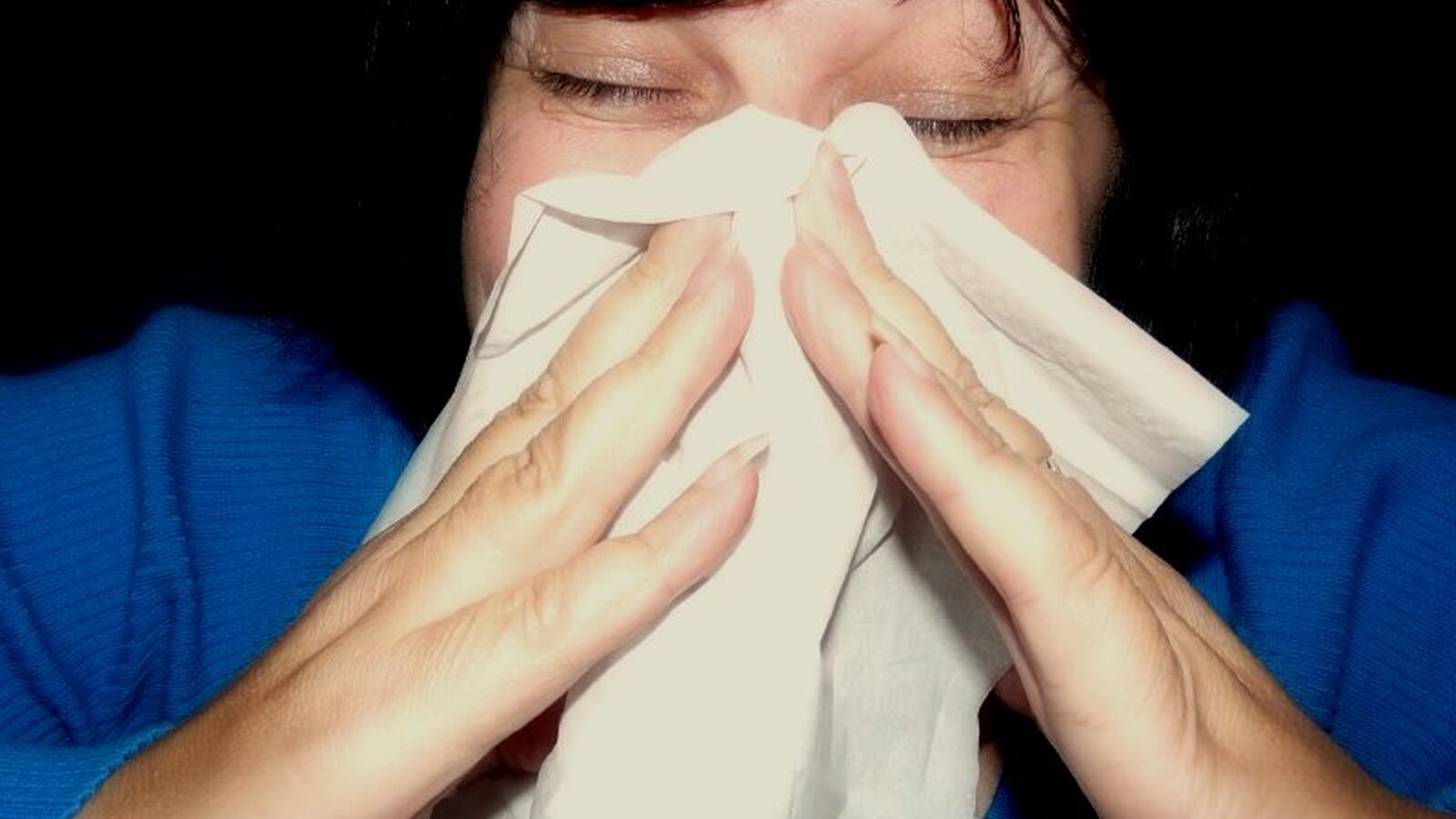
Step out of a dim cinema or drive into sunlight after a tunnel and a sneeze may arrive within seconds. Nothing had to enter the nose. In susceptible people, the sudden increase in brightness can activate an involuntary response called the photic sneeze reflex. The light reaches the eyes, yet the final action belongs to the same protective system that normally clears irritants from the nose.
That does not make sunlight an allergen. An allergy involves an immune response to a substance, while this is a reflex triggered by a sensory change. Researchers can observe the pattern, but they still cannot point to one confirmed neural shortcut that explains every case. The most accurate answer is therefore both simple and unfinished: bright light can set off the sneeze network in some nervous systems, and science is still working out exactly how.
A sudden jump in brightness matters more than the Sun itself
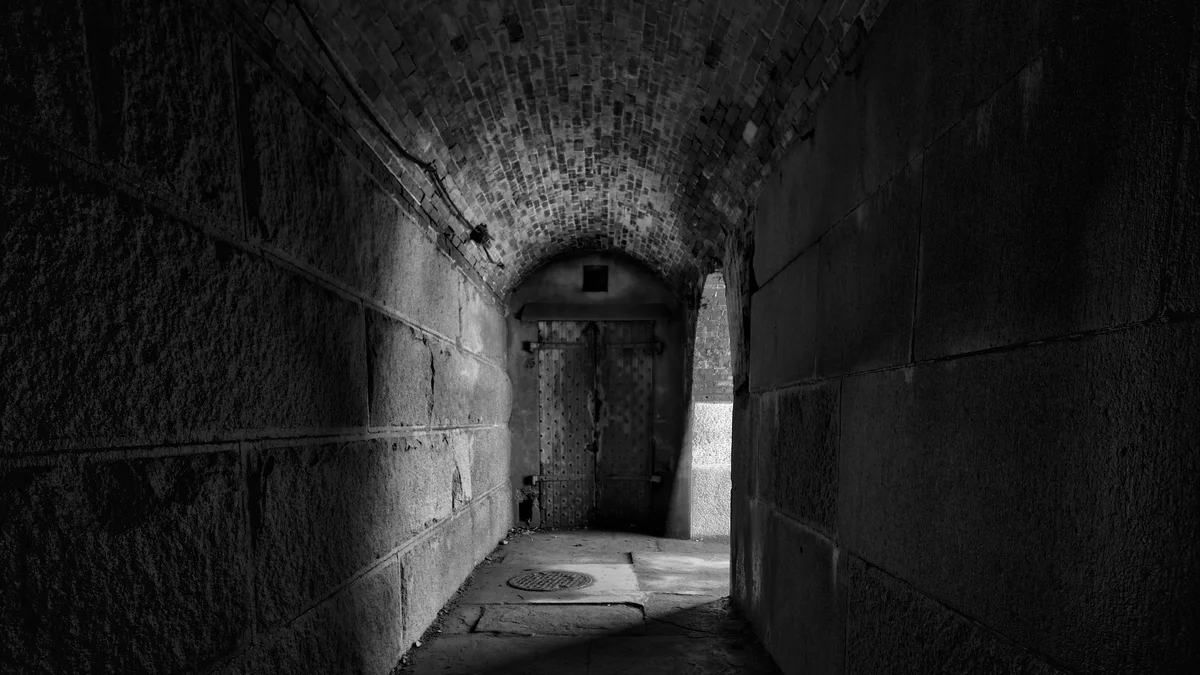
The classic trigger is not merely being outdoors. It is the transition from relative darkness into intense light. A recent review found that bright natural and artificial light can provoke the sensation or sneeze, usually soon after exposure, but studies use very different lamps, durations and definitions. Researchers do not yet have a standard laboratory stimulus that reliably makes every photic sneezer respond on command.
A 2026 naturalistic case study tracked one affected participant for 30 days. Sneezes followed large rises in environmental illuminance, while more than 150 controlled artificial exposures caused tickling but not a sneeze. One person cannot establish a general rule, yet the result shows why this deceptively ordinary reflex is difficult to pin down. A doorway can reproduce a mixture of brightness, adaptation and context that a laboratory lamp may not.
The eye and nose use different routes, but their signals may meet
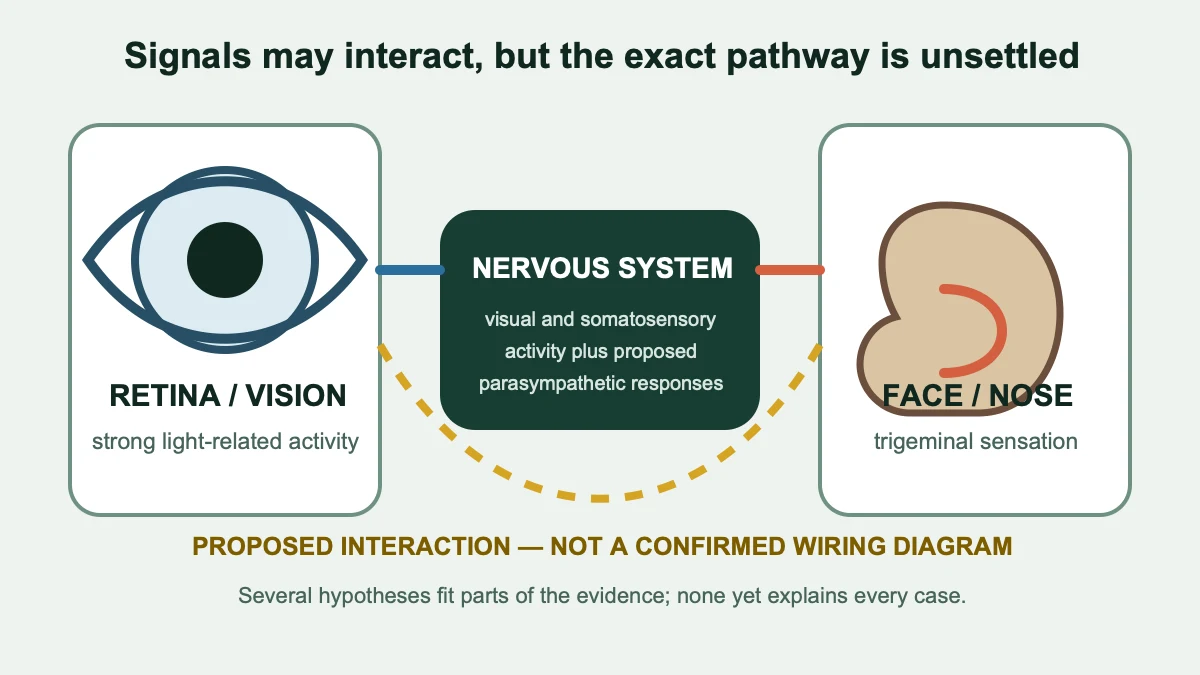
Light information begins with the retina and travels through visual pathways. Nasal irritation is carried largely through branches of the trigeminal nerve, a major sensory nerve for the face. One long-standing idea proposes that unusually strong light-related activity spills into or is combined with trigeminal processing, creating the feeling that the nose has been tickled even though no dust arrived. Other proposals involve broader parasympathetic responses, the automatic system that also helps control tears and nasal secretions.
Those explanations are plausible models, not established wiring diagrams. An electroencephalography study found that people with the reflex showed stronger activation in visual areas and secondary somatosensory regions than controls. That supports the idea that their response involves more than a simple brainstem reflex, but it does not prove which nerve connection starts the sneeze. The newer stimulus review reached the same careful conclusion: several mechanisms fit parts of the evidence, and none has been validated conclusively.
It runs in families, but there is no single sneeze switch
The playful name ACHOO syndrome expands to autosomal dominant compelling helio-ophthalmic outburst. The acronym makes the trait sound as if it must follow one simple dominant gene. Family studies do support inherited influence, but modern genetic evidence is more complicated. Genome-wide studies look across many DNA variants and ask whether particular versions appear more often in people who report the reflex.
Studies in Chinese and Japanese populations have found associations at several locations in the genome, including a repeatedly observed region on chromosome 3. The Chinese study described the trait as polygenic, meaning that multiple genetic differences probably contribute rather than one universal on-off gene. Genes may help explain susceptibility, but self-reported answers, study design and population differences also change the measured result. Inheriting a tendency is not the same as carrying a completely understood ACHOO gene.
The famous one-in-four estimate is useful, but not universal
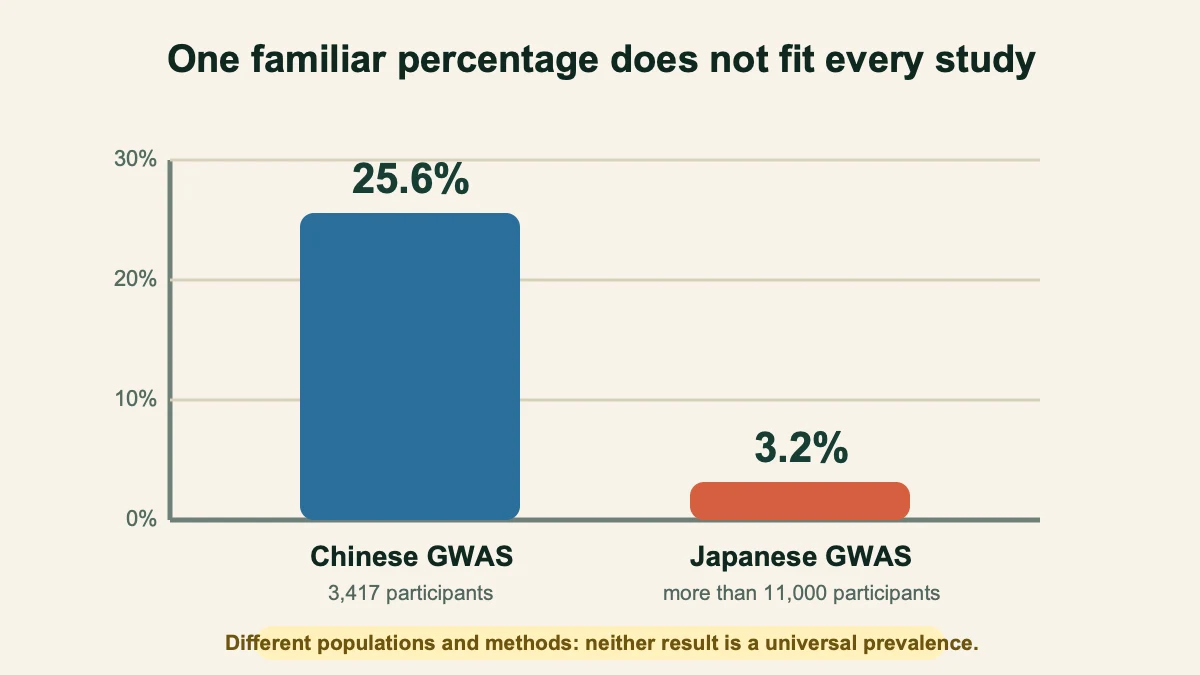
You will often read that about a quarter of people sneeze in bright light. Several samples do land near that figure. A Swedish blood-donor study reported roughly 24 per cent, and a Chinese genome-wide study found 25.6 per cent among 3,417 participants. Those numbers show that the reflex is not rare or imaginary.
They do not establish one worldwide prevalence. A Japanese genome-wide study reported 3.2 per cent among more than 11,000 participants. Question wording, ancestry, sampling and the threshold for calling a mild tickle a reflex can all influence the result. The responsible summary is that photic sneezing affects a meaningful minority of people, with estimates varying substantially across studies. A precise global percentage would claim more certainty than the evidence provides.
Usually harmless, the reflex matters most when a second is costly
For most people, a sunlight sneeze is a brief oddity. The practical risk appears when it interrupts a task that needs uninterrupted vision and control. Driving out of a dark tunnel, flying, cycling or working around moving machinery leaves little room for a sudden eye-closing reflex. If you know bright transitions trigger you, a vehicle visor, hat or sunglasses can reduce the abrupt light change. Put them in place before the transition rather than reaching for them while driving.
Do not test the reflex by staring at the Sun or another painfully bright source. Looking directly at the Sun can injure the retina, and a sneeze experiment cannot diagnose health. A familiar, brief light-triggered sneeze is different from persistent sneezing, breathing trouble, new eye pain or new visual symptoms. Those deserve appropriate medical advice. The everyday mystery remains striking enough without taking a risk: for some people, a burst of light aimed at the eyes can make the nose behave as though it detected an intruder.
Sources and further reading
- F1000Research: naturalistic bright-light exposure case study ↗
- Scientific Reports: review of the light conditions that elicit photic sneezing ↗
- Scientific Reports: genome-wide association study in a Chinese population ↗
- Journal of Human Genetics: genome-wide association study in a Japanese population ↗
- PLOS ONE: EEG study of neural activity during photic sneezing ↗
- NCBI Bookshelf: clinical summary of ACHOO syndrome ↗
- Wikimedia Commons: contextual sneeze photograph and CC BY 2.0 licence record ↗
- Wikimedia Commons: dark-tunnel-to-bright-doorway photograph and CC BY-SA 2.0 licence record ↗
This article was written for Curiosity Desk. We do not copy other publishers or invent quotes. If a material error is found, we correct it openly.
Read the full standards →One answer should lead to a better question
Bring your curiosity to the group
Curious Minds is our public Facebook community for surprising science, strange history, Australian wildlife and everyday questions. No copied posts, no personal-friend invitations and no link dumping.
- Three self-contained discussion prompts each week
- Sourced answers and honest uncertainty
- Respectful conversation without spam