The strongest test used a voice with no person attached
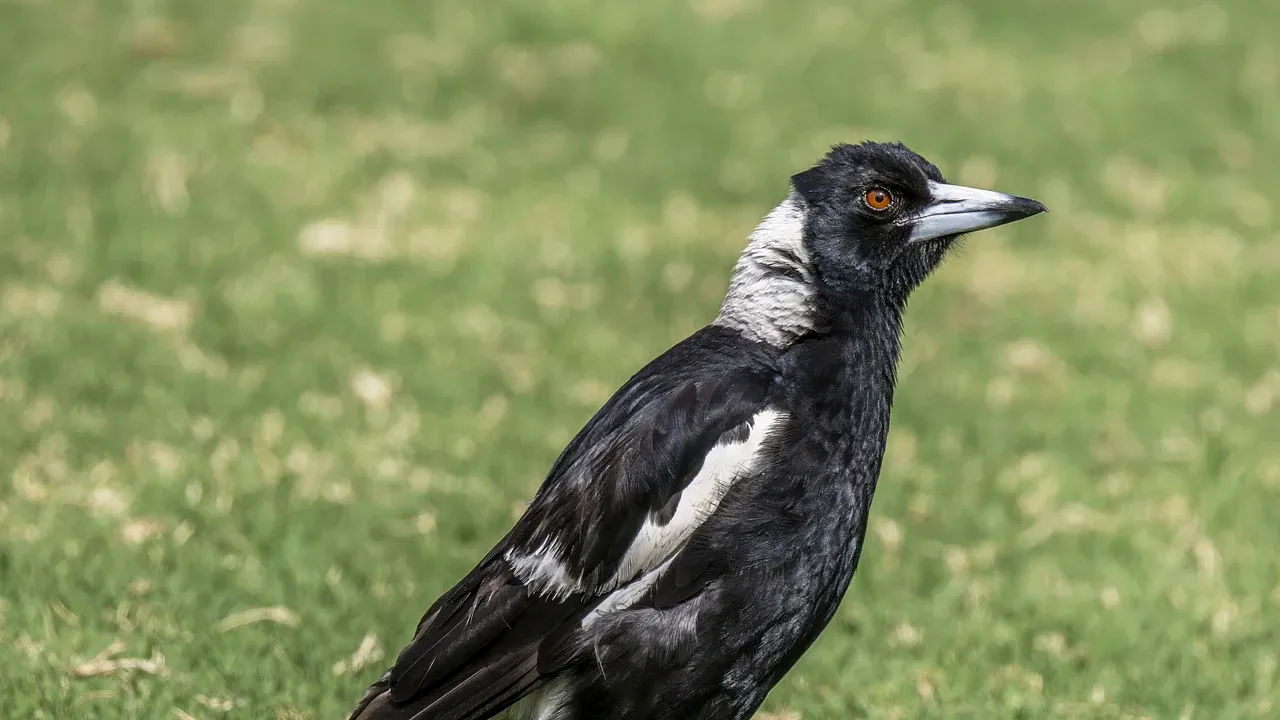
An Australian magpie in a suburban territory hears the same neighbours, gardeners and researchers again and again. That makes a simple question surprisingly difficult to test. If a bird reacts differently to two people standing nearby, it might be reading their face, clothing, movement, posture or previous behaviour. A voice playback removes most of those extra clues.
In 2021, researchers worked with wild female Western Australian magpies and played recordings of familiar and unfamiliar humans. The unfamiliar voices produced more vigilance than the familiar voices. With the speaker separated from the person who made the sound, the experiment showed that vocal information alone was enough for the birds to sort a known human from a stranger.
A stranger's voice changed what the bird did next
Vigilance is visible behaviour. A bird interrupts other activity, scans its surroundings or holds itself ready to respond. The magpies did more of this after hearing an unfamiliar voice, suggesting that the unknown person represented greater uncertainty or possible threat. The familiar voice did not demand the same level of checking.
That response makes sense in a landscape shared with people. A familiar human who has repeatedly passed without causing trouble supplies a history of low-risk encounters. An unknown voice does not. The bird does not need a human-like biography for the speaker; it only needs a useful distinction between familiar and unfamiliar.
Recognition is not the same as the viral face claim
The experiment provides direct evidence for discrimination by voice. It does not demonstrate that every Australian magpie can identify a hundred human faces, remember a face for decades or recognise someone through any disguise. Those claims are frequently repeated online, but they are stronger than the Australian playback evidence can support.
Even the word recognition needs care. A bird can respond to the category familiar without the experiment proving that it stores a unique identity file for each person. The result is still remarkable: a wild bird extracted stable information from human speech sounds and used it to change its assessment of risk.
Their social lives give memory plenty of work
Western Australian magpies live in territorial social groups. They encounter group members, neighbours, rivals, predators and people while defending space and raising young. In that setting, treating every sound as new would be wasteful. Familiarity lets an animal reserve attention for changes that may matter.
A 2023 playback study found that the same population responded more strongly to territorial carols from outside its group than to calls from its own group. That study concerned other magpies, not humans, but it shows the broader value of vocal sorting. Sound can reveal whether a caller belongs inside or outside a familiar social world.
Larger groups were linked with stronger cognitive performance
Another Western Australian field study repeatedly tested wild magpies with four cognitive tasks. Performance across the tasks was correlated, and birds living in larger groups performed better. In juveniles, the relationship emerged during development, which supported the idea that a more demanding social environment may help shape cognition rather than merely attracting already-skilled birds.
Female task performance was also positively associated with measures of reproductive success. The researchers described a general cognitive factor, not a special face-recognition module. The study does not prove that group size caused the human-voice result, but it shows that flexible learning in these birds is measurable, variable and connected to their real social ecology.
Swooping is a separate question from recognition
A bird can recognise familiarity without swooping, and a swooping bird may respond to a category such as cyclists rather than one particular person. A Brisbane-area study of breeding pairs found that some suburban pairs were consistently aggressive to human intruders while others were not. In 97.5 per cent of recorded attacks on humans, the attacker was male.
None of the rural magpies in that study attacked human intruders, even though they defended against other bird species. That contrast suggests that aggression toward people is not an automatic property of the species. Local experience, breeding context and the behaviour of individual males all matter. Recognition may help refine a response, but it is not a simple switch labelled friend or enemy.
The name magpie creates a scientific trap
Australia's magpie is not the same species as the black-and-white Eurasian magpie. The Australian bird belongs to the family Artamidae, alongside butcherbirds and currawongs, while the Eurasian magpie Pica pica is a corvid. A shared common name does not make experimental results interchangeable.
A well-known controlled study found that wild Eurasian magpies distinguished individual people who had approached their nests. It is useful comparative evidence about what birds can learn, but it cannot be cited as a direct test of Gymnorhina tibicen. The Australian voice-playback study is the cleaner evidence for our local species.
Being familiar is not an invitation to feed wildlife
A magpie may become accustomed to people who share its territory, but food is not required to create that familiarity. Regular feeding can produce nutritional imbalance, dependence, crowding and conflict. It can also turn a careful scientific observation into a human-controlled relationship with consequences for the bird.
The safer form of familiarity is predictable distance. Do not approach a nest, harass a bird or test whether it remembers you. During a swooping event, official New South Wales guidance recommends moving quickly and carefully away, avoiding the area while the behaviour continues and protecting the head without striking at the bird.
What the magpie probably knows about you
The direct answer is narrower and more interesting than the folklore. A wild Western Australian magpie can hear enough individuality in a human voice to distinguish a familiar speaker from an unfamiliar one. Its response is practical: an unknown voice produces more watchfulness.
Faces, gait, clothing and repeated behaviour may provide additional clues in daily life, but each requires its own test. Good curiosity does not need to inflate the result. A bird listening from a lawn has already done something impressive before a face enters the story: it has placed one human voice inside its known neighbourhood and another outside it.
Sources and further reading
- Ethology: Female Western Australian magpies discriminate between familiar and unfamiliar human voices ↗
- Nature: Cognitive performance is linked to group size and affects fitness in Australian magpies ↗
- Ibis: Australian magpies discriminate between territorial calls from inside and outside their group ↗
- Emu: Aggression by Australian magpies toward human intruders ↗
- Queensland Government: Australian magpie behaviour and swooping ↗
- NSW Environment and Heritage: Australian magpie safety guidance ↗
This article was written for Curiosity Desk. We do not copy other publishers or invent quotes. If a material error is found, we correct it openly.
Read the full standards →One answer should lead to a better question
Bring your curiosity to the group
Curious Minds is our public Facebook community for surprising science, strange history, Australian wildlife and everyday questions. No copied posts, no personal-friend invitations and no link dumping.
- Three self-contained discussion prompts each week
- Sourced answers and honest uncertainty
- Respectful conversation without spam