Spirit stayed awake and caught the colour reversal
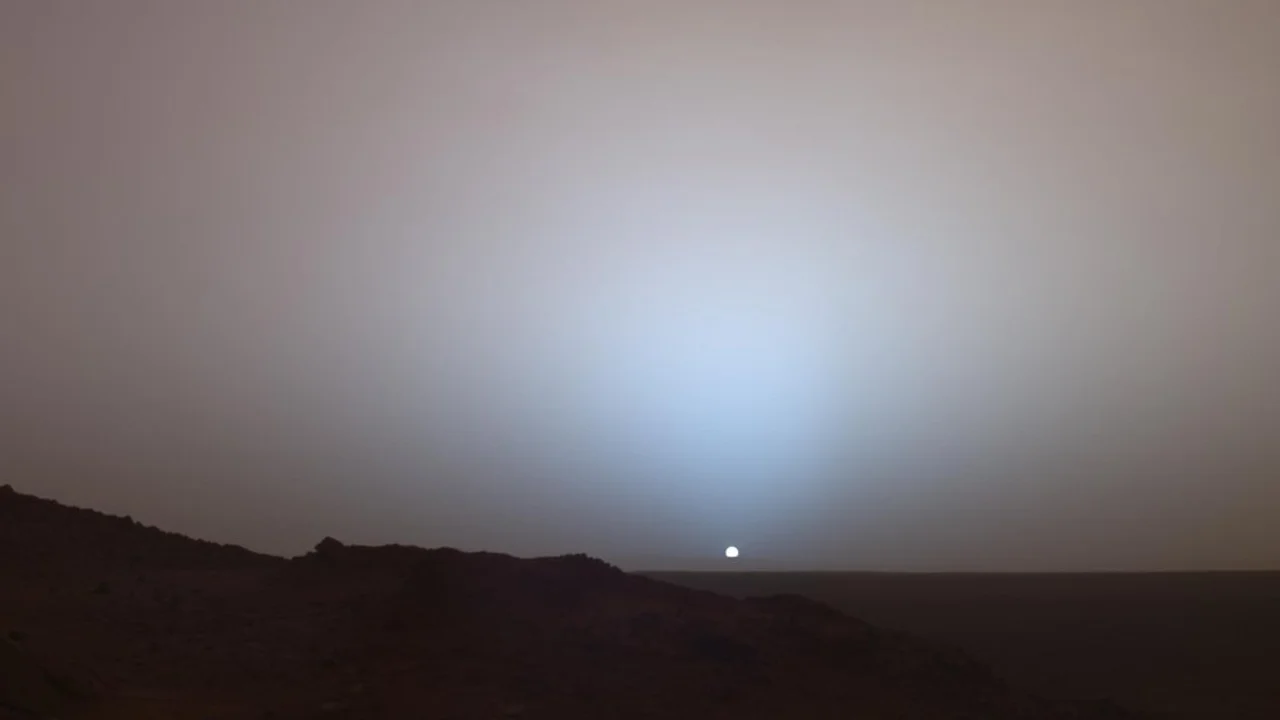
On 19 May 2005, NASA's Spirit rover remained awake after its normal data transmission and aimed its Panoramic Camera west. At about 6:07 pm on mission sol 489, the Sun slipped behind the rim of Gusev crater. A cool blue glow surrounded it while the wider sky retained a dusty reddish cast.
This is the exact scene in the photograph above. It is not an artist's impression and it is not a photograph of an earthly desert passed off as Mars. NASA has also recorded comparable blue regions near the Sun with Pathfinder, Opportunity and Curiosity. Perseverance saw a more muted sunset when less dust was present.
Does Mars have a blue sky?
Usually not in the familiar Earth-like sense. Under dusty daytime conditions, a person on Mars would generally see a butterscotch, tan, yellow-orange or reddish sky. The precise colour changes with the amount and type of dust, the viewing direction, the time of day and the way a camera image has been calibrated.
Near sunrise or sunset, the strongest blue or blue-grey colour gathers close to the solar direction. The rest of the sky can remain yellow, orange, tan or red. A blue halo and a warmer wider sky are therefore parts of the same Martian scene, not contradictory descriptions.
Why are sunsets on Mars blue?
NASA's Pathfinder description makes the distinction explicit. Dust absorbs some blue light, contributing to the red sky, yet particle size also allows blue light to be scattered into the area immediately around the Sun. These processes happen together, so a blue halo and a reddish wider sky are not contradictory.
Sunset makes the effect easier to see because sunlight crosses a much longer path through the dusty atmosphere. Fine particles send more of the blue light forward, keeping it closer to the direction of the Sun, while yellow and red light spread more widely across the sky.
Mars is not simply Earth with the colours reversed
Earth's clear blue sky is dominated by Rayleigh scattering from gas molecules much smaller than visible wavelengths. Shorter blue wavelengths are scattered strongly across the sky. When the Sun is low, its light travels through a longer path and much of that blue is redirected away, leaving familiar oranges and reds in the direct beam.
Mars has a very thin carbon dioxide atmosphere, but suspended dust often controls what a surface observer sees. Those particles are roughly comparable with the wavelengths of visible light. Their optical behaviour is more complicated than the simple rule used for molecules in a clear terrestrial atmosphere.
Micron-sized dust keeps blue close to the Sun
A 2014 Applied Optics study modelled common Martian dust using Mie theory and a Debye series. It found that the blue glow surrounding the Sun is dominated by near-forward scattering of blue light. A simple explanation based only on removing one colour from the direct beam could not reproduce the observed aureole.
NASA scientist Mark Lemmon describes the result in plainer language. Blue light penetrates the dusty atmosphere slightly more efficiently, then remains closer to the direction of the Sun when it scatters. Yellow and red light spread more broadly through the sky. The geometry sorts the colours by both wavelength and direction.
Sunset supplies the longest dusty path
Near noon, sunlight takes a relatively short route through the atmosphere to a rover. At sunrise and sunset, the shallow angle forces it through much more suspended dust. That longer path makes the difference between the concentrated solar halo and the wider sky easier to see.
The same dust can keep twilight alive after the Sun disappears. NASA reports that Spirit observations found a fading glow for as long as two hours before sunrise or after sunset because high-altitude dust scattered sunlight around to the planet's night side. The colour photograph therefore also contains information about vertical dust distribution.
More dust does not guarantee a prettier blue
The amount, height, size and shape of suspended material all matter. A very dusty atmosphere can dim the Sun dramatically, while a clearer one can produce a less pronounced colour separation. Perseverance's first Mastcam-Z sunset in November 2021 appeared muted, and the mission team linked that appearance to lower dust abundance.
Ice clouds can also occupy the Martian sky, but NASA's Pathfinder team concluded that the blue area in its sunset image came from the dust itself rather than a water-ice cloud. One photograph cannot describe every Martian evening. It records a particular atmosphere, season, camera and viewing geometry.
The famous Spirit frame needs an honest colour caption
Spirit combined measurements through 750, 530 and 430 nanometre filters. NASA describes the result as false colour that is similar to human vision but slightly exaggerated. The blue glow above the Sun would be visible to a person there, while the camera's infrared capability made the redness farther from the sunset stronger than the normal daytime colour.
That qualification does not make the sunset fake. It separates the observed atmospheric effect from the way a scientific instrument turns filtered measurements into a screen image. Curiosity's Mastcam sunset was calibrated and white-balanced differently, and its camera sees colour much like human eyes while being somewhat less sensitive to blue.
Rover sunsets double as atmospheric instruments
Mission teams do not keep rovers awake at dusk only for beautiful pictures. The Sun is a known light source, and the way its brightness and surrounding glow change lets researchers estimate atmospheric opacity and investigate dust or ice clouds. The blue halo is data about particles suspended far above the ground.
Dust influences much more than colour. It changes how sunlight heats the atmosphere and surface, affects visibility and can reduce the power available to solar panels. Understanding its distribution matters for weather models, robotic operations and any future crew that must live with Martian air and dust.
The surprise comes from direction, not a swapped paint palette
It is tempting to remember only that Earth has red sunsets and Mars has blue ones. The better explanation is directional. On Mars, a blue aureole stays concentrated near the Sun because of the way fine dust scatters light forward. Look farther from the Sun and warmer colours still dominate much of the sky.
Spirit's sol 489 image is powerful precisely because it records familiar sunlight after an unfamiliar atmosphere has sorted it. The Sun is smaller because Mars is farther away, the horizon belongs to Gusev crater and the blue is real. What changed was not the star, but the particles between the star and the camera.
Sources and further reading
- NASA JPL: Spirit's sol 489 sunset, camera filters and image interpretation ↗
- NASA Science: What sunrises and sunsets look like on Mars ↗
- NASA Science: Pathfinder colour variations at sunset ↗
- Applied Optics: Blue moons and Martian sunsets ↗
- NASA Science: Curiosity's calibrated sunset at Gale crater ↗
- NASA JPL: Mastcam-Z's first Martian sunset ↗
This article was written for Curiosity Desk. We do not copy other publishers or invent quotes. If a material error is found, we correct it openly.
Read the full standards →One answer should lead to a better question
Bring your curiosity to the group
Curious Minds is our public Facebook community for surprising science, strange history, Australian wildlife and everyday questions. No copied posts, no personal-friend invitations and no link dumping.
- Three self-contained discussion prompts each week
- Sourced answers and honest uncertainty
- Respectful conversation without spam