The names hide the most important difference
A buyer could reasonably assume that Galaxy Z Fold8 is the direct replacement for Galaxy Z Fold7 and that Fold8 Ultra is simply a larger premium edition. Samsung's own Australian product pages say something more unusual. The company describes Fold8 Ultra as the model that continues the original Z Fold line, while Fold8 is an all-new shape and experience.
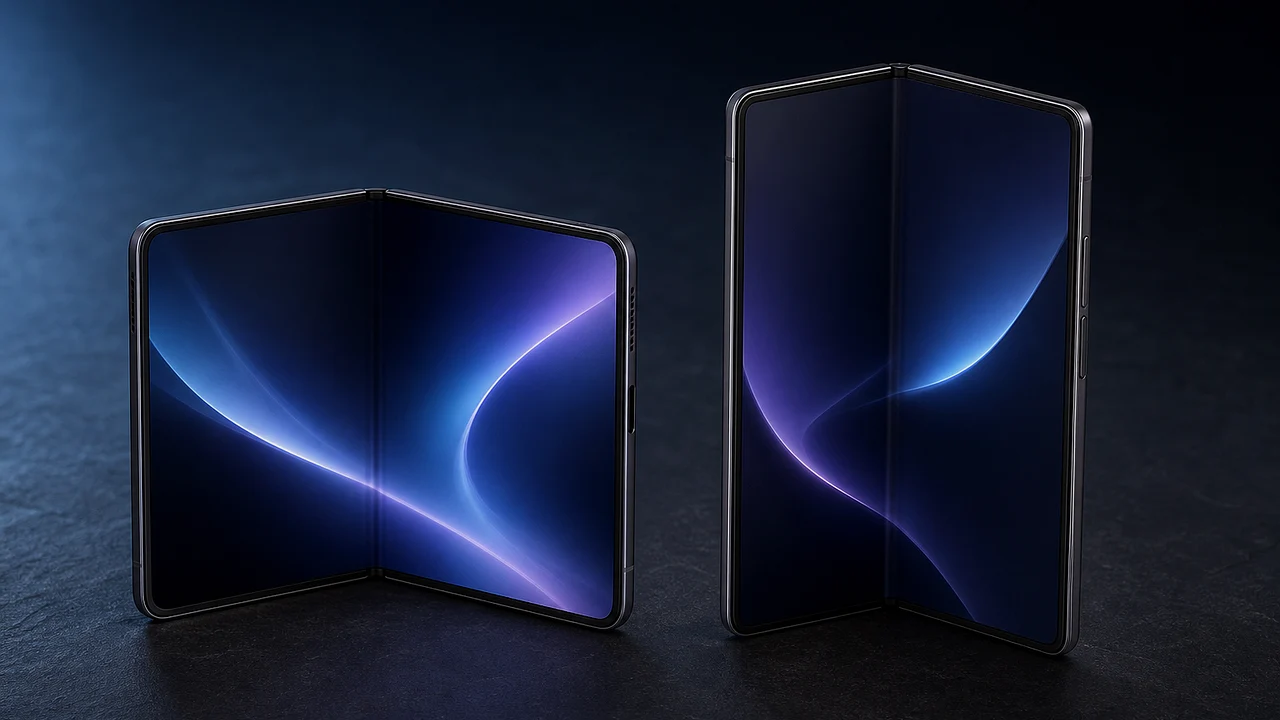
That makes this less like choosing a standard phone and paying extra for an Ultra version of the same body. Both devices open like books, but they are built around different proportions. The Fold8 is shorter and much wider when closed. The Ultra keeps the taller, narrower shape that owners of recent Galaxy Z Fold phones will recognise.
Australian prices start $300 apart
The Australian recommended retail price starts at $2,699 for a Fold8 with 12GB of memory and 256GB of storage. The equivalent Fold8 Ultra starts at $2,999. At 512GB the prices are $2,999 and $3,299. The 1TB versions, which pair that storage with 16GB of memory, are $3,599 and $3,899 respectively.
Pre-orders opened on 23 July 2026 and run through 13 August, with general Australian availability from 14 August. Those dates and prices were checked on 24 July. Retail discounts, trade-in valuations and plan costs can change, so the useful comparison is the total amount payable for the same storage capacity, not an advertisement's largest possible saving.
The Fold8 is the lighter phone but the wider object
Folded, the Fold8 measures 81.9 by 123.9 by 9.7 millimetres and weighs 201 grams. The Ultra is 72.8 by 158.4 by 8.9 millimetres and weighs 215 grams. The Fold8 is therefore 14 grams lighter and 35 millimetres shorter, but about 9 millimetres wider and slightly thicker when closed.
Those numbers describe a real ergonomic trade-off. A shorter device may sit more comfortably in some bags and jacket pockets, while the wider body may be harder to wrap one hand around or fit into a narrow trouser pocket. The Ultra occupies more vertical space but resembles a conventional phone when closed. A specification sheet cannot decide which shape fits your hand, pocket, car mount or daily use.
Open them and the aspect ratios tell two different stories
The Fold8 has a 5.5-inch cover display and a 7.6-inch main display. Samsung describes its outer screen as 10:16 and the unfolded screen as 4:3. The idea is a compact passport-like device that becomes a wide canvas for video, games, magazines and reading.
The Ultra has a 6.5-inch cover screen and an 8-inch main screen. Its larger, taller body leaves more room for side-by-side apps and resembles the established Fold layout. Diagonal measurements alone do not show the difference: two displays can have similar diagonal sizes while their width, height and usable shape feel very different.
The $300 does not buy a faster processor
Both Australian models use the Snapdragon 8 Elite Gen 5 for Galaxy. Both offer 12GB of memory with 256GB or 512GB of storage and 16GB with 1TB. Both launch with Android 17 and One UI 9, support 5G and Wi-Fi 7, and carry Samsung's promise of up to seven generations of operating-system and security updates.
That means the base Ultra is not automatically faster merely because it costs more. The extra money primarily buys the larger conventional Fold shape, a more capable rear camera system and a slightly larger battery. Actual sustained performance, heat and battery life still need independent testing; launch specifications are not a substitute for measured results.
The camera system is the clearest hardware upgrade
The Fold8 has two rear cameras: a 50-megapixel wide camera with optical image stabilisation and a 50-megapixel ultra-wide camera. The Ultra uses a 200-megapixel stabilised wide camera, the same 50-megapixel ultra-wide resolution, and adds a 10-megapixel telephoto camera with 3x optical zoom.
Megapixel counts do not guarantee better photographs in every condition, but the telephoto lens changes what the system can do without relying entirely on digital cropping. The Ultra also targets advanced video work with 8K recording and extra creator tools. Someone who mostly scans documents, photographs pets and makes video calls may value that difference less than a person who regularly shoots distant subjects or edits mobile video.
Battery capacity rises by 200mAh, not by a whole category
Samsung lists a typical 4,800mAh battery in the Fold8 and 5,000mAh in the Ultra. Both support 45W wired charging with the required adapter and cable sold separately, plus 20W wireless charging. Samsung's laboratory claim is about 63 per cent charge in 30 minutes for Fold8 and 67 per cent for Ultra under its specified conditions.
The Ultra's battery is roughly four per cent larger by rated typical capacity, but it also powers larger displays. That is not enough information to declare a real-world endurance winner. Network signal, brightness, camera use, games, multitasking, heat and background software can change results substantially. A careful buyer should wait for repeatable independent battery tests rather than converting capacity alone into hours.
IP48 is water resistance with a dust limitation
Both devices have an IP48 rating. Samsung says its water test involves up to 1.5 metres of fresh water for as long as 30 minutes, but warns against beach or pool use and notes that resistance can diminish with wear. The second digit, eight, describes the tested water protection.
The first digit, four, does not mean dust-tight. It indicates protection against solid objects larger than one millimetre under the relevant test, not complete exclusion of fine dust or sand. A folding hinge adds moving surfaces that deserve care. IP48 should be read as useful accident protection under stated laboratory conditions, not permission to take the phone into surf, sand or a dusty work site.
Neither Fold8 model supports the S Pen
Samsung's Australian FAQ says the Galaxy Z Fold8 does not support the S Pen. The Fold8 Ultra FAQ gives the same answer. That matters because the larger display can look like a natural notebook, and some previous Fold marketing trained buyers to associate the format with stylus input.
A case with a magnetic ring or a stand does not add digitiser support. If handwriting, drawing or precise pen input is central to the purchase, do not assume the word Ultra restores it. Check the exact model's compatibility page and included accessories before ordering.
The AI headline comes with accounts, availability and changing terms
Samsung promotes Photo Assist, Now Nudge, Gemini features and other Galaxy AI tools across the range. Its Australian material says some functions require a Samsung account, a network connection or third-party services, and that availability can vary by country, language and app. Samsung also states that its basic Galaxy AI features are free while future enhanced services may be offered on paid terms.
That does not make the features useless. It means they should be evaluated like services, not permanent physical components. Ask whether a feature works on-device or in the cloud, which account it needs, what data it analyses, whether the language you use is supported and what happens if the service changes. A camera sensor remains in the phone; an online feature can depend on terms outside the hardware.
Pre-order savings need a full-cost calculation
Samsung's launch offers include trade-in bonuses, accessory bundles, payment-method discounts and subscription promotions with separate conditions and end dates. A headline trade-in figure is not a universal cash discount. The final credit can depend on the old device, its assessed condition, the new configuration and whether the buyer completes every return step.
Compare three numbers: the outright price after all confirmed discounts, the value you could receive by selling the old phone elsewhere, and the total cost of any plan or finance arrangement. Also check whether a gift card expires, whether a returned order requires the bonus item or card to be returned, and whether a monthly protection or upgrade program continues charging after an introductory period.
Which shape makes sense on paper
The Fold8 makes the stronger paper case for someone who wants the lightest Samsung book-style foldable, consumes a lot of video or reading content, does not need a telephoto camera and prefers the lower starting price. Its unusual width is also the reason to handle it before buying rather than ordering from specifications alone.
The Ultra makes the stronger paper case for an owner upgrading from an older Galaxy Z Fold, a person who wants a conventional phone-like cover screen, or someone who values the larger workspace, 3x optical zoom and 200-megapixel main camera. Neither conclusion proves value for a particular buyer, and neither device has been independently reviewed by Curiosity Desk.
Use four checks before choosing
First, compare the shapes in person with the phones closed and open. Second, compare the same storage tier, not two promotional monthly figures. Third, list the hardware differences you will actually use: telephoto camera, screen proportions, battery capacity, weight and pocket fit. Fourth, verify every offer condition and the final amount payable.
The surprising answer is that Fold8 versus Fold8 Ultra is not simply smaller versus larger or standard versus premium. Samsung split one familiar foldable idea into two: a short, wide device built around content and a taller continuation of the established Fold built around workspace and cameras. Understanding that split is more useful than the Ultra badge alone.
Sources and further reading
- Samsung Newsroom Australia - Galaxy Z Fold8, Fold8 Ultra and Flip8 announcement and specifications ↗
- Samsung Australia - Galaxy Z Fold8 product page ↗
- Samsung Australia - Galaxy Z Fold8 Ultra product page ↗
- Samsung Australia - Galaxy Z8 series launch offers and conditions ↗
- Finder Australia - Galaxy Z Fold8 Australian prices and release date ↗
This article was written for Curiosity Desk. We do not copy other publishers or invent quotes. If a material error is found, we correct it openly.
Read the full standards →One answer should lead to a better question
Bring your curiosity to the group
Curious Minds is our public Facebook community for surprising science, strange history, Australian wildlife and everyday questions. No copied posts, no personal-friend invitations and no link dumping.
- Three self-contained discussion prompts each week
- Sourced answers and honest uncertainty
- Respectful conversation without spam