Where the turbine and electric system fit
Hybrid-electric flight does not mean a regional aircraft carries a battery large enough to replace its turbine. It means the propulsion system combines a fuel-burning engine with electrical machines and, in some architectures, energy storage. The two energy pathways can share the work of turning a fan or propeller, or the turbine can make electricity that the motor uses to provide the thrust.
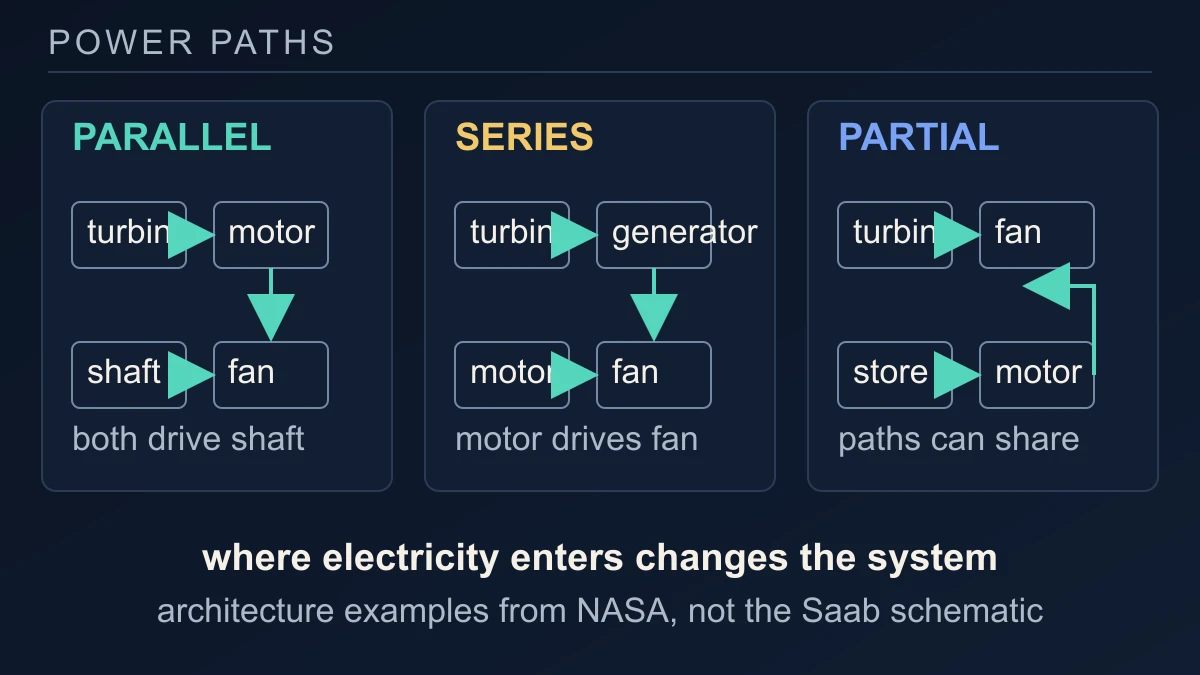
NASA describes several ways to arrange that relationship. In a parallel hybrid, a traditional engine and a battery-powered motor are both connected to the shaft that drives the fan, so either or both can provide propulsion. In a series hybrid, the fuel-burning engine drives a generator; the electric motor alone turns the fan, while the generator and battery supply its electricity. A series/parallel partial hybrid mixes those ideas, with some fans driven directly by the turbine and others powered electrically.
That distinction matters because 'hybrid electric' names a family of power paths, not one universal machine. NASA's July 2026 report says the GE Aerospace system developed with the agency integrates electric motors, a gas turbine and energy-storage capabilities in a megawatt-class engine. The report establishes the integrated flight demonstration. It does not publish every detail needed to redraw the demonstrator's internal schematic, so the architecture diagram above compares NASA's documented examples rather than pretending to reveal the Saab's proprietary layout.
Why the powertrain has to be tested like an aircraft system
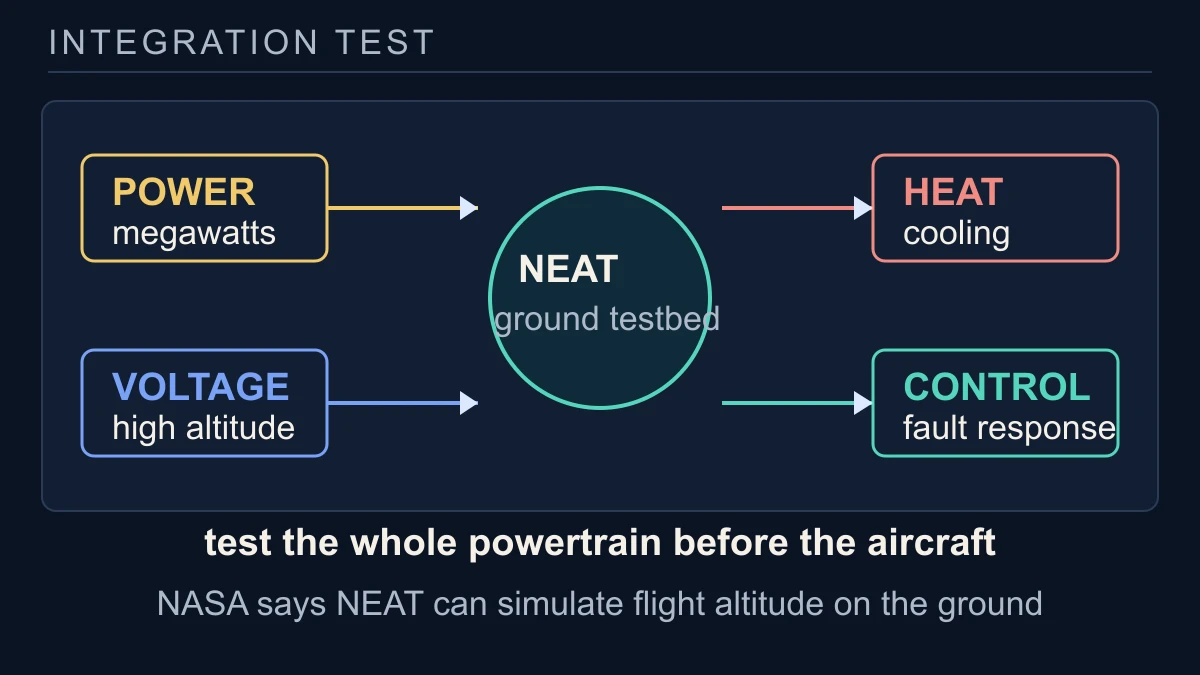
An aircraft powertrain has to work in a difficult physical environment. Electric motors, generators, power converters, batteries, wiring, controls and a gas turbine all affect one another. A component that looks efficient on a bench can behave differently when the air is thin, the electrical load is high or the cooling system has to reject heat without the conditions available at sea level.
That is the role of NASA's Electric Aircraft Testbed, or NEAT, at the Neil Armstrong Test Facility in Sandusky, Ohio. NASA says the facility can test megawatt-scale powertrains under simulated flight-altitude conditions and can simulate altitudes up to 60,000 feet. It is large enough for a 737-class powertrain and can evaluate system interactions involving motors, generators, controls, batteries, fault management, electrical loads and thermal support.
Ground testing cannot reproduce every detail of flight, but it lets researchers expose the integrated system to controlled power and altitude conditions before carrying the risk into an aircraft. The important object is not just the turbine or motor; it is the chain connecting them. The demonstration becomes meaningful because years of component and ground testing have made it possible to ask whether the complete system can deliver power, control heat and respond safely while an aircraft is flying.
What the Saab demonstration proves and what it does not
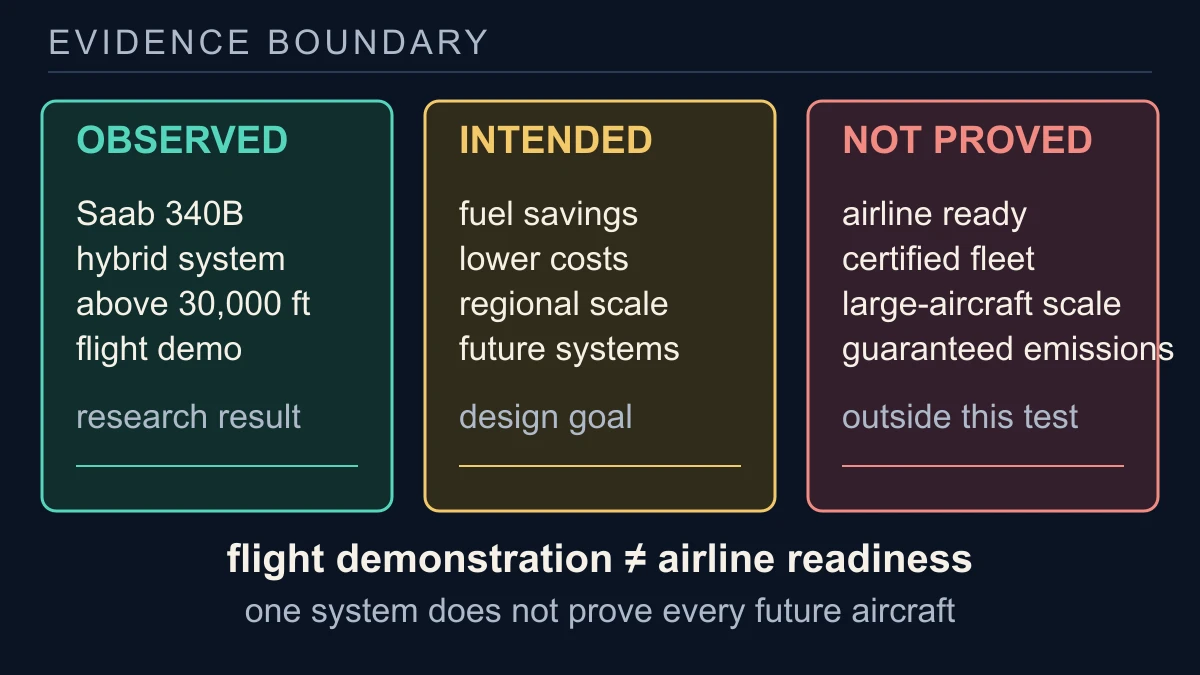
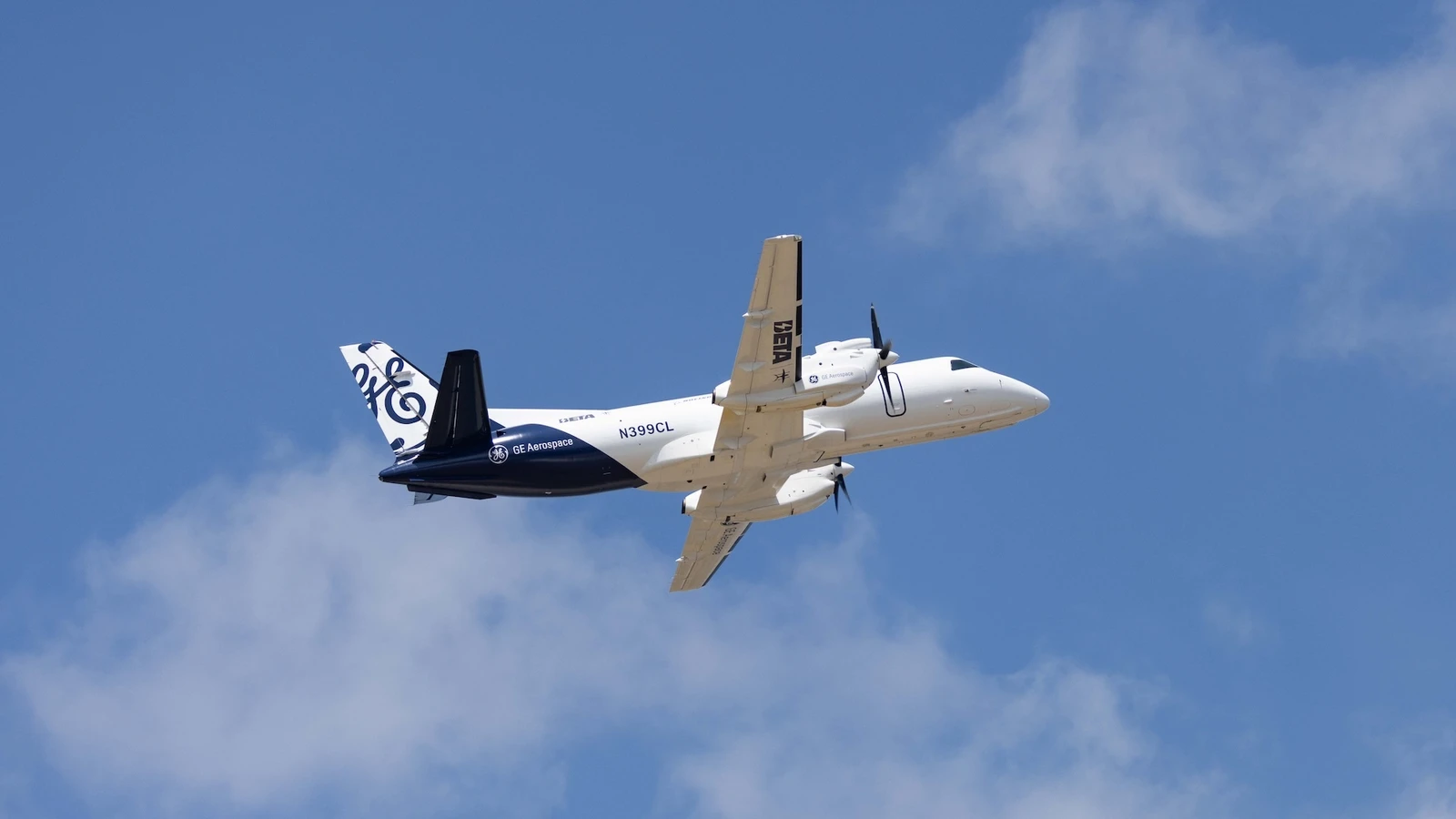
The July report describes a modified Saab 340B carrying a megawatt-class hybrid-electric engine built by GE Aerospace with NASA and partners. The aircraft flew at the Farnborough International Air Show, and NASA says the system had made historic test flights in the preceding months, including becoming the first hybrid-electric-powered aircraft to fly above 30,000 feet. That is a real flight demonstration of a complex propulsion system, not only a laboratory motor spin.
NASA also says the system was designed to demonstrate the capacity to power an aircraft around the size of a regional-class jet while reducing fuel burn and costs without sacrificing performance. Those are the technology's goals and the reason for the demonstration. They are not the same as a measured airline-wide fuel saving, a certification result or a guarantee that the system will scale unchanged to a large passenger or cargo aircraft.
The honest conclusion is narrower and more useful: a turbine and electric system can be integrated into a flying regional-aircraft research platform, and the combined system can be tested beyond the ground. The flight does not erase the remaining work on reliability, maintenance, thermal management, certification, economics, battery and power-system scaling or real-world emissions. Hybrid-electric flight is no longer only a diagram—but it is still a technology pathway being validated one system and one test condition at a time.
Sources and further reading
This article was written for Curiosity Desk. We do not copy other publishers or invent quotes. If a material error is found, we correct it openly.
Read the full standards →One answer should lead to a better question
Bring your curiosity to the group
Curious Minds is our public Facebook community for surprising science, strange history, Australian wildlife and everyday questions. No copied posts, no personal-friend invitations and no link dumping.
- Three self-contained discussion prompts each week
- Sourced answers and honest uncertainty
- Respectful conversation without spam