The beach crossing begins after the working day
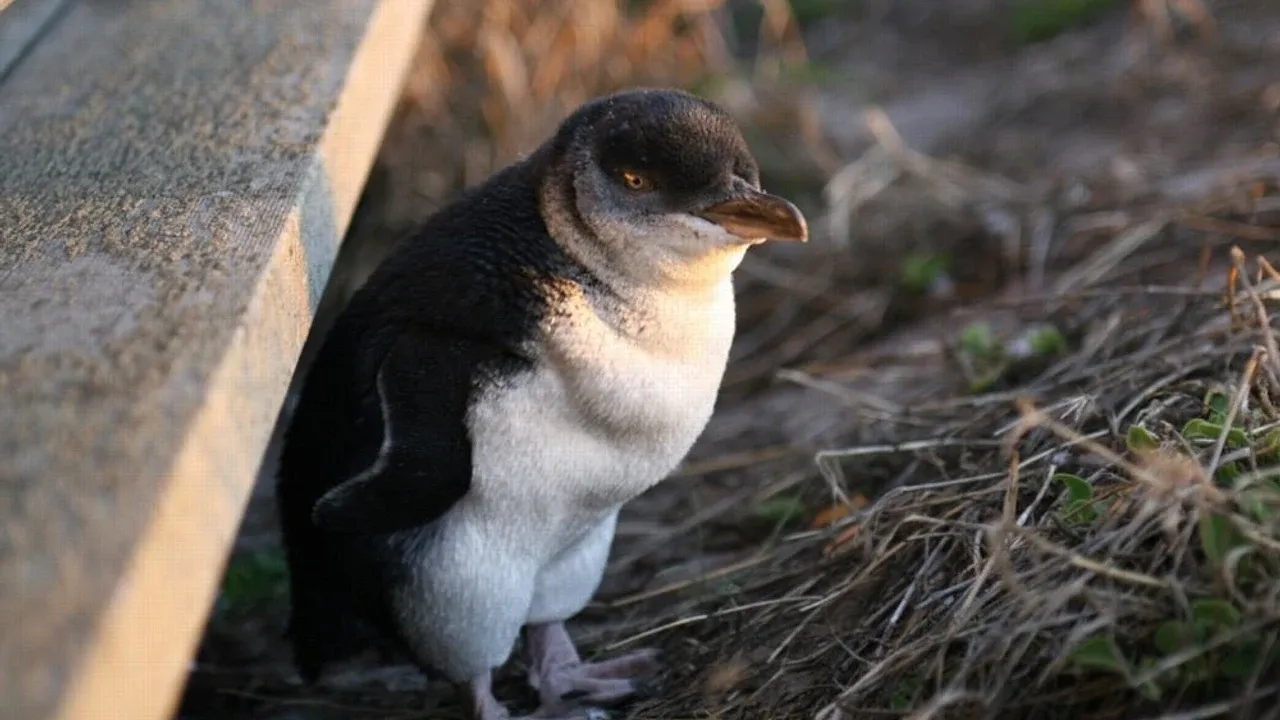
A little penguin can spend daylight chasing small fish, squid and krill at sea, then approach the same coast as a very different animal. In water it is streamlined and fast. On an open beach it is short, conspicuous and committed to a slow walk. That contrast explains why the final few hundred metres can matter as much as the long journey offshore.
The species is active at sea during the day but normally visits exposed land at night. During breeding, an adult may return to court, take a turn incubating or feed a chick waiting in a burrow. The familiar evening parade is therefore not simply bedtime. It is the landward half of a commute between two habitats that demand different behaviour.
Sunset is the clock, not a fixed hour
Researchers on Phillip Island used automated gates to record marked penguins at two colonies over thirteen years. Arrivals moved with sunset through the seasons rather than occurring at one fixed time on a human clock. Across the data, penguins arrived about 81 minutes after sunset on average and departed about 92 minutes before sunrise.
Those figures describe the monitored colonies, not a promise for every beach or every night. Weather, breeding stage, trip length, the shape of the shoreline and local disturbance can all change what an observer sees. The stronger conclusion is that ambient light is a major timing cue. A winter sunset and a summer sunset move the whole schedule with them.
Moonlight adds a second timetable
Sunlight was not the only pattern in the long record. Penguin attendance also shifted with the lunar cycle. Fewer birds came ashore on full-moon nights. At both monitored colonies, arrivals tended to be later and departures earlier around the brighter part of the cycle than around first quarter nights, although the exact pattern differed between sites.
It is tempting to turn this into a simple claim that little penguins fear the full Moon. The study does not prove an emotion or one universal cause. Moon phase changes natural light, which can change visibility for the penguins and for other animals. The useful finding is behavioural: even after the seasonal effect of sunset and sunrise was removed, lunar timing remained visible in the attendance data.
The dark patch offshore can be a waiting room
Returning penguins often gather close to shore in a raft before making landfall. Individuals then cross the beach in small groups. That pause can look indecisive from a viewing platform, but waiting lets more birds begin the exposed part of the journey together and under lower light.
Researchers commonly describe this as an antipredator strategy. Moving in a group can spread individual risk and add more eyes to a crossing, while darkness makes a small bird less visible on land. The group also has a cost because waiting can delay a bird that needs to reach a chick. The decision is therefore not simply safety versus danger. It balances light, companions, urgency and conditions at that particular colony.
A parade is not one permanent friendship group
A four-season Phillip Island study used automated monitoring to ask whether the same penguins repeatedly crossed together. The researchers treated birds passing within a forty-second interval as one group and estimated typical groups of about five to ten individuals. Group composition was more clearly non-random in two years with high breeding success than in two poorer years.
Even then, the association values were low, suggesting that finding the same companions was not the main priority. Age and breeding conditions influenced patterns, but the parade was not a nightly reunion of fixed best friends. A better picture is flexible coordination. Birds take advantage of company when it is available without waiting indefinitely for one particular partner.
Darkness probably reduces danger, but the evidence has limits
Tasmanian wildlife guidance says the cover of darkness helps protect penguins from predators during their vulnerable move ashore. That explanation fits their nocturnal land activity, their moon-related timing and their tendency to cross together. It should still be presented as a supported biological explanation rather than a controlled experiment proving that every delayed landing prevents an attack.
Predator communities also differ between colonies. A mainland Tasmanian beach with dogs or cats is not identical to a protected offshore site, and danger can come from land, air or the water. Darkness reduces some kinds of exposure but cannot remove every threat. Habitat layout, burrow access, fencing, traffic and animal management remain important after the Sun has gone down.
Artificial light produces a more complicated result
A later Phillip Island experiment compared lighting responses at a tourist site that had been illuminated for decades and a site without that history. Changing light intensity did not alter attendance behaviour at the long-lit site, possibly because the birds were habituated. At the previously unlit site, penguins chose illuminated paths over dark ones when travelling toward their nests.
That does not make bright coastal lighting harmless. A useful path can help an animal see obstacles, but attraction can also pull it toward roads, people or unsuitable routes. The researchers recommended keeping necessary lighting dim and limited in time. The result is a warning against slogans in both directions: light is not automatically catastrophic in every setting, and a penguin walking toward it is not proof that the light is safe.
A watcher can accidentally delay the commute
Tasmania's official penguin-watching guidance warns that torchlight, loud noise and a person standing in the access route can make birds remain at sea longer. A delay can interfere with breeding or keep food from a chick in the burrow. The penguin may also treat a quiet human silhouette as a potential predator, even when the visitor intends no harm.
The practical rules follow from the animal's point of view. Arrive before last light, stay at least three metres from burrows, keep access paths clear, remain still and quiet, and follow signs or ranger instructions. Do not use flash. Use only dim red light where local guidance permits it, and never bring a dog or cat to a colony. A lead does not remove the smell or the stress caused by a predator nearby.
Tasmania offers better places than an improvised beach search
Tasmania Parks and Wildlife lists established viewing locations including Bruny Island Neck, Lilico Beach, Low Head, Burnie and The Nut at Stanley. A platform or managed viewing area helps keep people away from burrows and movement corridors. Conditions and access can change, so local signs and current official advice matter more than a social-media location pin.
The best sighting is one the bird completes normally. A little penguin should be able to leave its raft, cross the shore and disappear into cover without walking around feet, phones or a bright beam. Darkness is not an inconvenience added to the experience. It is part of the behaviour people have come to see.
The honest answer is a sequence, not one trick
Little penguins come ashore after dark because their daily lives join bright-water foraging to nocturnal activity on land. Sunset sets the broad clock. Moonlight can shift attendance. Gathering offshore provides flexible company for an exposed crossing, and local landscape, artificial light and disturbance modify the final decision.
That sequence makes the parade more interesting than the easy answer that penguins merely wait until predators cannot see them. They are reading a changing light environment, coordinating loosely with neighbours and timing a risky transition between ocean and burrow. The darkness is not empty. It is information.
Sources and further reading
- Journal of Biological Rhythms: Ambient light affects attendance behaviour of little penguins ↗
- Journal of Experimental Zoology: Penguin colony attendance under artificial lights for ecotourism ↗
- Animal Behaviour: Synchronized group association in little penguins ↗
- PLOS ONE: Departure time influences foraging associations in little penguins ↗
- Tasmanian Government: Penguin Watching Guidelines ↗
- Tasmania Parks and Wildlife Service: Seabirds and shorebirds ↗
This article was written for Curiosity Desk. We do not copy other publishers or invent quotes. If a material error is found, we correct it openly.
Read the full standards →One answer should lead to a better question
Bring your curiosity to the group
Curious Minds is our public Facebook community for surprising science, strange history, Australian wildlife and everyday questions. No copied posts, no personal-friend invitations and no link dumping.
- Three self-contained discussion prompts each week
- Sourced answers and honest uncertainty
- Respectful conversation without spam