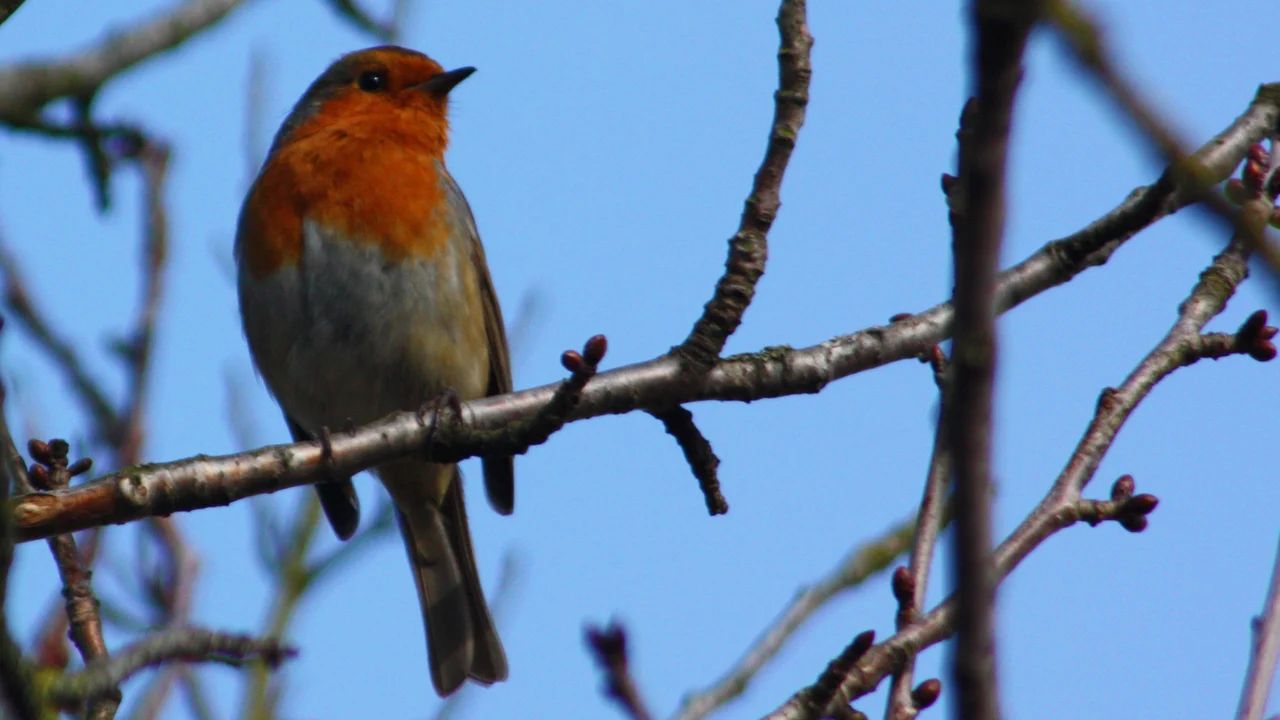
The robin in the photograph carries more than one answer
European robins became famous in navigation science because controlled experiments showed that they can orient using Earth's magnetic field. Yet a robin released beneath a clear sky is not forced to ignore every other clue. Sunlight, stars, the horizon, smells and remembered scenery can all contribute information.
That is the first correction to the usual mystery. Researchers have not discovered one tiny biological GPS that explains every journey. They have uncovered several sensory systems that can agree, conflict, recalibrate one another or become useful at different stages of a route.
A compass is not the same thing as a map
A compass supplies direction. A map tells the traveller where it is relative to a goal. Knowing south is enough for a young bird following a broad inherited migration program, but it cannot by itself explain how an experienced adult returns to a particular breeding site after being carried far off its usual route.
Scientists therefore separate orientation from true navigation. A bird may first estimate position using learned or environmental information, then select a course with a celestial or magnetic compass. The two jobs interact, and experiments must be designed carefully to reveal which job a cue is performing.
The Sun works only when the internal clock keeps up
The Sun moves across the sky, so its direction cannot mean east, south or west without knowing the time of day. Classic clock-shift experiments altered a bird's daily rhythm by changing its light schedule. When released, the bird treated the Sun as though it occupied the position expected at its shifted internal time and departed on a predictably rotated bearing.
Modern tracking shows that this time-compensated Sun compass can remain influential even over familiar terrain. It can work beside visible landmarks rather than vanishing the moment a bird recognises the neighbourhood. Cloud can hide the Sun, however, which helps explain the value of other systems.
Indigo buntings learned the centre of a turning sky
Stephen Emlen raised young indigo buntings under different planetarium skies. Birds that had never watched a rotating sky before migration failed to choose their normal direction. Birds exposed to a realistic rotation later oriented normally under the projected stars.
The most revealing group saw the stars rotate around a false centre near Betelgeuse instead of Polaris. Those birds later treated the artificial centre as their reference. They had not inherited a complete chart of named constellations. They learned which region stayed central while the sky appeared to turn, then used the surrounding star pattern as a compass.
A robin's magnetic compass is unlike the one in a phone
In a 1972 experiment, Wolfgang and Roswitha Wiltschko changed the magnetic field around European robins. The birds did not read the polarity of the field in the way a handheld compass distinguishes magnetic north from south. They responded to the angle at which field lines meet gravity.
This inclination compass distinguishes poleward from equatorward. Reverse the vertical component of the experimental field and the preferred direction reverses; simply swapping magnetic polarity does not produce the same response. That design could support related migration programs in both hemispheres, although conditions near the magnetic equator create special complications.
Scientists still do not have a finished magnetic sensor
One leading model proposes light-dependent chemical reactions involving cryptochrome proteins in the eye. Radical pairs created by light could respond differently as the bird turns through the magnetic field, giving the visual system directional information. Behavioural experiments and neural activity support parts of this picture.
Other work has investigated magnetite-based structures and signals carried by the trigeminal nerve, particularly for magnetic intensity that might help a positional map. The exact receptors, molecular steps and brain integration remain disputed. It is accurate to say that birds use magnetic information; it is premature to point to one proven magnetic organ that explains it all.
Twilight may let separate compasses compare notes
Near sunrise and sunset, scattered light forms a pattern of polarization around the sky. Experiments with Savannah sparrows found that access to polarized light close to the horizon could recalibrate the birds' magnetic headings. That result suggests twilight can provide a shared reference before a night flight.
The calibration story is not universal or settled. Later studies with European robins, sedge warblers and dunnocks in Sweden did not reproduce the predicted recalibration after a cue conflict. Species, season, latitude and experimental details matter. The honest conclusion is that compasses can interact, not that every migrant follows one mandatory twilight ritual.
Smell can supply a map while landmarks sharpen the route
Homing-pigeon experiments provide strong evidence that atmospheric odours help birds learn the regional pattern around their loft. Measurements have found real geographic gradients in volatile compounds that could contribute to such a map. The mechanism is still debated, and evidence from pigeons should not be pasted onto every migratory species.
Once a bird knows an area, roads, rivers, coastlines and other visual features can guide a familiar route. GPS tracking of pigeons showed that landmark guidance and a time-compensated Sun compass can operate together. Familiar scenery is therefore more than a final decorative cue, but it cannot explain a first journey across an unseen continent.
A first migration and a return journey are different problems
Many juvenile songbirds travel without experienced adults. An inherited program can specify a broad direction and duration, producing vector navigation toward a population's wintering region. That astonishing program need not contain a detailed world map.
When researchers moved white-crowned sparrows about 3,700 kilometres across North America, experienced adults corrected toward their known wintering grounds while juveniles continued in the inherited migratory direction. Other species and experiments produce more complicated results, but the contrast reveals how experience can turn a compass-guided first trip into a richer navigational map.
The winning system is the one that can change its mind
Cloud removes celestial detail, wind pushes a bird sideways, magnetic conditions vary and a coastline eventually becomes familiar. A robust navigator can reweight its information instead of failing when one cue disappears. What looks like redundancy may be the reason migration survives bad nights and unfamiliar ground.
So the mind-blowing part is not that a bird owns five miniature compasses. It is that a small nervous system learns when several imperfect signals agree, notices when they do not and builds experience into later journeys. Navigation is a conversation among senses, memory and an inherited plan.
Sources and further reading
- Science: Indigo buntings learn celestial rotation rather than inheriting a complete star map ↗
- Science: The inclination compass of European robins ↗
- Journal of the Royal Society Interface: Review of magnetoreception in birds ↗
- Frontiers in Physiology: The time-compensated Sun compass revisited ↗
- Science: Polarized light and compass calibration in Savannah sparrows ↗
- Biology Open: A comparative test that did not support twilight recalibration ↗
- Proceedings of the National Academy of Sciences: Adults but not juveniles corrected a 3,700-kilometre displacement ↗
- Scientific Reports: Atmospheric compounds that could support an olfactory map ↗
- Proceedings of the Royal Society B: Pigeons combine landmark and compass guidance ↗
This article was written for Curiosity Desk. We do not copy other publishers or invent quotes. If a material error is found, we correct it openly.
Read the full standards →One answer should lead to a better question
Bring your curiosity to the group
Curious Minds is our public Facebook community for surprising science, strange history, Australian wildlife and everyday questions. No copied posts, no personal-friend invitations and no link dumping.
- Three self-contained discussion prompts each week
- Sourced answers and honest uncertainty
- Respectful conversation without spam