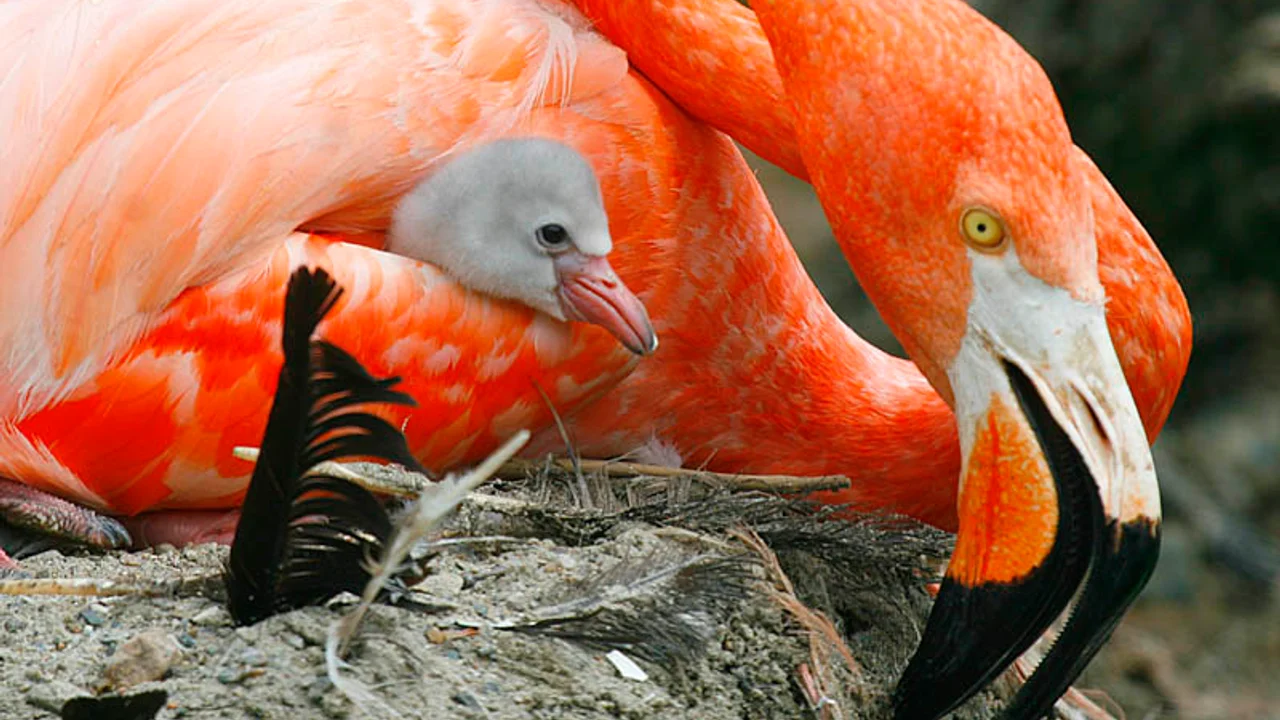
The chick in the photograph was four days old
John Harrison photographed the American flamingo above with its four-day-old chick at Stone Zoo. The adult is scarlet, coral and black. The chick has soft grey-white down and a nearly straight bill. The contrast looks like two unrelated colour schemes sharing one nest.
Smithsonian's National Zoo describes the same starting point: flamingo chicks hatch in white-grey down with straight bills. Adult colour is not a coat waiting beneath the down. It is the visible result of pigments acquired, processed, placed in growing tissues and maintained across the bird's development.
An old tissue analysis found the colour system had not started
A 1962 biochemical study examined captive American and Chilean flamingos and reported no detectable carotenoids in the tissues of newly hatched white or grey chicks. Adult birds in the same work stored several carotenoids in feathers, skin, blood plasma, egg yolk and other tissues.
Methods from that era were less sensitive than modern analytical chemistry, and the finding should not be treated as a universal zero for every chick and species. It nevertheless supports the visible developmental gap. A hatchling has not yet accumulated and displayed the adult pigment pattern simply by inheriting flamingo genes.
Pink begins with carotenoids, not with shrimp alone
Carotenoids are a large family of yellow, orange and red molecules made by plants, algae and some microorganisms. Flamingos obtain them by filtering algae, small aquatic organisms and other food. Brine shrimp can carry pigments acquired through their own diet, which is why the familiar shrimp explanation contains part of the story.
It is still too narrow. Different flamingo species feed in different wetlands and target different particle sizes. Lesser flamingos may rely heavily on cyanobacteria, while other species take a broader mixture of algae, seeds, larvae, crustaceans and molluscs. The pigment pathway can begin with microscopic producers rather than one pink crustacean.
The upside-down bill is a pigment-harvesting machine
A feeding flamingo lowers its head, sweeps the bill through water and uses its tongue as a pump. Comb-like lamellae inside the bill retain suitable food while water and unwanted particles move out. Bill shape and lamella spacing differ among species, helping them exploit different portions of the wetland food web.
This explains how diet can remain consistently rich in particular pigments. A flamingo does not need to find a bright red object at every meal. It repeatedly processes large volumes of shallow water containing carotenoid-producing algae and animals that have concentrated those molecules.
Eating pigment and wearing pigment are separate jobs
Digestion releases carotenoids from food. The bird absorbs, transports, modifies and stores selected molecules rather than depositing every food colour unchanged. Chemical studies of flamingo feathers have identified canthaxanthin as a major red carotenoid, with astaxanthin and other related pigments varying among species and tissues.
That biology is why blue food colouring would not reliably create a blue flamingo. A dye must survive digestion, enter circulation, be accepted by cellular transport and become incorporated into a growing tissue in a visible form. Flamingos have evolved pathways for particular carotenoids, not a general plumbing system for any colour swallowed.
A feather receives its internal colour while it grows
Once a feather is fully formed, its internal structure is inert. Dietary carotenoids are incorporated into replacement feathers during growth, so colour develops with maturation and moult rather than washing instantly through every feather after a pigment-rich meal. Skin and bill tissues can respond on different schedules.
Juveniles therefore pass through grey, brown and pale stages before approaching adult plumage. Even adults vary. American flamingos are often more intensely red than the much paler greater flamingo, and shade can reflect species, age, diet, condition, breeding stage, feather wear and the environment where the bird moulted.
Flamingo crop milk is red, but it is not a paint delivery system
Both parents can feed a chick with a nutrient-rich secretion from the upper digestive tract commonly called crop milk. It contains fat and protein and can be red because carotenoids are present. The name describes its function, not mammary milk, and no blood needs to be involved for the fluid to look startlingly red.
A popular online claim says parents simply drain their pink colour into the chick. Direct evidence for that simple transfer story is weaker than the meme suggests. Chicks remain grey while receiving crop milk, and adult plumage cannot be emptied like a reservoir. Raising young is demanding and parental colour can change, but pigment budgets, feeding, moult and maintenance must be separated before assigning one cause.
Captive colour can be nutritionally managed without being fake
The 1962 study found captive flamingos gradually lost exposed skin colour and produced paler replacement feathers when their diet lacked enough carotenoids. Modern zoological diets therefore include appropriate pigment sources alongside the protein, fat, vitamins and minerals needed for the whole animal.
Supplying canthaxanthin or carotenoid-rich ingredients does not spray-paint a bird. It provides molecules the animal would obtain through a wild food web, after which its own digestion and metabolism determine where they go. A brightly coloured captive flamingo still made the feather; nutrition supplied raw material.
Some greater flamingos add their own cosmetic layer
Greater flamingos collect carotenoid-rich secretion from the uropygial gland near the tail and spread it over feathers during preening. A 2011 study found this behaviour increased around group display periods and made plumage more colourful. Both males and females participated.
A later experiment placed neck feathers from 30 flamingos in sunlight without further maintenance. Exposed feathers faded, while controls kept in darkness did not show the same loss. Pigment inside the feather creates the underlying colour, and repeated cosmetic application can intensify and maintain the visible surface. The result is closer to make-up than to permanent dye.
Pink is a history, not a single health score
Colour can participate in social and reproductive signalling, and redder greater flamingos have been linked with display and partner choice. Yet a pale bird is not automatically sick. Species, age, recent breeding, diet, moult timing, sunlight, feather maintenance and individual variation can all alter what an observer sees.
The grey chick beside its scarlet parent captures the complete answer. Flamingo genes build the machinery, wetlands supply carotenoid molecules, the body chooses and transforms them, growing tissues record them and behaviour can polish the result. Pink is not the bird's default paint. It is a living record assembled over time.
Sources and further reading
- Smithsonian's National Zoo: Why flamingos are pink and why chicks begin white-grey ↗
- Comparative Biochemistry and Physiology: Metabolic storage and display of flamingo carotenoids ↗
- Behavioral Ecology and Sociobiology: Greater flamingos use uropygial secretions as make-up ↗
- Ecology and Evolution: Flamingo feathers fade without cosmetic maintenance ↗
- Zoo Biology: Plumage variation and social partner choice in greater flamingos ↗
- IUCN SSC Flamingo Specialist Group: Species feeding, colour and display biology ↗
- Zoo Biology: Nutrient composition of American flamingo crop milk ↗
This article was written for Curiosity Desk. We do not copy other publishers or invent quotes. If a material error is found, we correct it openly.
Read the full standards →One answer should lead to a better question
Bring your curiosity to the group
Curious Minds is our public Facebook community for surprising science, strange history, Australian wildlife and everyday questions. No copied posts, no personal-friend invitations and no link dumping.
- Three self-contained discussion prompts each week
- Sourced answers and honest uncertainty
- Respectful conversation without spam