The harder-looking pose can be the quieter one
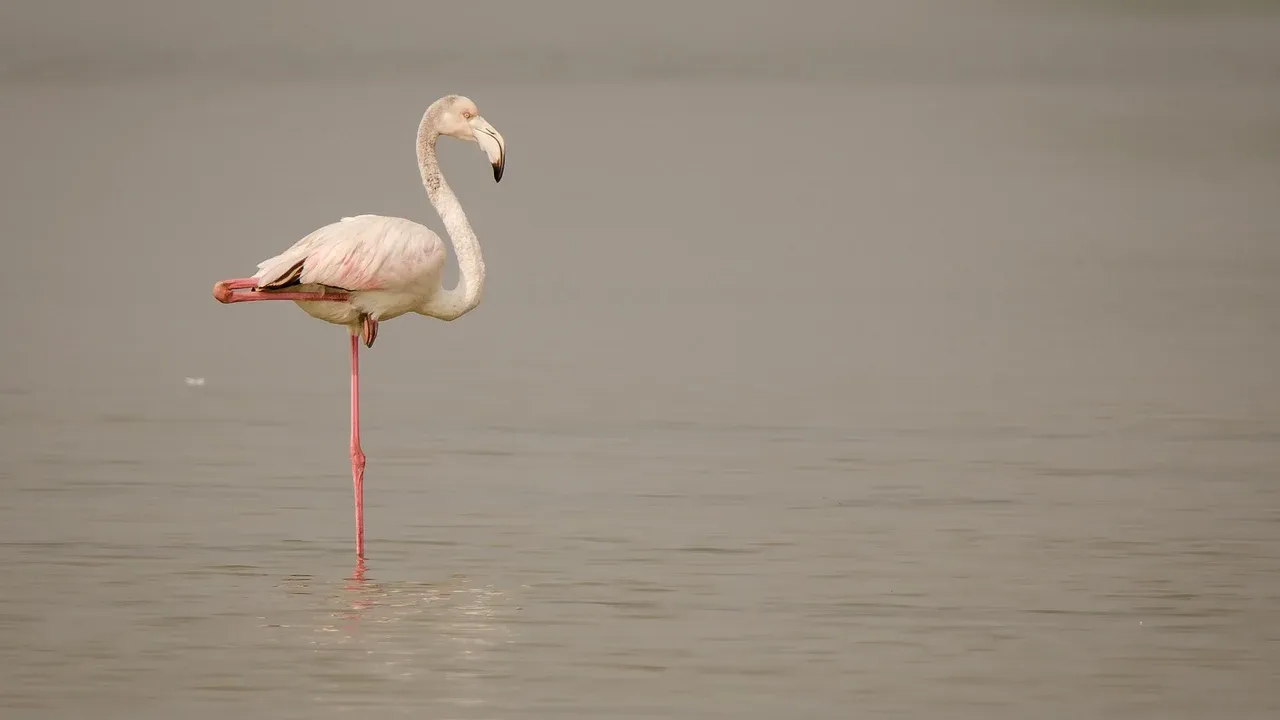
Try standing on one leg and your ankle immediately begins making small corrections. That human experience makes a resting flamingo look as though it is performing a tiring balance exercise. Force-plate measurements suggest almost the opposite. When juvenile Chilean flamingos became quiescent with their eyes closed, the point of pressure beneath the foot moved through a smaller area than it did when the birds were alert or active.
One bird remained on a single leg through a continuous twenty-minute trial, first awake and then apparently asleep. Its movements became smaller as it settled. That observation does not mean every flamingo is perfectly motionless, but it reveals the central surprise: the famous pose can become more stable when the animal stops actively doing things.
Two specimens exposed a gravity-driven support system
To investigate the anatomy, researchers worked with two frozen and thawed Caribbean flamingo specimens supplied by Birmingham Zoo. A one-legged specimen could be positioned so its own body weight held the hip and knee in a fixed configuration. The joints stayed remarkably stable while the lower leg was tilted forward and backward through a wide range.
The mechanism depends on geometry. The body centre of mass sits in front of the knee, anatomical limits resist further joint movement and the foot is placed inward beneath the hip. Together those conditions let gravity create stabilising moments around the joints. If the alignment is lost, the passive support disappears. It is more accurate to describe a weight-engaged joint configuration than to repeat the popular claim that a flamingo simply locks its knee backward.
The live birds became steadier as activity fell
The same study recorded eight juvenile Chilean flamingos at Zoo Atlanta standing on a force plate. When a bird was quiescent, the force passed close to the joint at the base of the foot, reducing the torque that would otherwise need active correction. An alert bird that groomed, shook or vocalised produced much larger and faster pressure movements.
The researchers proposed that one-legged standing could require less muscular energy than standing on two legs, but they did not directly measure metabolic cost or muscle electrical activity. Their results demonstrate passive body-weight support and very small sway in resting birds. The conclusion about lower energy use is a well-supported hypothesis, not a completed measurement of calories saved.
Temperature supplies another part of the answer
Mechanical efficiency explains how the pose can be comfortable. It does not by itself prove why a flamingo chooses it at a particular moment. A 2010 observational study of captive Caribbean flamingos found one-legged resting was more common in water than on land and became less common as temperature rose. With one leg tucked into the plumage, less bare limb surface is exposed to moving water and air.
A 2024 study covering five flamingo species also found more one-legged behaviour in water and inside housing, although the weather variables it tested did not show a direct effect. Those results do not erase the earlier temperature pattern. They show why a single universal explanation is too neat: local environment, species, activity and the mechanical cost of the posture can all shape what an observer sees.
The birds do not appear committed to one favourite side
The 2010 study found no consistent left-leg or right-leg preference at either the individual or group level. Birds divided their resting time between the two sides. That makes the pose different from a fixed handedness in which one limb is always selected.
Switching sides is sometimes presented online as proof that the raised leg is recovering from fatigue. The observational study tested a related prediction and found flamingos were slower, not faster, to begin moving after one-legged rest than after two-legged rest. That result did not support the idea that the pose exists mainly to prepare a fresh leg for rapid escape.
A mechanism and a benefit are different questions
The anatomical experiment explains how a flamingo can support itself with little active force. The behavioural studies ask when birds use the pose and what benefits may follow. These answers can coexist. An inexpensive posture can make long resting bouts possible, while tucking away one exposed leg can reduce heat transfer under some conditions.
The honest answer is therefore better than the familiar trivia line. Flamingos do not balance on one leg because they enjoy difficulty. Their body turns the pose into a low-effort resting arrangement, and the choice may become especially useful when water or cool air would otherwise draw heat from two long bare legs.
Sources and further reading
- Biology Letters: Mechanical evidence that flamingos can support their body on one leg with little active muscular force ↗
- Dryad: Force-plate and anatomical data from the mechanical study ↗
- Zoo Biology: Why do flamingos stand on one leg? ↗
- Applied Animal Behaviour Science: What influences feather care and unipedal resting in flamingos? ↗
This article was written for Curiosity Desk. We do not copy other publishers or invent quotes. If a material error is found, we correct it openly.
Read the full standards →One answer should lead to a better question
Bring your curiosity to the group
Curious Minds is our public Facebook community for surprising science, strange history, Australian wildlife and everyday questions. No copied posts, no personal-friend invitations and no link dumping.
- Three self-contained discussion prompts each week
- Sourced answers and honest uncertainty
- Respectful conversation without spam