One wave can switch on billions of cells
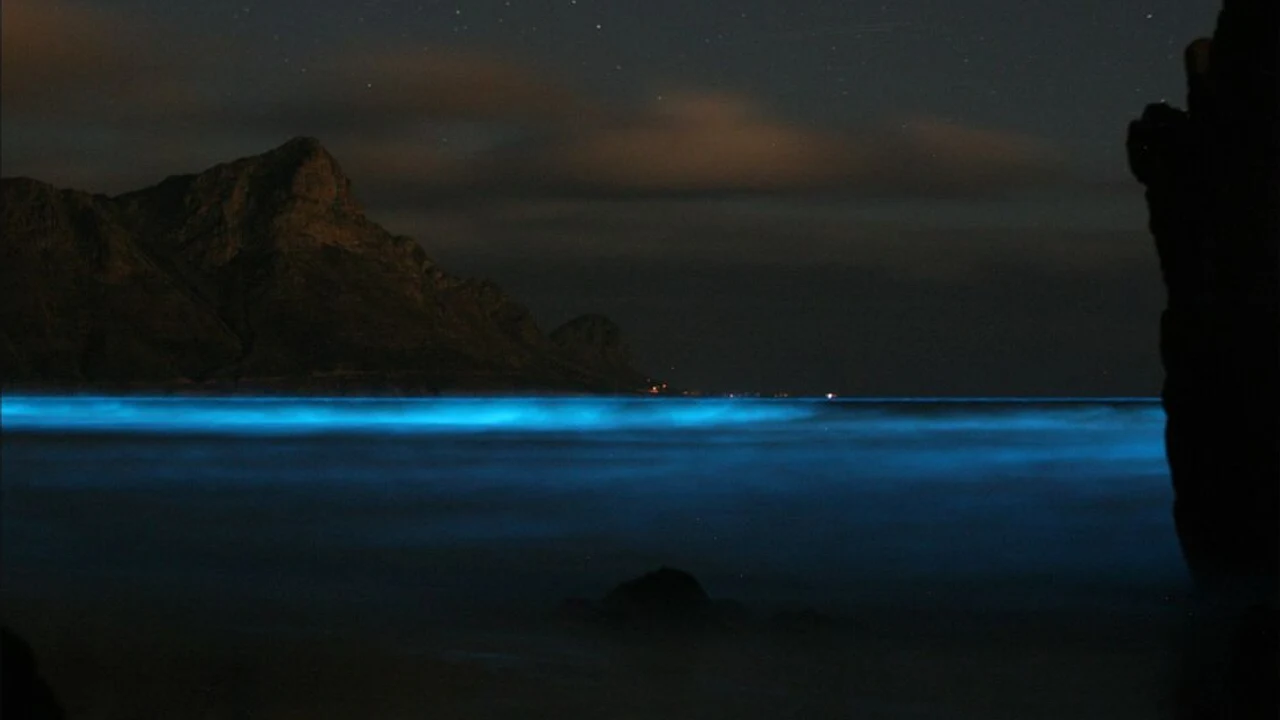
A dark Tasmanian shoreline can suddenly draw an electric-blue line around each breaking wave. The colour is not moonlight reflected by foam. In many local displays it comes from Noctiluca scintillans, a single-celled marine organism often called sea sparkle. Individual cells are usually around half a millimetre across, but a dense surface gathering can make their combined flashes visible from shore.
Noctiluca is a dinoflagellate and a heterotrophic protist, meaning it consumes other plankton instead of photosynthesising like a plant. In daylight an intense aggregation may appear pink, orange or tomato-soup red. At night, movement from waves, a passing animal or turbulent water can turn the same gathering into a brief field of blue light.
The flash begins with a mechanical alarm
Mechanical stress on a Noctiluca cell triggers an electrical signal across its large internal vacuole. Proton channels then open, changing the acidity inside thousands of tiny light-producing structures called scintillons. The lower pH activates luciferase and frees its light-producing partner, luciferin, so an oxidation reaction releases energy as visible light.
The chemistry takes place inside the organism, not in the surrounding foam. Each flash is short, which is why a footprint at the waterline or a cresting wave can look as though it is drawing with blue sparks. Researchers think the display may work as a defensive alarm by startling grazers or attracting larger predators that eat those grazers, but its ecological role is not completely settled.
The glow needs a crowd before it needs darkness
A single cell is not enough to paint a bay. Noctiluca can adjust its buoyancy and gather near the surface, while wind and currents push enormous numbers into slicks or against a shoreline. Because it feeds on other plankton, the distribution of its food also matters. Rainfall, nutrients, temperature and local circulation can all influence whether the cells multiply or collect in one visible place.
Those interacting factors make the spectacle difficult to forecast. A beach that glowed one evening may be dark the next after wind or tide moves the cells. Warm seasons can favour abundance in Australian coastal waters, but there is no dependable nightly calendar. A fresh observation is more useful than an old viral photograph when deciding whether a glow may still be present.
Sea sparkle moved south into Tasmanian records
The University of Tasmania's plankton guide records Noctiluca blooms affecting Tasmania from 1994. A later university explainer describes blooms becoming more common off Sydney from the 1990s and then drifting south into Tasmanian waters more regularly from the 2000s. Long-term Australian observations also associate the species' southward range expansion with the East Australian Current.
That history does not mean every blue flash in Tasmania is Noctiluca, or that one sighting proves a climate trend. Other marine organisms can produce light, and confirming a species requires identification rather than colour alone. The defensible conclusion is that Noctiluca is now a familiar source of spectacular Tasmanian displays within a changing plankton community.
Beautiful water is not automatically harmless water
IMAS reports no known toxic effects from Noctiluca itself and describes the daytime slicks as essentially harmless to people. Dense blooms can still affect an ecosystem. The cells may accumulate ammonia, fish can avoid or be irritated by concentrated blooms, and decomposition of a large biomass can reduce oxygen in the water.
A photograph also cannot establish which organism is present or whether unrelated contamination exists. Treat the glow as a biological clue, not as proof that water is safe for swimming, tasting or collecting. Observe local access rules and public-health notices, and avoid disturbing wildlife or entering an unfamiliar night shoreline just to trigger a brighter photograph.
Sources and further reading
- IMAS, University of Tasmania - Noctiluca scintillans species guide ↗
- University of Tasmania - The science behind sea sparkles ↗
- Journal of Eukaryotic Microbiology - Molecular basis of Noctiluca bioluminescence ↗
- CSIRO - Plankton: critical little critters ↗
- IMAS - Storm Bay biotoxin risk assessment and plankton observations ↗
This article was written for Curiosity Desk. We do not copy other publishers or invent quotes. If a material error is found, we correct it openly.
Read the full standards →One answer should lead to a better question
Bring your curiosity to the group
Curious Minds is our public Facebook community for surprising science, strange history, Australian wildlife and everyday questions. No copied posts, no personal-friend invitations and no link dumping.
- Three self-contained discussion prompts each week
- Sourced answers and honest uncertainty
- Respectful conversation without spam