The short answer: geography and sovereignty are different
Ceuta is physically on the northern coast of Africa, beside Morocco and across the Strait of Gibraltar from mainland Spain. Politically and legally, however, it is an autonomous Spanish city. It belongs to Spain, is part of the European Union and uses the euro. A map of continents answers where Ceuta is; it does not, by itself, answer which state governs it.
That apparent contradiction is the reason the city suddenly produces such a powerful search question whenever Ceuta enters the news. The answer is not a recent border adjustment. It is the result of a chain that began with a Portuguese conquest in 1415, continued through the union and later separation of the Portuguese and Spanish crowns, and was formalised between the two kingdoms in 1668.
A Spanish city faces Europe from the African shore
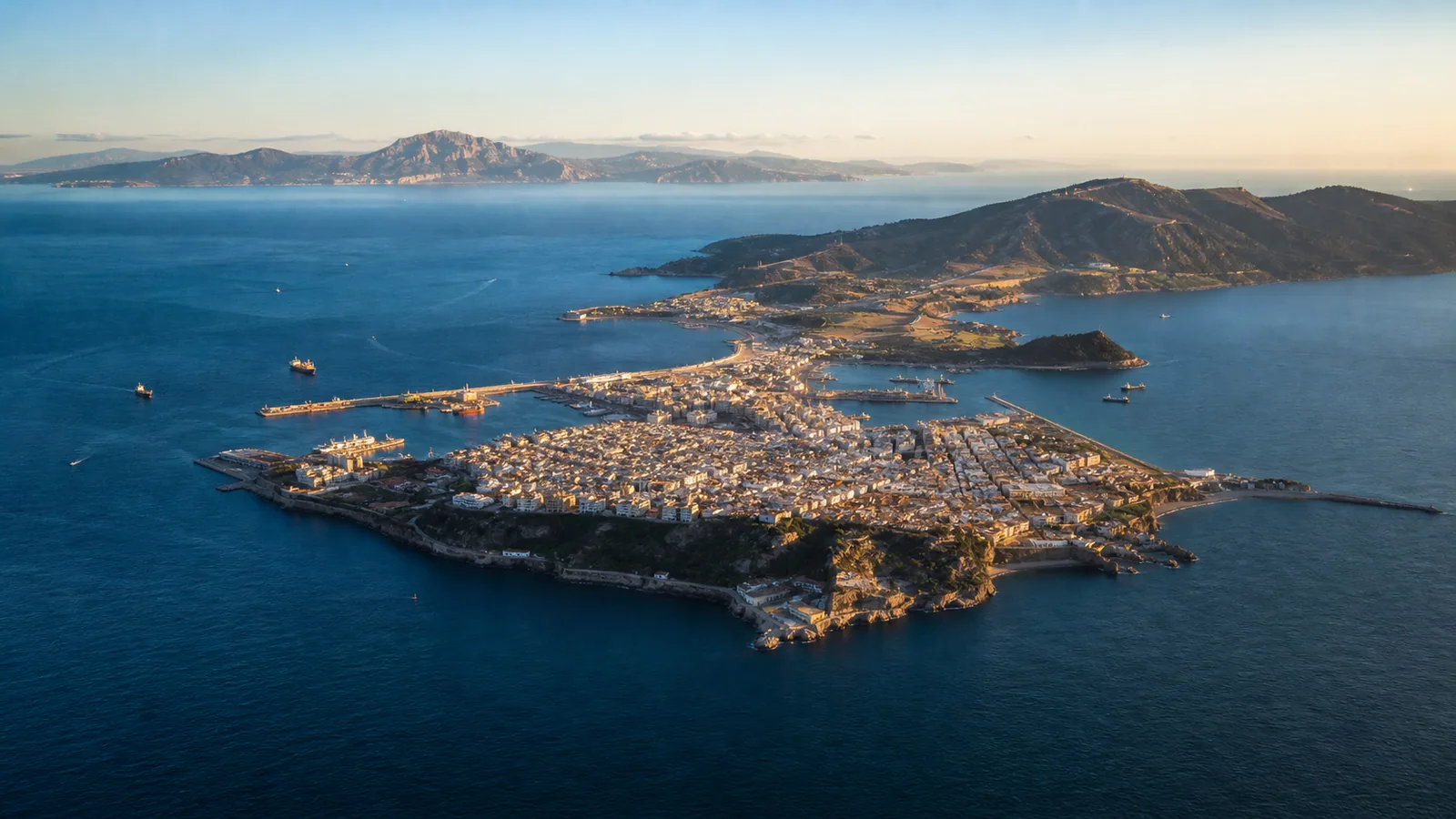
Ceuta occupies a small peninsula near the narrow western entrance to the Mediterranean. Europe is visible across the water, but the city's land boundary is with Morocco. Together with Melilla farther east, it creates the European Union's only land borders with Africa. That makes a very small place unusually important to shipping, migration, trade, diplomacy and the daily lives of people who move through the surrounding region.
The word enclave is commonly used because Ceuta is a pocket of Spanish territory beside Morocco. From Spain's point of view, it can also be described as an exclave because it is separated from the Spanish mainland. Neither label changes the essential fact. Ceuta is on the African continent, while its government, citizenship, institutions and currency connect it to Spain and the European Union.
Portugal changed Ceuta's path in 1415
Ceuta's history did not begin with Portugal or Spain. Its position beside the Strait of Gibraltar attracted a long succession of Mediterranean and North African powers. The Encyclopaedia of Portuguese Expansion records Phoenician, Carthaginian, Roman, Vandal, Byzantine and Arab periods. By the early fifteenth century, the port was strategically placed between Mediterranean and Atlantic routes and connected to commerce across North Africa.
On 21 August 1415, forces led by Portugal's King João I captured Ceuta. Historians still debate the mixture of motives, which included dynastic ambition, religion, military strategy and access to trade. What matters for the modern map is that Portugal decided to hold the city. Ceuta therefore entered the Portuguese crown's possessions more than seventy years before Portuguese ships rounded the Cape of Good Hope.
Ceuta became Spanish through a political split, not a new African invasion
In 1580, the crowns of Portugal and Spain came under the same monarch. Ceuta retained Portuguese administration during this Iberian union, but the political picture changed when Portugal restored an independent monarchy in 1640. Ceuta did not follow the new Portuguese king. It remained aligned with the Spanish crown, unlike several other Portuguese possessions.
The choice was later formalised in the 1668 Treaty of Lisbon, when Portugal recognised Ceuta as Spanish territory. That sequence is why the city's flag still preserves a striking Portuguese inheritance: black and white sections related to Lisbon's flag surround a Portuguese-style shield. The symbol makes the history visible. Ceuta is Spanish today, but the route to that status ran directly through Portugal.
Being in the EU does not move Ceuta into Europe
The European Central Bank describes Ceuta and Melilla as autonomous Spanish cities on the northern coast of Africa. Because they are parts of Spain, they belong to the European Union and use euro banknotes and coins. This is a political and legal connection, not a claim that the African coastline has moved north of the Mediterranean.
Ceuta is therefore a useful reminder that continent, country and political union are different layers. A place can be geographically African, nationally Spanish and institutionally European at the same time. Similar surprises appear elsewhere on maps because states can include islands, overseas regions and separated territories far from their main continental landmass.
Why the border remains disputed and sensitive
Spain treats Ceuta as an integral part of the country under the city's autonomy statute. Morocco does not officially recognise Spanish sovereignty over Ceuta or Melilla and has described them as occupied territory. The disagreement sits beside an intensely practical border used by residents, workers, authorities and people trying to reach European territory. It cannot be reduced to an unusual line on a map.
The current search spike followed a deadly surge of crossings from Morocco into Ceuta. The Associated Press reported on 31 July that at least 18 people had died and that Spain was deploying military personnel to support border control. That human reality deserves careful language. Curiosity Desk's purpose here is to explain why the border exists, not to turn suffering into a spectacle or pretend that six centuries of history settle every modern political claim.
The surprising map survives because history became law
If modern borders were drawn only by the nearest coastline, Ceuta might look impossible. Real borders preserve conquests, unions, treaties, local institutions and decisions made by earlier states. Portugal's capture of the city, Ceuta's alignment with Spain after 1640 and the treaty recognition of 1668 formed a legal chain that Spain continues to rely on today.
So the clean answer is both simple and layered. Ceuta is in Africa because continents describe geography. It is Spanish because sovereignty followed a particular history and remains enforced by modern law and government. It is connected to Europe because Spain belongs to the European Union. The same city can fit all three statements without any of them cancelling the others.
Sources and further reading
- Autonomous City of Ceuta: Article 1 of the autonomy statute ↗
- European Central Bank: Ceuta, Melilla and the euro outside geographic Europe ↗
- Encyclopaedia of Portuguese Expansion: Ceuta's conquest and transfer to Spain ↗
- European Parliament Research Service: EU external borders including Ceuta and Melilla ↗
- Associated Press: Current Ceuta border context and sovereignty dispute ↗
This article was written for Curiosity Desk. We do not copy other publishers or invent quotes. If a material error is found, we correct it openly.
Read the full standards →One answer should lead to a better question
Bring your curiosity to the group
Curious Minds is our public Facebook community for surprising science, strange history, Australian wildlife and everyday questions. No copied posts, no personal-friend invitations and no link dumping.
- Three self-contained discussion prompts each week
- Sourced answers and honest uncertainty
- Respectful conversation without spam