A reef that looks fixed suddenly fills the water
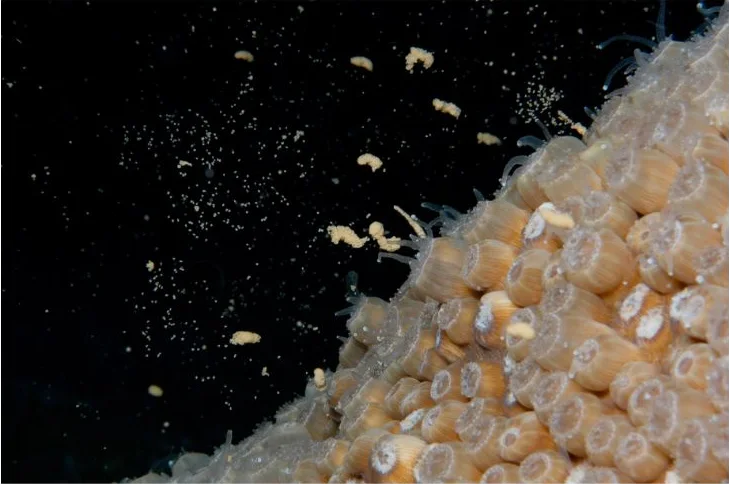
Coral colonies spend most of the year looking permanently attached to the reef. On a small number of nights, many broadcast-spawning species release buoyant bundles containing eggs and sperm. The bundles rise, separate near the surface and can turn the dark water into a drifting field of pale pink or cream particles.
The Great Barrier Reef event is often called mass spawning, but it is not one perfectly simultaneous explosion. Multiple species may release over several nights, and timing changes with species and location. The useful idea is synchrony at a large scale: enough compatible colonies reproduce within the same narrow period for their gametes to meet in moving seawater.
The calendar uses more than the full moon
On much of the Great Barrier Reef, mass spawning follows full moons in late spring and early summer, commonly during October, November or sometimes December. Researchers track seasonal water warming, lunar phase, tides and the hours after sunset. No single cue should be treated as an independent countdown clock.
Darkness matters at the final stage. Australian Institute of Marine Science researchers report that many corals spawn after sunset and before moonrise, and that artificial white light can confuse their timing. Conditions also vary across the reef, so an expected regional window is not a promise that every species and colony will release on the same evening.
Synchrony solves a problem created by distance
Adult coral colonies cannot move closer to a mate. Once eggs and sperm enter the water, currents dilute them and other animals can eat them. Their viability is also brief. Releasing together increases the concentration of compatible gametes during the few hours when fertilisation is possible.
This strategy trades precision for scale. Enormous numbers are released because any individual bundle has a small chance of completing the journey. Synchrony raises the odds without removing the hazards, and some coral species use different reproductive strategies altogether. Mass spawning is therefore a powerful solution, not a universal rule for every coral.
The pink cloud becomes drifting larvae
After fertilisation, an embryo develops into a tiny planula larva. It drifts with currents before responding to chemical and physical cues from reef habitat. If it reaches suitable substrate, it can settle, metamorphose into a polyp and begin budding genetically identical polyps that build a colony.
Most larvae never reach that point. They can be dispersed away from suitable habitat, consumed, or encounter poor water quality and an unsuitable surface. Even a successful settler must survive later heat, storms, disease and competition. The glowing cloud seen during spawning is therefore a field of possibilities rather than a reef already rebuilt.
Spawning is encouraging, but it is not an all-clear
A spawning event shows that participating colonies reached reproduction. It does not show that every colony is healthy, that enough larvae will recruit, or that future marine heatwaves will spare the next generation. Bleaching, poor water quality and repeated disturbance can still reduce both adult survival and the habitat available to settlers.
Scientists at the Australian Institute of Marine Science use spawning windows to study fertilisation, larval development and restoration methods. In the SeaSim aquarium facility, they can manipulate temperature, day length and moonlight to induce spawning outside the usual season, giving researchers more opportunities to test ideas. That work can support reef recovery, but it does not replace reducing the pressures that damage reefs.
Sources and further reading
This article was written for Curiosity Desk. We do not copy other publishers or invent quotes. If a material error is found, we correct it openly.
Read the full standards →One answer should lead to a better question
Bring your curiosity to the group
Curious Minds is our public Facebook community for surprising science, strange history, Australian wildlife and everyday questions. No copied posts, no personal-friend invitations and no link dumping.
- Three self-contained discussion prompts each week
- Sourced answers and honest uncertainty
- Respectful conversation without spam