The colour change begins as a muscular movement
A cuttlefish does not pump coloured liquid around its skin. Its outer layer contains thousands of chromatophore organs, each built around a tiny elastic sac of pigment. Radial muscles pull a sac outward so that a small dark point becomes a visible patch. When those muscles relax, the sac shrinks again.
Those muscles are controlled directly by nerves from the brain. Different regions can be expanded in coordinated combinations, producing spots, bands, mottles and sharp borders. A scientific review of cephalopod colour systems reports that individual chromatophores can expand or retract in less than a second, which is why a pattern can appear to move across the animal rather than slowly fade in.
Three optical layers make more than a palette
Chromatophores supply dark and warm pigments such as yellow, orange, red, brown and black, depending on the species. They are only the top layer of the display. Beneath them sit iridophores, structures with thin protein plates that reflect particular wavelengths and can produce iridescent colours that change with the viewing angle.
Leucophores add a third effect. Instead of selecting one narrow colour, they scatter a broad range of wavelengths and can look white under white light. The visible result depends on how pigment, reflection and scattering interact. It is closer to a layered screen than a row of paint pots, with each layer changing what the observer finally sees.
The skin can copy texture as well as pattern
Colour alone would not hide a smooth oval body beside rough coral or algae. Cuttlefish can raise muscular bumps called papillae that break up their outline and give the skin a three-dimensional texture. Experiments show that the papillae are under neural control and can be fully expanded or retracted in less than a second.
Some of the papillary muscles can also hold tension without continuous neural input, reducing the effort needed to maintain a rough disguise. This lets the animal combine a mottled surface pattern with a physical shape that resembles nearby material. The repertoire is not unlimited, but it is enough to switch rapidly between smooth skin and several species-specific textured forms.
The colour-vision puzzle is still open
Most cephalopods examined in conventional visual tests have only one known visual pigment and appear unable to compare wavelengths in the way a human trichromatic eye does. Yet cuttlefish choose body patterns that can be remarkably effective against colourful natural backgrounds. That tension is a real research question, not proof that the animal sees exactly as we do.
Brightness, contrast, edges and the size of background features clearly help guide camouflage. Cephalopods can also detect polarised light, but researchers continue to test how all of these cues contribute. The careful conclusion is that cuttlefish control colour extremely well while apparently having limited conventional colour discrimination; a complete explanation of the match is still being investigated.
Australia's giant cuttlefish makes the display public
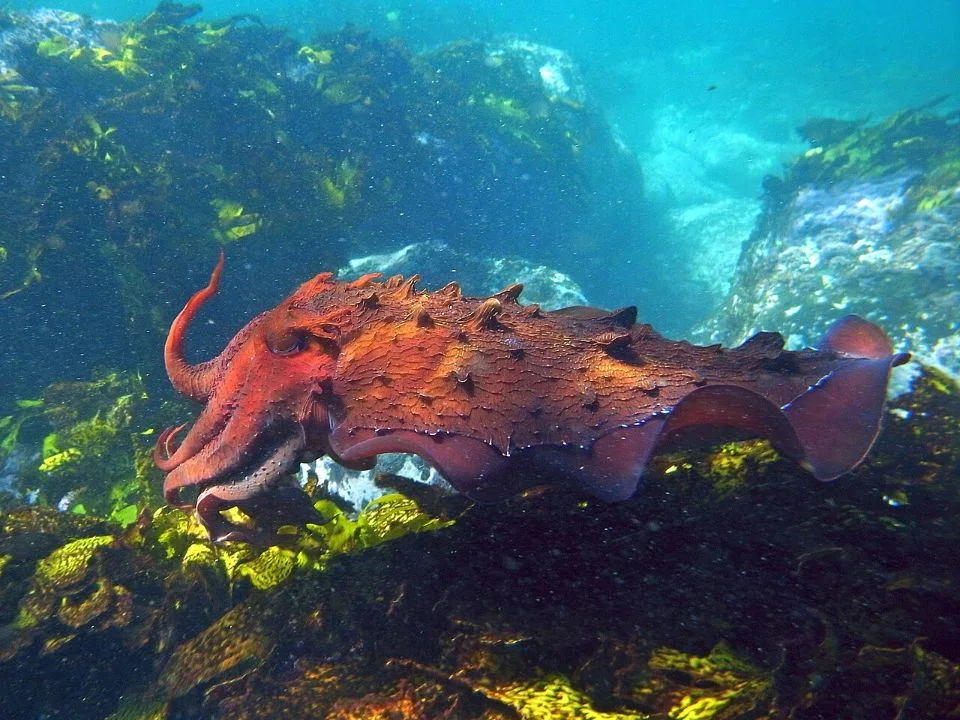
The photograph on this page shows the Australian giant cuttlefish, Sepia apama. Each winter, large numbers gather in northern Spencer Gulf near Whyalla to breed. South Australia's fisheries authority describes it as the world's only known dense breeding aggregation of this species, making the region an unusual place to watch camouflage turn into conspicuous courtship signalling.
That contrast reveals what the skin system is really for. It is not a single invisibility switch. The same fast, layered display can conceal an animal, warn a rival or communicate during breeding. Thousands of local changes are organised into a whole-body message by the nervous system, then rewritten almost instantly when the situation changes.
Sources and further reading
- Philosophical Transactions of the Royal Society B - Mechanisms and behavioural functions of structural coloration in cephalopods ↗
- iScience - Neural control of dynamic three-dimensional skin papillae for cuttlefish camouflage ↗
- Primary Industries and Regions South Australia - Giant Australian Cuttlefish management ↗
This article was written for Curiosity Desk. We do not copy other publishers or invent quotes. If a material error is found, we correct it openly.
Read the full standards →One answer should lead to a better question
Bring your curiosity to the group
Curious Minds is our public Facebook community for surprising science, strange history, Australian wildlife and everyday questions. No copied posts, no personal-friend invitations and no link dumping.
- Three self-contained discussion prompts each week
- Sourced answers and honest uncertainty
- Respectful conversation without spam